
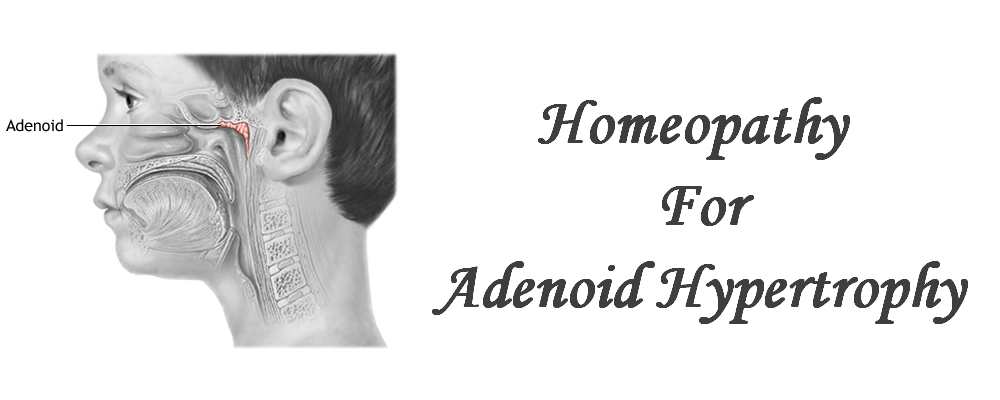


Are you looking for a homeopathic cure for adenoid hypertrophy? This article discusses the homeopathy treatment of adenoid hypertrophy along with the best homeopathic medicine for adenoid hypertrophy treatment.
Adenoids is the name given to a lump of lymphoid tissue that sits between the tonsils, higher up in the back of the mouth.Tonsils and adenoids are the part of our lymphatic system; they are much helpful to protect us from infection by germs coming through our mouth and nose. Adenoids trap germs that enter the body through the nose. An enlarged tonsil is the unusual growth of the adenoid tonsil that normally exists in the nasopharynx of children
This tissue cannot be seen without special instruments or x-rays, since it is hidden behind the roof of the mouth. It is located right behind the nose and if it is large enough, it can block air from flowing through the nose.
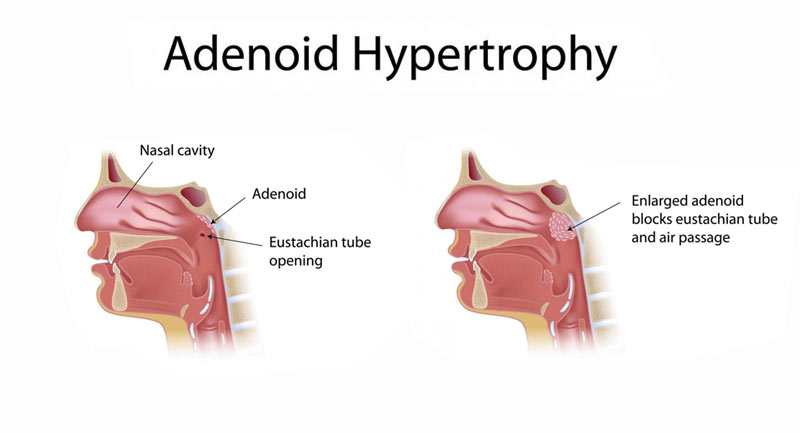
The adenoids become swollen and enlarged for just the same reasons as the tonsils become enlarged – infections, both viral and bacterial, as well as allergic stimuli. If the adenoids are quite large, they can cause significant respiratory obstruction, with resultant chronic mouth breathing and snoring. This mouth breathing can cause permanent changes in the facial shape – “adenoidal facies” with elongation of the face and an open-mouthed, slack-jaw appearance. Nighttime respiratory obstruction, with snoring and even sleep apnea can cause significant load upon the right side of the heart. Other problems caused by chronic adenoid hypertrophy include blockage of the eustachian tubes and chronic ear disease and hearing loss.
Adenoids – Homeopathy Treatment & Homeopathic Remedies
Homeopathy is one of the most popular holistic systems of medicine. The selection of homeopathic medicine for adenoid hypertrophy is based upon the theory of individualization and symptoms similarity by using holistic approach. This is the only way through which a state of complete health can be regained by removing all the sign and symptoms from which the patient is suffering. The aim of homeopathic medicine for adenoid hypertrophy is not only to treat enlarged/infected adenoid but to address its underlying cause and individual susceptibility. As far as therapeutic medication is concerned, several remedies are available to treat enlarged/infected that can be selected on the basis of cause, sensations and modalities of the complaints. For individualized remedy selection and treatment, the patient should consult a qualified homeopathic doctor in person. There are following remedies which are helpful in the treatment of enlarged/infected adenoids:
Agraphis – child breaths through mouth and has enlarged tonsils. Adenoids of the throat, deafness. Obstruction of the nostrils from adenoids. Throat deafness. Clarke of London regarded this remedy as a leading one in cases of adenoids. It was first used by Copper in 1892. Deafness and deaf-mutism, breathes with mouth ;open. It is essentially a catarrhal remedy and acts specially on the glands connected with the nasal cavity, and its use generally avoids adenoid surgery.
Tuberculinum –homeopathic medicine for adenoid hypertrophy in weak children with the history of tuberculosis in the family. Adenoids are greatly benefited and often times permanently cured by a weekly dose of Tuberculinum or preferably Bacillinum.
Calcaria carb – obese children, whose head perspires at night and who take cold very easily
Calcaria phos – Highly recommended by copper, Clifton and many others as a most efficacious remedy in enlarged adenoids. It corresponds to the dyscrasia,which permits adenoid growths or tonsillar enlargement. Calcarea iodide may be used in cases which are febrile in nature.Baryta carbonica is also a useful remedy, especially in children who have recurring attacks of acute tonsillitis.
Sulphur – children who have dread of bathing and are always hungry with nasal polyps.
Calcaria iod – adenoids with enlarged tonsils and cough
Baryta iod – mentally retarded children with frequent attacks of tonsillitis
Merc iod – is a another remedy which should be remembered in the treatment of adenoids
Cistus can – scrofulous swelling and suppuration of the glands of throat, burning high up behind uvula, Must swallow saliva to relieve dryness. In scrofulous or arthritic individuals who have enlarged adenoids. There is extreme sensitiveness to cold air, this is characteristic. Sensation of heat and dryness in the throat so intense that the patient must drink to relieve. Cold air inhaled causes distress in the throat, the 6th potency seems to succeed the best. Cistus has a special affinity for the naso-pharynx.
Hydrastis – Hydrastis is perfectly homoeopathic to the totality of the symptoms produced by enlarged adenoids, it has the yellow mucus and general lymphoid hypertrophy.Dr. Lambrechts, of Antwerp, uses a tampon of Hydrastis and glycerine, one part of the tincture to six of glycerine, introduced deep into each nostril, having the child make inspiration leaving it there about fifteen minutes. He regards surgical intervention as merely palliative and medical treatment indispensable.Kali bichromicum may also be indicated.
Causes of enlarged Adenoids
- Infection
- Congenital
- Epstein-Barr virus
- Allergy
- Adenoid cystic carcinoma
Symptoms of Adenoids
If there is swelling in the adenoids, nasal breathing becomes difficult as they interfere with airflow through nose so that the child has to breathe from his or her mouth which can cause heavy snoring at night. Nasal tone in speech can also be there when there are swollen adenoids. For normal sound articulation the cavities of mouth and nose must be normal and the air passage should be unobstructed. When patient takes breath through mouth it can also case dryness, and the child may feel thirsty all the time.
As the adenoids fight off infection, lymphocytes – both dead and alive- are released in the form of pus. Child can have as a discharge from the nose, which can be easily distinguished by clear , watery discharge of runny cold. The child try to sniff in order to make it make it clear but it then runs down in the throat, and causes cough. This cough is more often in the night and is a characteristic sign of infected adenoids. In the morning time, swallowed pus may cause vomiting.
Complications of swollen/enlarged adenoids
When adenoids are swollen they can cause blockage in the Eustachian tubes; these run through the skull bones from the middle ear to the pharynx. The main function of tube is to equalize the pressure inside the middle ear with the outside pressure. When there is blockage of tube, the pressure cannot be balanced, and in this condition secretions in the ear cannot drain from the inside which cause “glue ear”, in which hearing apparatus becomes stuck together by secretions inside. And when secretions become infected, causes otitis media. This is a very painful condition and may cause hearing impairment in the child permanently. If it is untreated, the eardrums often burst to release infection.
Diagnosis of swollen/enlarged adenoids
Examination of postnasal space is possible in some young children and an adenoid mass can be seen with a mirror. A rigid or flexible nasopharyngoscope is also useful to see details of the nasopharynx. Soft tissue lateral radiograph of nasopharynx will reveal the size of adenoids and also the extent to which nasopharyngeal air spaces has been compromised. Detailed nasal examination should always be conducted to exclude other causes of nasal obstruction.


I have a boy of 14 yrs hold having adenoid and cold cough from his childhood. Can you advise me a doctor name from Bangladsesh for his treatment?