
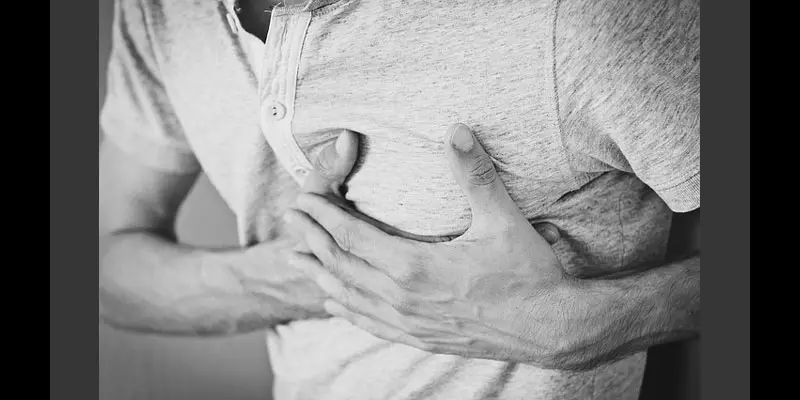

Angina pectoris is a transient chest pain with discomfort that results when the heart’s demand for oxygenated blood exceeds supply from the coronary arteries. This decreased supply of oxygenated blood usually results due to spasm in the coronary artery.
Symptoms and signs of angina pectoris resemble myocardial infarction. During the course of attack of angina pectoris, the patient experiences chest pain (Homeopathy for Pains in Chest) with heaviness, pressure, suffocation, tightness, choking or squeezing. The typical discomfort is sub-sternal in location.
The attack of angina pectoris occurs during physical or emotional stress and is relieved by rest. The syndrome of angina pectoris may occur due to fright, shock, hurrying, anger, exertion, violence, sexual activities, walking against the wind, ascending staircases, walking uphills, walking on ramps as well as by having heavy meals and during exercise. Angina may also occur during or after eating, exposure to cold temperature or to wind.
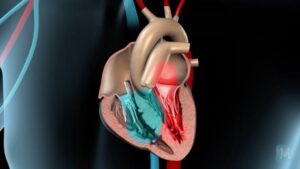 The main cause of occurrence of angina is only when the workload on the heart is increased and furthermore the most common cause of angina is due to accumulation of atheroma (fatty deposits/bad ‘cholesterol’) inside the blood vessels wall, which causes obstruction in the normal flow of the blood to the heart.
Due to deposit of atheroma, the passage becomes narrow in the blood vessels and if the normal coronary artery becomes totally blocked, the heart attack takes place.
Thus, the angina is a symptoms of coronary artery disease and in other word it is a sign of future heart attack (due to impairing the pumping ability of the heart).
The pain is normally experienced in the chest, behind the sternum, neck, jaw, throat, back, left shoulder, abdomen, left wrist and in the left arm with numbness or heaviness as well as with peculiar sensation of anxiety and fear of death.
The pain is knife-like and cutting (stabbing pain) may accompany the feeling of cold, sweating and breathlessness. Angina is always of a short duration, say 1-2 minutes.
However, if the chest pain persists ten minutes or more and is not relieved by rest, there is a possibility of heart attack. Therefore, all chest pain should be considered seriously and the medical assistance and care is required immediately.
Angina Pectoris is more common in men than woman (The heart’s size and work load are usually smaller in women) aged 35-60 years, who normally take rich diet, smoke and do not exercise.
Pathophysiology of angina pectoris
Acute myocardial ischemia occurs when myocardial oxygen demand exceeds supply-
- Narrowing of the coronary artery due to arthrosclerosis
- Non arthrosclerosis coronary artery disease such as coronary spasm
- Valvular heart disease
- Systemic hypertension
- Pulmonary hypertension
- Syphilis (Coronary osteal stenosis)
- Aortic regurgitation
- Kawasaki’s disease
- Severe anemia
- Emboli to coronary arteries (e.g. infective endocarditis).
- Hypertrophic or dilated cardiomyopathy
- Precipitating causes of angina pectoris
Precipitating causes of angina pectoris
- Heavy meal
- Physical exertion
- Emotion or excitement particularly anger and anxiety
- Exposure to cold
- Hyperinsulism in diabetic patients
- Straining at stool
- Sexual intercourse
- Micturition
Types of angina pectoris
Angina is classified in three main types
- Stable angina
- Unstable angina
- Prinzmetal’s angina
Stable angina – angina is said to be stable when there is no change in frequency, duration and precipitating factors, mostly symptoms occurs during exertion and last for less than five minutes and relieved by rest.
Unstable angina – in unstable angina symptoms are symptoms are more severe, angina of effort with increasing frequency and duration, provoked by less than usual stimuli and occurs at rest.
Prinzmetal’s angina – Prinzmetal’s angina almost always occurs when a person is at rest, usually between midnight and early morning. These attacks can be very painful. Prinzmetal’s angina is rare, representing about two out of 100 cases of angina, and usually occurs in younger patients than those who have other kinds of angina.
Symptoms of angina pectoris
Symptoms of angina pectoris mainly include
- Breathlessness or dyspnoea
- Chest pain over middle or lower sternum or behind the sternum
- Palpitation
- Sweating
- Chest pain with “vice like” constriction or chocking
- Extension of pain to right or left arm, forearm, fingers, neck and jaw.
- Dizziness
- Faintness
- Apprehension
- Rapid heart rate
The clinical appearance is as follows:
- Chest pain lasting 3 to 5 minutes— not all patients get substernal pain; it may be described as pressure, heaviness, squeezing, or tightness. Use the patient’s words.
- Can occur at rest or after exertion, excitement, or exposure to cold-due to increased oxygen demands or vasospasm.
- Usually relived by rest — a chance to re-establish oxygen needs.
- Pain may radiate to other parts of the body such as the jaw, back, or arms- angina pain is not always felt in the chest.
- Sweating (diaphoresis) —increased work of body to meet basic physiologic needs; anxiety.
- Tachycardia — heart pumping faster trying to meet oxygen needs as anxiety increases.
- Difficulty breathing, shortness of breath (dyspnea)- increased heart rate increase respiratory rate and increases oxygenation.
- Anxiety – not getting enough oxygen to heart muscle, the patient becomes nervous.
Clinical Diagnosis of angina
History
Clinical diagnosis of angina pectoris depends on the history of chest discomfort. Differentiation from other causes of chest pain is by careful analysis of site, duration, aggravating factor, relieving factor, radiation and other aspects of the chest discomfort.
Physical Examination
Physical examination is usually normal Diagnosis depends on history and ECG changes.
It is important to look for any aggravating factors.
Aggravating Factors of Angina
- Anemia
- Hypertension
- Thyrotoxicosis
- Aortic stenosis
- Hypertrophic Cardimyopathy
Investigations for Angina
Investigations in case of stable angina
- Echocardiography
- Stress echocardiography
- Intravascular ultrasonography
- Intracoronary Doppler
Main Investigations in case of unstable angina pectoris
ECG (EKG) – at rest may show ischemia changes especially in acute phase of illness. ECG is the single most important investigation and should be done in all patients with suspected angina. ECG at rest may be normal in about 25 to 50% of patients.
Echocardiography can detect abnormalities of ventricular wall motion due to ischemia or myocardial infarction. Stress (exercise) echocardiography is more sensitive than exercise ECG in the diagnosis of IHD. Echocardiography should be done to asses left ventricular function in patients with angina.
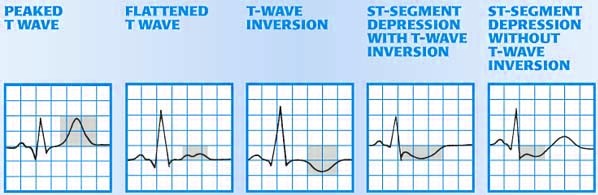
ECG changes associated with myocardial ischemia include horizontal or down-sloping ST-segment depression or elevation [≥ 1mm (0,1mV) for ≥ 60-80ms after the end of the QRS complex]. ST-segment depression is associated with an 100% increase in the occurrence of three-vessel/left main disease and to an increased risk of subsequent cardiac events. Left main and 3-vessel coronary artery disease shows a frequent combination of leads with abnormal ST segments: ST-segment depression in leads I, II and V4-V6, and ST-segment elevation in lead aVR.
Stress Testing (TMT)
This is most commonly used test for making the diagnosis and determining the prognosis of angina. ECG is recorded before, during, and after exercise. It is abnormal in about 80% of patients.
Stress Thallium -201 Myocardial imaging
This is superior to exercise ECG for the diagnosis of angina pectoris, but this test is not widely available.
Coronary angiography – should be done in all cases where atherosclerosis or emboli are suspected.
Difference Diagnosis of angina symptoms
Conditions which Cause Chest Pain Very Similar to Angina Pectoris
- Oesophageal spasm
- Gastrop-oesophageal reflux
- Musculoskeletal pain
- Anxiety and hyperventilation
- Pericardial pain
- Pulmonary embolism
- Aortic dissection
Homeopathy Treatment of Angina pectoris
 Homeopathy is one of the most popular holistic systems of medicine. The selection of remedy is based upon the theory of individualization and symptoms similarity by using holistic approach.
This is the only way through which a state of complete health can be regained by removing all the sign and symptoms from which the patient is suffering.
The aim of homeopathy is not only to treat angina pectoris but to address its underlying cause and individual susceptibility. As far as therapeutic medication is concerned, several remedies are available to treat angina pectoris that can be selected on the basis of cause, sensations and modalities of the complaints.
For individualized remedy selection and treatment, the patient should consult a qualified homeopathic doctor in person. There are following remedies which are helpful in the treatment of angina pectoris:
Glonine, Cactus, Amyl Nitrate, Crataegus, Lachesis, Naja, Aconite, Spigelia, Arsenic Album, Mag Phos, Cimicifuga and many other remedies..
Aconite – sudden attack of angina with acute pain in the region of heart, arm and shoulder, pulse full, hard, and bounding, great palpitation, much restlessness with obstructed feeling in the chest. Cough may also be associated with angina.
Bryonia Alba – pains are stitching and tearing in the region of heart, aggravated by motion, and better by rest and lying on painful side.
Digitalis – sensation as if heart would stop working, condition of patient is worse by motion. Pulse is slow
Lachesis – shooting type of pain in the heart, left side of chest and left arm
Crataegus – pain in the region of heart, and under left clavicle. Pulse, feeble, accelerated and irregular, Blueness of fingers and toes
Glonoinum – violent heart beat as if it would burst pain radiates in all direction, throbbing all over the body. It has been proved and its action is fairly well known. Its grand characteristic is throbbing all over the body in every vessel, a feeling of fullness in region of heart, and perhaps sharp pains radiating in all directions from heart, labored breathing, and fluttering of the heart, it feels contracted. Arsenicum has also proved useful especially in preventing the paroxysms.
Amyl nitrate – heart’s action is rapid, feeling of band around the head; oppressed breathing with constricted feeling about the heart, face flushed with anxiety and apprehension. In acute attacks of this disease Amyl nitrite is usually the remedy given, and it is given by olfaction of the crude substance, Its action is to produces a speedy dilation of the capillaries in the upper part of the body, the face becomes flushed, the heart’s action is rapid and tumultuous, there is a feeling as of a band around the head, constriction about the heart and oppressed breathing. It is very useful in relieving the paroxysm, and if the symptoms correspond it will be found useful at other times. Aconite is especially useful during a attack of vaso-motor angina from exposures to cold, with intense anxiety. Coldness pain radiating from head in all directions, with numbness, tingling, paraesthesia.
Naja – severe pain in the region of the heart, extending to nape of the neck, pulse slow and irregular with fluttering and palpitation
Secale cor – angina pectoris results due to spasms or constrictions of the coronary artery.
Spigelia – shooting, stabbing pain with pressure and oppression in chest down the left arm. Acts well in smokers and drunkards. Is a useful remedy in anguishing substernal pain which radiates to neck and arms, irregular pulse, tendency to syncope, palpitation and sharp stitches in heart, pulse weak and irregular, or full and bounding with aggravation from the least motion
Arsenic album – remarkable remedy for angina pectoris, violent throbbing in heart when lying on back, aggravation after 12 a.m
Cimicifuga – heart action suddenly ceases with severe pain in the region of heart, pulse week and feeble. Has pains radiating all over the chest and a sensation as if the left arm were bound to the side The patient may become unconscious;us, the heart’s action suddenly ceases, there is a sense of impending suffocation,l and the pulse is weak and feeble.
Cactus – excellent remedy of the cases of angina pectoris, constriction and congestion of the heart, marked palpitation with prostration
Veratrum album – heart action poor in tobacco chewers, much palpitation, anxiety and rapid respiration
Lilium tig – angina pectoris with pain in the right arm, pulsation all over the body, patient feels much suffocated.
Argentum Nitricum – well known medicine in cases of angina pectoris where complaints occur after taking meal.
Ammonium carb – complaints occur after long continued illness.
Strophanthus – angina pectoris due to weakness of the heart.
Note: Angina is a serious medical condition and may require emergency intervention. If a patient suspects having angina pain, they should immediately consult a physician for proper diagnosis and treatment.
Reference
- Ahmad Sayeed: Angina pectoris & lts Cure; 2002 ; 3-4.
- Mary digiulio, James Keogh, Donna Jackson- Medical-Surgical Nursing Demystified; 2008; 7-8
- Rajenderan-Clinical Diagnosis Cardiovascular System; 2004; 193
Angina Pectoris Cases Cured with Homeopathic Medicine
Anecdotes of Cardiac Emergencies – Dr. K. V. Natrajan
Four Cardiac Cases with Clinical Observations – by Thomas C. Duncan
Spigelia and Digitalis Cases – by Temple S. Hoyne
Acute Cardiovascular Diseases – Case Studies – by Guillermo Zamora




Homeopathic treatment can only relieve angina pectoris temporarily. There are many more remedies which can relieve if given on indication. But any remedy is helpful only in single dose. It is better to remember that a second dose is not only useless but can be fatal if the first dose was the correct similimum.
I have relieved angina with aconite, carbo veg, phosphorus, lycopodium, acid phos. But permanent cure was not possible.
plz send your cell nbr. for sharing knowledge and confabulation on different turns in homoeopathy….
thanks
dr.aamir
I had slightly back pain in July 2016 than i was advice for tropenin test it was out of normal rate allopathic doctor diagnose stable angina NSTEMI and Atherosclosrises as per their opinion 2 arteries 60 and 80 found blockage I have an angioplasty and a stent already planted 2016 I am using this time ASCARD 75 CONCOR 2,5 MG AND XPLANDED 20 M now it is 2021 4 years have passed
As a knowledge of homoeopathy and having degree of homeopathy council Pakistan I also alternate using following medicine along with above
Homeo medicine I am alternate using DIA CARD MEDAS COMPANY 2, Arnica 30 sometime using R 2 DR recweg
Now my question
Complain
I easily can walk 30to 40 minutes daily without breake so my best effort to walk daily at leat 20 t0 30 minutes and daily I am using trade mill 10 to 15 minutes in 4 to 5 km speed
Latest position
From last 3 month when I try to walk fast or joking way fast way I can walk only 10 to 15 minutes than I fell slight back pain right shoulder (2), but it is very slight some time I feel short breath (3 ) some time when I jumped or climb or try to climb in stairs than after 2nd 0r 3rd floor I fell my breath out .
3. Stomach condition my stomach build lot of gases which easily passes without pain but whole days I face this situation
4. I often have mucus in my chest and mucus falls in my throat and I am a patient of sinus
5. I have a lot yawning and anxiety
6. Sometime feel like insomnia .
7. I feel sleepy but sleep comes after trying for a long time. Sleep problem is not so much but when I try to sleep, sleep comes after a long time.
Milk curd yogurt rice like biryani never suit me similarly cold thinks cold water cold ice cream all cold items make problem for me when I am using these items it built much mucus in chest and throat
I am using omega 3 as vitamin and centrum 50 plus for cover of deficiency but I read its usual use harm full for heart patience and it may be built plaque and may be reason of blockage in arteries let me advise which is right and wrong .
I did latest ETT test which show positive my cardio consult advise for angiography
But I am not interested for that please advise me which homoeopathy medicine is suitable for me I am agree to pay all amount through credit card on line but please advise me which homoe and herbal medicine is suitable according my symptoms
At present I am using cratagus q 1 time 10 drops (2) R2 1 time (3) sometime dia card meads company 1 time arnica 30 5 drops 1 time
Last cholesterol reported 2020 135 sugar fasting 104 I will send my report after develop connection between us
I also tried reperotaraisation by the symptom I found and find remedy PHOSPHORUS arnica and what’so ever but I am not satisfied by the medicine so it is my request look this matter on top priority basis .
I hope you would be oblige on priority base please read all my case with full attention you suggest me medicine and I will pay you on line if facility available you registered me as your patient and friend