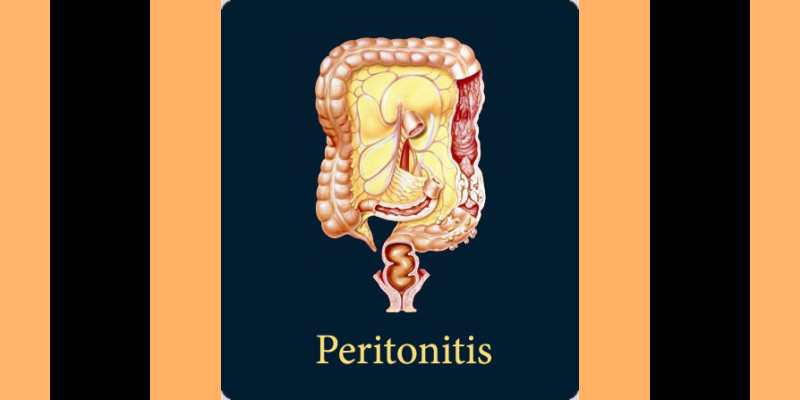

Peritonitis is an inflammation (irritation) of the peritoneum, the membrane that lines the wall of the abdomen and covers the abdominal organs.
Peritonitis can result from infection (such as bacteria or parasites), injury and bleeding, or diseases.
What is Peritoneum?
The peritoneum is a thin membrane that lines the abdominal cavity. It also covers each of the organs contained within the abdomen.
The liver, stomach, and intestines are all covered with peritoneum, as are the spleen, gallbladder, pancreas, uterus, and appendix. The peritoneum is so thin that if it was separated from the organs that it covers, it would be transparent. Despite this, it is also very strong. The way it is attached inside the abdominal cavity creates various spaces where fluid could collect in the event of leaking from one of the intra-abdominal organs.
Causes of Peritonitis
Causes are divided into two headings –
- Infectious causes
- Non-infectious causes
Infectious causes –
Perforation of the peritoneum membrane is the chief cause of peritonitis. Examples include perforation
- Perforation of the distal esophagus
- Perforation of the stomach (peptic ulcer, gastric carcinoma),
- Perforation of the first part of small intestine duodenum (peptic ulcer),
- Perforation of the remaining intestine (e.g., appendicitis, diverticulitis, meckel diverticulum, inflammatory bowel disease , intestinal infarction, intestinal strangulation, colorectal carcinoma),
- Perforation of the gallbladder (cholecystitis)
- Other possible reasons for perforation include abdominal trauma, ingestion of a sharp foreign body (such as a fish bone, toothpick or glass shard), perforation by an endoscope or catheter.
- Systemic infections (such as tuberculosis) may rarely have a peritoneal localisation.
Non-infectious causes
- Leakage of body fluids into the peritoneum, such as blood, gastric juice, bile, urine, pancreatic juice. These body fluids are sterile at first; they frequently become infected once they leak out of their organ, leading to infectious peritonitis within 24 to 48 hours.
- Sterile abdominal surgery, under normal circumstances, causes localised or minimal generalised peritonitis. However, peritonitis may also be caused by the rare case of a sterile foreign body inadvertently left in the abdomen after surgery (e.g., gauze, sponge).
Symptoms of Peritonitis
- Swelling and tenderness in the abdomen; pain can range from dull aches to severe, sharp pain causing board-like rigidity
• Fever and chills
• Loss of appetite
• Nausea and vomiting
• Increased breathing and heart rates
• Shallow breaths
• Low blood pressure
• Limited urine production
• Inability to pass gas or feces
Diagnosis of Peritonitis
- Severe abdominal pain in a person with directal or rebound tenderness suggests peritonitis. Abdominal x-rays or CT scan showing swelling and gaseous distension of the small and large bowel support the diagnosis.
- In the case of perforation of a visceral organ, the X-ray shows air lying under the diaphragm in the abdominal cavity. Other appropriate tests include following:
- Chest X-ray may show elevation of the diaphragm.
- Blood studies shows infection.
- Paracentesis (taking fluid from the abdomen to directly check for infection. A thin needle is inserted through the abdominal wall under local anesthetic.The fluid is then tested for signs of inflammation and infection)reveals bacteria, exudates, blood, pus, or urine.
Risk factors involved
- Infection inside the abdomen
- Inflammation of the stomach, gallbladder, or pancreas
- Penetrating injury to the abdominal wall, such as from a knife or bullet wound.
- Peptic ulcer
- Pelvic inflammatory disease
- Rupture of an ectopic pregnancy
- Recent abdominal surgery
- Bowel obstruction
- Advanced liver disease
- Tuberculosis
- Hernia
- Ovarian cyst or abscess.
Treatment for Peritonitis
- Antibiotics for bacterial infection
- Surgery for underlying cause.
Homeopathic Remedies & Homeopathy Treatment for Peritonitis
Homeopathy treats the person as a whole. It means that homeopathic treatment focuses on the patient as a person, as well as his pathological condition. The homeopathic medicines are selected after a full individualizing examination and case-analysis, which includes the medical history of the patient, physical and mental constitution etc. A miasmatic tendency (predisposition/susceptibility) is also often taken into account for the treatment of chronic conditions. The medicines given below indicate the therapeutic affinity but this is not a complete and definite guide to the treatment of this condition. The symptoms listed against each medicine may not be directly related to this disease because in homeopathy general symptoms and constitutional indications are also taken into account for selecting a remedy. To study any of the following remedies in more detail, please visit our Materia Medica section. None of these medicines should be taken without professional advice.
Homeopathic Remedies
- Belladonna
- Bryonia alba
- Apis mellifica
- Apocynum
- Silicea
- Rhus tox
- Lachesis
- Arnica
- Podophyllum
- Bellis –p
- Merc sol
- Pulsatilla
- Nux vomica
- China officinalis
- Colocynthis
- Colchicum
Bryonia
- The second stage of peritonitis, especially of the serous variety, corresponds well to Bryonia; as a rule, however, it should not be given if copious diarrhea be present.
- There is violent thirst, the patient drinking much and probably vomiting it soon afterwards.
- The patient is alternately chilly and hot, and the great characteristic of the remedy is present.
- Liver region swollen, sore, tensive. Burning pain, stitches; worse, pressure, coughing, breathing. Tenderness of abdominal walls.
- Sharp stitching pains in the abdomen worse from pressure and motion.
- The abdomen is also swollen, hot and sensitive ;
- There is constipation and the patient has a yellowish gray complexion.
Belladonna
- The characteristic of Belladonna are the swollen abdomen, which is tense like a drum, very sensitive to touch, so sensitive that the patient wants the bedclothes removed.
- The least jar greatly aggravates
- Abdomen Distended, hot.
- Transverse colon protrudes like a pad.
- Tender, swollen. Pain as if clutched by a hand; worse, jar, pressure. Cutting pain across;
- Stitches in left side of abdomen, when coughing, sneezing, or touching it. Extreme sensitiveness to touch.
- The slightest noise, loud talking and light aggravates.
- The patient is uneasy; must constantly change her position, but is made worse thereby.
- There is also a continued distressful retching, and vomiting even of bile.
Apis mellifica
- Sore, bruised on pressure, when sneezing.
- Extremely tender. Sore feeling.
- Vomiting of food. Craving for milk
- Dropsy of abdomen. Peritonitis.
- Swelling in right groin.
- Extreme sensitiveness to touch and general soreness is marked.
- Apathy, indifference, and unconsciousness. Awkward; drops things readily.
Silicea terra
- Pain or painful cold feeling in abdomen, better external heat.
- Hard, bloated.
- Colic; cutting pain, with constipation; yellow hands and blue nails.
- Much rumbling in bowels.
- Inguinal glands swollen and painful. Hepatic abscess.
- Lack of vital heat.
- Prostration of mind and body.
- Great sensitiveness to taking cold.
- Intolerance of alcoholic stimulants.
Aconite
- Burning, cutting, darting pain in the bowels, which is aggravated from slightest pressure, motion, and lying on the right side.
- Abdomen feels hot to touch; unquenchable thirst; taste is bitter; skin dry and hot.
Arsenic album –
- Burning in the bowels; constant vomiting; great thirst of short intervals; complaints worse in the middle of the night.
- Patient is anxious with cold clammy skin and sudden sinking of the strength; internal restlessness.
Mercurius –
- At the later period, when the exuded fluid becomes purulent, with frequent starts; foul smell from the mouth.
- Vomiting of slime and slimy stools, with straining; weakness and emaciation; oedematous swelling of the feet.
Lycopodium
- In complication with hepatitis; when lying on the side, a feeling as if a hard body were rolling from the navel to that side; or when after three or four days the face assumes a yellowish color; marked flatulence and constipation.
Opium
- Distension of the abdomen; antiparistaltic movements of the of the intestine; constant vomiting and belching; retention of stool and urine; complete inactivity of the lower bowels.
Rhus toxicodendron
- Violent pains, relieved by lying on abdomen.
- Swelling of inguinal glands.
- Pain in region of ascending colon.
- Colic, compelling to walk bent.
- Excessive distention after eating.
- Rumbling of flatus on first rising, but disappears with continued motion.
Lachesis
- Another remedy for the low forms is Lachesis.
- Liver region sensitive, cannot bear anything around waist.
- Especially suitable to drunkards.
- Abdomen tympanitic, sensitive, painful
- Here the fever is worse at night.
- The slightest touch to the surface of the body is unbearable. It follows Belladonna well.
- There is tenderness at one spot.
- In inflammations associated with a gangrenous tendency, such as is found in appendicitis, it may be well indicated.
- Restless and uneasy; does not wish to attend to business; wants to be off somewhere all the time.
Peritonitis Cases Cured with Homeopathic Medicine
A Day From My Practice – by Hpathy.com
Right Sided Ovarian Torsion – by Vitan Gosain
A Chronic Case – Headache – by Roger A Schmidt
Homeopathy in Surgical Cases – by James B. Bell
A Typical Pyrogen Case with Comments on the Remedy – by Royal E.S. Hayes
A Case of frozen shoulder with wasting of the deltoid muscle – by Santosh Joshi