
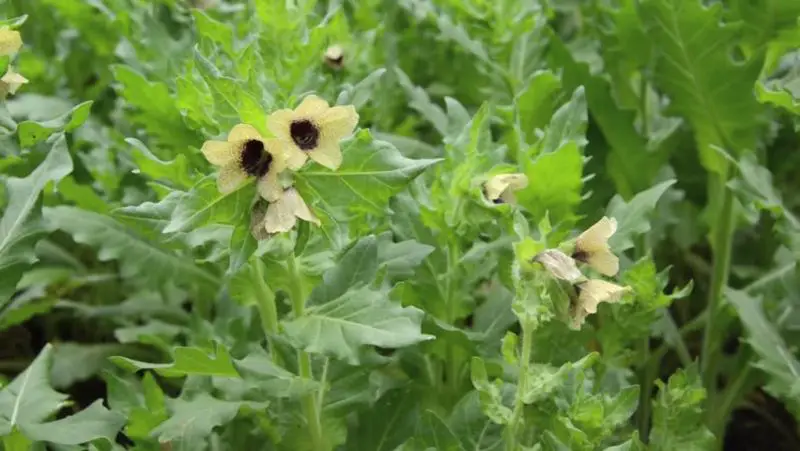

Hyoscyamus (Hyoscyamus) is a very interesting and intriguing remedy, which has many subtle presentations beyond the caricatures often described in books. It’s a remedy with some common mental and emotional themes running through all its various expressions. Along with the clearly provocative characteristics of Hyoscyamus, we want to perceive its indications in less obvious situations, where the person has learned to compensate the expression of their state.
One description which fits Hyoscyamus is ‘any attention is better than no attention’. Attention-seeking behavior through verbal or sexual provocation is a well-known feature of this remedy, and behaviors can be quite dramatic (lewdness, shameless, wanting to be naked, singing obsene songs, etc.). But these tendencies are extreme examples of the Hyoscyamus state, and such clear indications are not often seen in practice. From a deeper perspective, what would predispose someone to behave in this manner, and how might the expression of that state be less apparent?
One common etiology of the Hyoscyamus state is emotional neglect in childhood (delusion, deserted, forsaken). This stress leads to adaptation in the will to have one’s emotional needs met. The Hyoscyamus person can gain attention by shocking, annoying or provocative speech and behavior (inciting others, mocking, mania to ridicule, disposition to contradict, desire to fight). Hyoscyamus individuals may tell risque jokes or act like ‘clowns’ (jesting), and although not listed in the books, some Hyoscyamus individuals describe an attraction to, dislike or fear of clowns. The desire for attention leads some to behave like chameleons when in company, but these multiple personas undermine a truer sense of self-identity, as the desire for attention distracts them (and those in their company!). The sense of self-esteem or self-worth is often very low, and Hyoscyamus individuals may feel a strong sense of guilt (anxiety of conscience, delusion that he is a criminal, self-reproach).
Along with the Hyoscyamus stresses of emotional abandonment or neglect, the desertion may have been complicated by sexual abuse. This abuse leads to many conflicts later in life–an abuser may offer some ‘attention’, but not the emotional support they truly need. Fundamentally, their trust has been betrayed, and sensitivity to betrayal is a key theme underlying many behaviors in Hyoscyamus. In those situations where that trust was not learned, Hyoscyamus can also experience problems in gaining trust from others (reveals secrets, gossiping, meddlesome, indiscretion).
Hyoscyamus individuals can be understandably suspicious of other’s motives, but can also be jealous if they feel the little attention they receive is being threatened. A sense of this threat can be seen in the rubric ‘jealousy between children, when a new sibling takes the family attention away.’ Hyoscyamus can ‘act out’ if they feel such a threat, and be manipulative in their desire to gain others’ attention. Some adults describe themselves as ‘drama queens’, consciously or unconsciously creating drama in their lives so others will not ‘neglect’ them. Unfortunately for the Hyoscyamus individual, such behaviors can be self-defeating, as people tire of reacting to such needs. Many Hyoscyamus individuals describe anxieties related to situations of being deserted or abandoned by lovers, friends, etc. (ailments from disappointed love).
The opposite pole in Hyoscyamus could be described as ‘it’s better to have no attention than to have someone look too closely’. This tendency appears to stem from the challenges Hyoscyamus individuals experience with intimacy, and relating to people in a trusting manner. They can experience great difficulties learning to be vulnerable in a relationship. The Hyoscyamus adult has not been taught to trust, or if they did trust in the past, the trust was broken. So to have someone really ‘see’ them, with all their fears and defenses exposed, can be very threatening. They may expend a great effort to maintain defenses against this possibility (deceitful, sly).
Vermeulen describes the Hyoscyamus ‘fear of exposure’ with feelings of shame and strong aversion to undressing, or aversion to men because “all they want is sex”. Sankaran also conveys this fear by describing a woman who couldn’t face anyone if she was dressed informally (embarrassment, reserved, bashful timidity). There are often times where both ‘poles’ of Hyoscyamus are seen alternating in the same person. One Hyoscyamus client complained her breasts were too small and no one paid her any attention; then she described a past eating disorder to stay small-chested so men wouldn’t ‘stare and whistle’.
Hyoscyamus can become paranoid about others looking at them (fear of people, delusion – watched, desire to hide, agoraphobia), and what others’ motives truly are. When one feels no trust in relating to others, it may seem others are ‘out to get them’. This helps to explain the rubrics: fear of betrayal, fear of being sold, fear/delusion of being persecuted, fear/delusion of being injured, fear of being poisoned and fear to drink what is offered. Other common fears of Hyoscyamus include water, dogs and dark and alone.
In spite of all the above, many well-adjusted Hyoscyamus individuals have a great deal of insight into their challenges–it’s just that they may not know how to get beyond them! Hyoscyamus characteristics can be found in such positive rubrics as precocity, intellectual, introspection, inquisitive, and clairvoyance. Hyoscyamus may be compared to pulsatilla (complementary–Hyoscyamus demonstrates a more extreme need for attention), magnesiums (fears of abandoment), lachesis and other animal remedies (loquacity, themes of attractiveness), veratrum (themes of persecution), thuja (chameleon personality, reproaches oneself) and belladonna and stramonium (other members of the solanaceae family). The reader may read the proving and examine other rubrics for Hyoscyamus in order to fill out the above description.
In summary (with apologies to Shakespeare!), the Hyoscyamus state can be respectfully characterized as: ‘To be exposed or not to be exposed, that is the question.’

have question bout hyoscamus niger..can it be useful for acute ptsd? how does it compare to stramonium in cases of severe emotional trauma?
Hello Channa,
I’m sorry for the delay in replying.
Yes, hyoscyamus is definitely useful for acute ptsd, IF the person experiences an extreme sense of abandonment or betrayal of trust, and also experiences conflicts related to intimacy and others’ attention towards them.
The conflicts related to intimacy and “being seen” could be demonstrated through either 1) overt provocative behavior designed to attract immediate attention (at least then one is not ignored!), or 2) possibly an exaggerated sense of embarrassment or shame when one is “observed” too closely.
In either case, true intimacy creates a sense of vulnerability and distress, even if that intimacy is what the person truly seeks. In turn, they can either “act out”, “retreat”, or both.
Although there are many similarities between hyoscyamus and stramonium, in my experience, hyoscyamus has a stronger emphasis on the threat related to intimacy–‘my sense of trust and emotional safety has been deeply violated, and in this moment I must protect myself against emotional vulnerability’.
The emphasis in stramonium is more related to immediate physical threat and danger. In other words, the stramonium nervous system is in a reactive state with the feeling: ‘I’m surrounded by wolves, and in this very moment I must instinctively run or fight’.
dear sir
i m a medical graduate practicing allopathy for four and a half years.
i have lots of faith in homeopathy and am in constant endeavor of understanding it.
i was recently prescribed this drug for fibroid uterus.
i found this article very helpful in understanding myself
thank you so much
Dear Manisha,
Thank you for the feedback, and I’m glad the article has been helpful to you. I would add that, in my opinion, these remedies do not define us at our core, but rather represent stress response states resulting from the challenges of life. So while any of us can transiently experience various remedy states as a result of life’s challenges, the remedies themselves are helpful when we don’t fully recover after a stress, and our “stuck” survival response becomes a state of “dis-ease”.
Best regards,
Dave J.
Dear David, hi
First of all thanks a lot for your VERY good article- what is peculiar and most important: in an otherwise brilliant KENT’S Materia Medica the portraits of the remedies are given in their classic descriptions let say “full speed flourishing pathology” which is pretty rare and seldom to meet nowadays in our world and with modern society members prone to compensate inner turmoil and hide everything inside while being afraid to be proclaimed an “outsider” and so on(if we are talking about emotional realm of the remedies of course). So this situation makes job of modern homeopath extremely difficult. And your article (the way of approaching to the core issue of the given remedy) in that sense VERY USEFUL as a practical tool for modern homeopaths.I’m 40 years old I’m military medical doctor now retired from the military service beside of my conventional experience in allopathy I was trained as homeopath and I have strong faith in the science a lot (through my personal medical experience ). I would like to discuss with you little bit more about modern challenges we are facing today namely with the HIDDEN SIGNS and TRAITS of otherwise well-known remedies.
Thank you for the feedback, Vigen. Regarding the hidden signs and traits of well-known remedies, I’ve been helped by a few important considerations, which I attempted to express in the article. First, compensation may be evident when a certain limiting perception is expressed with the same “frequency” but dampened “amplitude” compared to the uncompensated state. That is, the same character of the remedy state is evident, but just not as overtly. Second, compensation can be seen when the person is simply “dancing on the opposite side of the same pole”–e.g., ‘I abhor violence’, or ‘I hate it when people are dishonest’, etc. Both of the above types of compensation are minimized in an atmosphere of “un-self-consciousness”–that is, when the client AND practitioner are safe and unhindered by perceptions of judgment. Finally, it’s helpful to “separate” all the qualities which are limiting (fears, anxieties, etc.) from those which are not (sympathetic, compassionate, concerned about family, etc.). By first focussing on the total gestalt of limiting beliefs, perceptions and behaviors (almost seeing the person in the worst possible light, but without judgement!), one can better distinguish what needs to be cured from those qualities which are well-adapted, and thereby find more deeply- matched remedies. Thank you again for your comments!
DAVID THANKS A LOT FOR REPLY! THERE IS NEVERTHELESS SOME CLARIFICATIONS I WOULD LIKE TO MAKE TO BE SURE I UNDERSTOOD YOU WELL,SO YOU WROTE: “……..Second, compensation can be seen when the person is simply “dancing on the opposite side of the same pole”–e.g., ‘I abhor violence’, or ‘I hate it when people are dishonest’”…YOU MEAN THAT IF A PERSON SAYS “I HATE VIOLENCE” HE CERTAINLY FAMILIAR WITH THE FEELING OF FURY I.E. EXPERIENCED IT BEFORE? OR DOES HE FELT AND KNOW FROM OWN BEHAVIOUR WHAT DOES IT MEAN TO BE DISHONEST TO SMB.WHEN HE IS SAYING ‘I hate it when people are dishonest’ ?
“…..Finally, it’s helpful to “separate” all the qualities which are limiting (fears, anxieties, etc.) from those which are not (sympathetic, compassionate, concerned about family, etc.). By first focussing on the total gestalt of limiting beliefs…..” HOW TO DO THAT IN PRACTICE TO BRING TOGETHER ALL GESTALT OF LIMITING BELIEFS? COULD YOU BRING A LIVING EXAMPLE?
THANKS IN ADVANCE, DEAR DAVID
Regarding your first question: As a student, I remember a person who talked about the importance of religious truth and non-violence. He kept referring to his faith and work with his church, and I couldn’t discern the fuller picture of his distress, beyond some non-specific physical complaints. Finally I asked how his religious beliefs had helped him change, and he replied how he as a child he believed his mother’s words when she said he “wasn’t worth two dead flies”. He also became very upset (weeping) recalling how during a certain time in his life he’d tortured squirrels. The remedy anacardium helped him greatly, even though he demonstrated none of the overt cruelty or violence described in the classic texts. Significantly, violence vs. non-violence was the conflict he was working to resolve. Or one could say, violence vs. non-violence was the pole around which he was dancing.
Regarding the second question: During the history-taking there will always be a story. Nevertheless, we don’t prescribe on the basis of previous circumstances, but rather on the individual’s specific stress RESPONSE (in other words, the specific signs and symptoms of their “mistuned vital force”). In other words, the story sets the “stage”, and the person is the character who uniquely responds to the circumstances on the stage.
The person may talk about the importance of their family, their faith, their community, their love for others, their desire for world peace, etc., but none of these characteristics are necessarily limiting. There are times, of course, when one or more of these characteristics comprise part of the stress response (fear for one’s family breaking apart, anxiety that people of another religion will overtake their own, etc.), but unless there’s a specific stress related to these “positive” qualities, we can consider them secondarily (rather than primarily).
More specifically, we want to discern in the midst of the story (and the person’s intellectual interpretations or judgments about the story) what really needs to be cured–in other words, how are they experiencing distress and limitation, as opposed to being able to “pursue the higher purposes of their existence”? We want to understand HOW and WHAT they’re FEELING and EXPERIENCING, not to ask them WHY they’re having those feelings. Gradually, as we work to be unbiased observers, the limiting physical, mental and emotional symptoms of the mistuned vital force make themselves known, and we’re able to “connect the dots”, with the help of our knowledge of remedies. It is truly amazing how specifically the remedies can match up with the various dilemmas of our earthly sojourn!
Hi David, great article. Loved reading it and the ending quote made me laugh. Very well done. I love intelligent input. Looking forward to getting more from you. Good job and keep it that way.
Dr.D.
Thank you for the nice feedback, Dr. D. I’m glad you liked the article!
I have a question regarding Hyos and children. I have a 5 year old son who has been given Hyos as his constitutional. He has ADHD and can present himself as extremely giddy, hyperactive and non-stop talking. He is extremely silly, animated and acts like a young Jim Carey (the outrageous comedian) He HAS to be the center of attention at all times to the point of annoyance. He will dance around the house laughing and exposing himself to me like a crazy court jester. He fits the Hyos profile but my son has never been “betrayed” emotionally, physically or sexually. So I am curious why he has these shocking sexual undertones. I have NO IDEA where it comes from. Would Hyos still be the right remedy for him even if he has not been betrayed in some way?
dear Catherine hindu philosophy tells that people are born with many sanskaras from their previous births.my guess is that though ur son is not betrayed in this life may be in his previous life he may be betrayed.please read the book MANY MASTERS MANY LIVES by BRAIN WEISS. MIASMATIC BLOCKS in a person may contain these previous sanskaaras also.
Sometimes the hyoscyamus state can occur from genetic/hereditary/familial/miasmatic tendencies. In other words, maybe he’s never been betrayed, but there’s something in the family lineage indicating this tendency. Hyoscyamus is also in the rubric “jealousy, when a new sibling takes the attention away”, so that’s another route by which this state could be experienced/expressed. But yes, regardless of where it came from, it sounds as though your son is exhibiting hyoscyamus behavior.
My son was recently precribed this to help trear adhd … what do u think about this remedy for adhd?
Yes, it can definitely be used for ADHD, but of course the rest of the hyoscyamus symptom picture needs to fit.
Thank-you for this insightful representation of Hyoscyamus, I have been searching for a while for some current dated text about this remedy. I recognise that not all Hyos behaviour is influenced by sexual abuse, but I am open to the idea that family energy influences past and present can on a cellular level be an undercurrent for behavior patterns. You have helped me to understand the broader picture of Hyos which is just what I was searching for.
Regards
Jennifer Varney
Thanks for the feedback, Jennifer; I’m glad the article was helpful.
Thank you for this great explanation of Hyoscyamus!
The structure and language are crystalclear, without disturbant and lengthy digressions and examples and without the (often incorrect) chemical and mythological vagueness.
Your feedback is appreciated, Edjus. Hyoscyamus is such a wonderful remedy.
A really lovely, memorable, and succinct description of the Hyos state – thank you
hello doctor
i’m mohamed nabil
from egypt cairo
i have A large amount of plant egypt Hyoscyamus
do you know any company want this plant And I export it
thank you to muck
Hi David ! Thanks for the excellent article. My kid was recently prescribed hyoscyamus in the power of 6 ch. He is 5.5 years and has some hyperactivity and low concentration. At this point there’s no sexual abuse but his need for emotional dependence in his peers is high. He ends up getting emotionally hurt by his friends and faces rejection and that becomes difficult for him to handle. He is too small to learn from his experiences and ends up seeking the same peers-friends despite them ridiculing him. Is this the right remedy ?
Thanks,
Komal
Hi Komal, I hope David sees this, though it doesn’t look like he’s checked this thread recently. Your child doesn’t really seem like Hyos. to me based on what you wrote. Hyos. kids are usually pretty eccentric and quite obnoxious (as David said, “attention-seeking”; meaning they are capable of being quite annoying, like getting right in your face, making stupid facial expressions and generally making fools out of themselves). The fact that your child seems to accept abuse from his peers makes me think of Staphysagria, a remedy often entangled in abusive relationships. But, again, I’m only going on the very limited information you’ve given.