

ONE METHOD
EXPRESSING A SYSTEM OF PRINCIPLES
ENCOMPASSING NUMEROUS TECHNIQUES
The case taking method taught at The Montreal Institute of Classical Homeopathy (MICH) follows as closely as possible the instructions of Hahnemann, as is shown below. MICH attempts to encompass a therapeutic and diagnostic method, which is unprejudiced, scientific, systematic, reproducible, individualized and faithful to Hahnemann’s instructions.
As we follow Hahnemann’s instructions, we also admit that every case is unique, and requires a unique approach. Fulfilling the requirement of individualized therapeutics brings out the need for more than one system of interpretation, and a broad spectrum of techniques. Individualization requires from us as homeopaths to be inclusive rather than exclusive. As homeopaths, we need to have an open mind and an expansive view of our practices, respecting the clinical findings, clinical results, and techniques of our colleagues. Our understanding of our patients, of ourselves, of disease and of homeopathy should be constantly expanding and evolving. This Method is a work in progress, a starting point for future discussions.
THE MICH METHOD = THE HOMEOPATHIC METHOD = HAHNEMANNIAN METHOD1
The MICH Method is a procedure of inquiry and exploration between a homeopath and a patient, with clearly defined stages whereby the disease picture/ the image/ the totality of symptoms of what is to be cured in a patient is discovered. The goal of the method is to completely individualize the anamnesis, diagnostic, treatment and prognostic. In all stages of the method, there is a process of the unconscious becoming conscious.
THE MICH SYSTEM2
Encompasses all the principles of homeopathy as described by its founder, Hahnemann in the 6th edition of the Organon.
MICH TECHNIQUES3
Include every manner of successful techniques developed over the past centuries in homeopathy, as they are understood, organized, and applied, within the framework of the system, which underlies its method. Numerous techniques can be applied according to the situation: acute, children, animals, using Chinese medicine, rubrics, 50 questions, following the chief complaint, unicist, pluralist, drainage, etc.
CHARACTERISTICS OF THE MICH METHOD
The MICH Method IS:
1 Scientific and Systematic
The Method operates within
- Proven and precise guidelines of procedure and goals.
- Clearly defined stages.
- Clearly identifiable levels.
- A step-by-step process: each step going deeper.
- Clearly defined process. Example: It is clear why a certain question is being asked at a particular time.
2 Reproducible
- Every homeopath comes to the same understanding of the individual.
- Other homeopaths taking same case come to the same understanding of center of case.
- They would ask the same question or fully understand why a question was asked.
- They would agree on the best fitting Similimum.
3 Individualized
- If treatment is to be individualized, the whole method, including the case taking, has to be individualized.
- The approach and techniques, language, attitude, pace and depth are adapted to the patient. The method is “patient centric”. The patient determines the approach.
- When case taking is dictated by the patient, the similimum is provided by the process.
- The process itself becomes a similimum of the patient; the case taking itself is healing.
- Techniques used within the method can change over time for one person, the level of experience of that patient can change, and therefore the approach needs to change as well.
4 Integrative, Global, and Holistic
- The Method involves taking the case as a whole not in parts.
- The patient is understood as a whole, including his/her disease as a movement within that whole.
- The process is neither analytical nor synthetic, it is integrative and whole.
- The case taking and treatment are global not local.
- The patient is regarded as a single expression of the whole of humanity, a reflection of humanity.
- Treating the patient IS treating humanity.
- The homeopath is an integral part of the process.
5 Therapeutic
- The primary goal of the process is to discover what needs to be cured in the patient: the state at the core of the disturbance.
- Once the primary goal has been achieved, the next goal is to match this core with what is clearly perceived as the core, and thus curative in each particular medicine (understanding the core of each remedy).
- The process itself is a similimum of the patient; the case taking process itself is healing.
- The method is therapeutic for both the patient and the homeopath.
6 Diagnostic
- Diagnostic involves both the patient and the homeopath.
- It is not externally observable.
- It is unique for every patient.
- When case taking is dictated by the patient, the similimum is provided by the process.
- Prognosis is predictable: based on the patient’s experience.
7 Unprejudiced
- Every case is regarded as unique, every process is unique, every individual is unique, and therefore is completely unknown and uncharted.
- There are no pre-conceived notions of how the process needs to unfold or of its outcome.
- While working towards the primary goal of determining what needs to be cured in a patient, no theories, maps, systems, categories or classifications can come in the way of that process.
- There is no judgment of anything the patient thinks, does, or says (from both homeopath and patient.)
- The Method requires that no thought process is occurring on the part of the homeopath during the first stage of the primary goal.
8 Effortless
- The homeopath must be completely free of prejudice (cannot be in a thought-dominated state) in order to induce a similar unprejudiced state in the patient.
- The process is like a spontaneous alchemical reaction, both the patient and the homeopath rise to another level of consciousness.
- If the process is shaped by the patient, there is a smooth flow, case taking goes to a healing level.
9 Faithful to Hahnemann’s instructions
- Aphorism 3: Clearly realize what is to be cured in each single case of disease.
- Aphorism 82: No genuine cure can take place without the strict individualized treatment of each case of disease.
- Aphorism 83: The individualizing examination of a disease case demands nothing from the medical art practitioner except freedom from bias, healthy senses, attention while observing, and fidelity in recording the image of the disease.
- Aphorism 84: …The physician sees, hears, and notices …what is altered, unusual …he writes everything down with the very same expressions used by the patient…The physician keeps silent, allowing them to say all they have to say without interruption.
- Aphorism 86: When the narrator has finished what he wanted to say of his own accord, the physician enters a closer determination… Aphorism 87 : without ever asking a question that would put words into the patient’s mouth or that would be answerable with a simple yes or no.
- Aphorism 88: If nothing has been mentioned in these voluntary statements about several parts, or of the patient’s emotional mood, the physician should then ask about…
- Aphorism 89: only after the patient has finished freely relating the pertinent information upon simply being invited to do so, and upon being prompted with general questions, thereby proving a fairly complete image of the disease, is it allowable and indeed necessary for the physician to ask more precise and specific questions if he feels he has not yet been fully informed.
- Most importantly, the MICH Method fully embraces and provides the procedure and techniques required to fulfill the criteria of the disease picture as required by Hahnemann. Aphorism 104: Once the totality of the symptoms that principally determine and distinguish the disease case – in other words, the image of any kind of disease- has been exactly recorded, the most difficult work is done. During the treatment (especially of a chronic disease) the medical art practitioner then has the total disease image always before him.
- The definition of the totality of symptoms is found in Aphorism 7: The totality of symptoms is the outwardly reflected image of the inner wesen of the disease, that is, of the suffering of the life force. The totality of symptoms must be the principal or the only thing whereby the disease can make discernible what remedy it requires, the only thing that can determine the choice of the most suitable helping means. Thus, in a word, the totality of symptoms must be the most important and indeed the only thing in every case of disease that the medical art practitioner has to discern and clear away, by means of his art so that the disease shall be cured and transformed into health.
- The totality of symptoms as the outwardly reflected image can be observed at different levels – wesen, essence, condition, state and appearance. The image is reflected in the 7 LEVELS of the patient’s experience.
STAGE 1 PURE WITNESSING
This is the most important stage, as it lays the foundation for the rest of the case taking. This first stage involves passive case witnessing. The homeopath listens without interrupting, questioning, directing, or altering the flow (Aphorisms 84, 86, 89). The homeopath is just allowing the natural unfolding to happen. This forms a base of essential elements of what is to be cured in the patient, created by the patient without interruption. These elements can be further explored in the later stages.
Allowing the patient to say whatever he wants to say without interference allows for a faithful image of his disease picture to emerge, and provides direction for the next stages.
In summary, the goals of Stage 1 is to discover what is:
- Important for the patient
- The center of the case, or at least what seems to be a focus
- The technique(s) to be used in further stages
- The questions that must be asked and in what way
The physical symptoms of disease are created on the limbic-neuro-endocrine level, which is out of reach of the conscious process of the neo-cortex. In this first stage, as in all stages of the MICH method, there is a process of the unconscious becoming conscious. Ideally, through self-inquiry the patient will slowly become conscious of the dynamic which underlies his or her physical symptoms. This process is encouraged throughout the 3 stages of the process, and is central to the method.
The underlying, unconscious disease dynamic is non-rational, instinctive, and, by definition, disturbing. The disease dynamic arises directly from the central disturbance of the vital force. Thus, by following disturbing, non-rational elements, the patient can follow the breadcrumb trail towards the central vital disturbance, and describe it. The role of the homeopath is to quietly identify and note what might be possible breadcrumbs as the patient speaks.
THINGS TO IDENTIFY WHILE LISTENING ATTENTIVELY WITHOUT INTERRUPTION
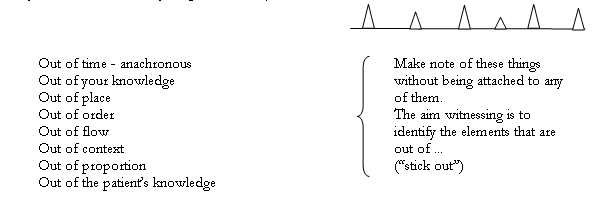
1. “WHAT STICKS OUT” During the patient’s description, it makes sense that the homeopath notes both the verbal and non-verbal elements that are not flowing with the rest: “what sticks out.” (Aphorism 153…the more striking, exceptional, unusual and odd (characteristic) signs and symptoms of the disease case are to be especially and almost solely kept in view.)
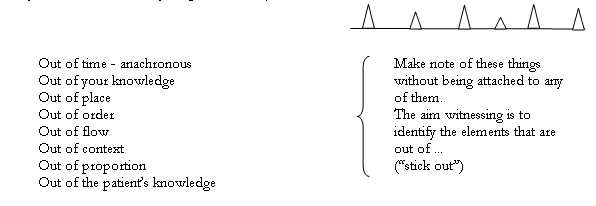
The most useful and well-tested case taking indications and tools to be found in modern day homeopathy come to us from the extensive clinical research done by Dr. Rajan Sankaran, and the group of well known of medical homeopaths in Mumbai who formed the Homoeopathic Research and Charities. Below are excerpts from the book “The Sensation Refined” (Mumbai: Homeopathic Medical Publishers, 2007) by Dr. Rajan Sankaran. Every homeopath should read this book. It outlines and defines how to elicit, and how to identify, the dynamic level as expressed by the patient. It is the patient’s expression of the dynamic level that must be matched to the closest simillimum in order for the homeopathic remedy to act most effectively as a dynamic medicine.
“Indicator words for what sticks out” MNO & PQRS
M = Movement (speed, direction, force, sound, gesture) in HG & all levels
N = Non human specific (common between man and nature, global, not local) esp. when they lead into a NHS realm.
O = Obdurate: persistent, holds throughout the questioning – does not change into something else or goes back to a previous description or word.
P = Picturised: creates an image, metaphor. Visualization indicates delusion, sensation. It usually bridges to a new level.
Q = Queer: A word that is used out of context, that doesn’t make sense within the context used.
R = Repeated: Same theme, same word, comes up in different contexts, levels, or situations.
S = Synonym or antonym of a previously mentioned word. A word used on its own often has no significance.
2. “THEMES” The vital force is at the root of the whole individual, therefore, a disturbance in the vital force will be reflected in all areas of an individual’s life. Thus, the homeopath pays attention to themes that come out in different areas of the patient’s life to find the point of confluence between them, or the focus. These can be areas which are not related to each other, or, different times of the patient’s life. Theme indicator words are defined by one of the 7 R’s:
“Indicators of themes” 7R’s
Root It feels basic and strongly related to the source or origin of disturbance.
Representative It is a symbolic metaphor of the core experience.
Repeated It occurs in the same way or form (e.g. in different parts)
Replicated It has very similar sensations/feelings in different contexts.
Retained It is a theme that is not dropped or altered during the process.
Refined The client will be trying to accurately describe it, make it precise and pure.
Related There will be many words to describe the sensation but they will belong to the same family, type or group of feelings/experiences, etc.
3. “ENERGY OBSERVATIONS” Because the central disturbance is a dynamic, energetic disturbance, it peeks through ordinary conversation in the form of hand gestures, movements of any part or the whole body, restlessness, change of position, body language, facial expression, eyes, direction of focus, intensity of focus, tears. If used judiciously and in a timely manner, these observations can open doors to the unconscious and provide confirmation of the focus of the underlying unconscious dynamic.
For example: “Hand Gestures”
Is the HG congruent to and illustrative of what the patient is saying? (The less congruent the hand gesture, the greater the distance between conscious and unconscious.)
- When the gesture is congruent, it is appropriate to ask about the HG.
- Is the HG showing exactly what the person is saying? Are the words and gestures congruent to each other?
4. “LEVEL OF EXPERIENCE” In order to guide the patient further in stages 2 and 3, the homeopath must resonate with the patient. The homeopath must follow the patient and be at the very same depth as the patient, so that they go to the next level together. Thus, the homeopath must be aware of the level of experience in any given moment, and be able to see if the same level is present in two or three different areas. This information will help the homeopath formulate his/her questions in a way that will encourage further and deeper exploration of the unconscious without confusing the patient. There are specific questions for each level, which will be illustrated in a separate document.
Some examples of questions tailored to the level of experience of the patient.
- Emotional: What is the feeling when …?
- Delusion: What is your perception of the event …?
- Sensation: What is the experience?
5. “NARRATING STYLE”: Again, by adopting the patient’s narrating style, the homeopath creates resonance with the patient which facilitates the process of uncovering the unconscious patterns. Examples of styles are: Projection, Denial, Avoidance, Intellectualization, or Rationalizing, and the “MIASM” as the patient’s coping mechanism and reaction to the core issue.
Questions must be tailored according to the narrating style of the patient. Techniques adapted and centered to the individual. For someone who uses denial language, you would ask the questions in the negative. Example “What faults don’t you have?” “What things would you never do?” “What kind of dreams don’t you have?”
Use the miasm for case taking purposes: if you can identify the coping mechanism, then you can make the process homeopathic and individual-specific.
6. “DIMENSION” As the goal is to move through unconscious levels to reach the vital dimension, the homeopath must observe the language of the patient, to discover the dimension that is most predominant, as well as the depth of dimension that the patient reaches on his/her own, so that the patient can be guided to the next dimension in Stage Two. Local descriptions constitute the first dimension, more general statements, the second, “I” statements which refer to the individual as a whole are third dimension or global, and the fourth, vital dimension brings sensation and energy into the description.
- Global, “other dimension” experience (I experience a feeling, sensation etc of…)
- General, global (I feel, I am …)
- Local (my pain, my leg, my stomach…)
TYPES OF QUESTIONS WHICH ARE PERMITTED IN STAGE ONE
What can be said to the patient to keep the flow going?
- Keep talking.
- A bit more about you.
- Whatever comes naturally to you right now – doesn’t need to be anything specific.
- My goal is to understand you.
- If anything comes to you – just say it.
- If your brain is making connections just go with them.
- Say anything that comes to mind.
- Tell me more, continue…please elaborate.
- Keep going deeper.
- Go deeply into yourself.
- Explore the core of what you just said.
At the end of Stage 1, themes have begun to form in different areas of the patient’s life.
STAGE 2 FOCUSING
FOCUSING
The verification of the focus (found in Stage 1, above) is the purpose of Stage Two. The homeopath should be asking him/herself the following questions as they listen to the patient’s answer.
- Are things getting connected to the focus or center?
- Is verbal or non-verbal language common?
- Is the unconscious description becoming conscious?
Possible questions for Stage Two:
- Out of everything you have talked about, what is the most important?
- What has had the most impact/ is bothering you the most?
- You have mentioned […]; how does it feel to be in the situation you are in?
- What is the essence of you?
- If I asked you to summarize yourself what would you say?
- Which events/incidents in your life have had a deep impact on you?
- How does it feel to have these symptoms?
The homeopath should start with the chief complaint only if that is the level of experience. If the level is already global, then the homeopath should begin on a more global level. The homeopath should not be restricted or blindly bound by any technique, being faithful only to the method of uncovering the unconscious level of disease.
Once the homeopath is ABSOLUTELY sure of the core of the case, he or she can then proceed to the next stage.
Example: questions tailored to the sycosis miasm and denial.
If the focus is clear:
The homeopath should help the patient to dissociate from him/herself. The following questions gently push the patient in that direction:
- “It has nothing to do with you, I am just trying to explore your imagination, see how your imagination works.”
- “In what situation would I have to find myself in, in order to feel that?”
- “What would it look like in a picture or drawing?”
- “Can you give me an example not related to you?”
- “Right now, if I asked you to imagine, what would come to your mind?”
- “Spontaneously, without thinking, what would be the first connection that’s made? Let the whole universe be your library.”
- “Tell me more about it” until the patient makes connections on his/her own.
As the patient goes deeper and deeper, the patient makes connections between feelings, delusions, thoughts, sensations. This process facilitates leaving the denial state behind and the case taking can move on to deeper levels.
If the focus is NOT clear:
- “Can you tell me three dreams that you would NOT like to have?”
- “Tell me situations in your childhood that you do not want to remember.”
- “Tell me about situations or things which did not affect you but affected others.”
Once the focus is clear, take the focus down to the deepest level possible, down to the source of the vital disturbance. Once the patient touches the source, something will change: voice, tone, tears, gesture, posture. The observant homeopath will see it in their eyes, face, body or stance.
What the patient is denying the patient will come to accept either during the case taking or after taking the similimum.
STAGE 3 CONFIRMING
The homeopath must now continue the inquiry without letting the patient backtrack to the rational, conscious, superficial level.
The confluence point between divergent areas must become clear. Up to this stage, the homeopath only has clues, now the focus gets clearer, and divergent aspects become more connected. This is the stage where everything comes together – kingdom, subkingdom, miasm, sensations and symptoms.
Indications of confirmation:
- Verbal/non-verbal expressions get connected into one pattern.
- Connections are made between the different aspects revealed in stage 1.
- Mind and body symptoms will be related.
- Fragments and disconnected parts come together.
- Non human specific words become predominant, the patient starts speaking the language of the substance.
CASE TAKING HINTS
When the patient describes the source of the disturbance (the wesen or totality of symptoms or disease picture which describes the remedy they need), they become the closest similimum to source. The homeopath needs to allow the space for this to happen. It is important to keep the patient in the state (whether panic, reaction, sensation, whatever is at the center.) The homeopath resonates with the whole process of the patient. This allows the homeopath to recognize the state more clearly, more precisely, and also more fully.
If the case taking is allopathic, (hammering questions from an objective, distant position) then the homeopath will not be able to come to the core and the process will not be healing.
Sitting with the patient, the homeopath learns to allow multidimensional experiencing. As the case progresses, the homeopath’s mind focuses on the center, the core of the patient’s suffering. Mind moves from multidimensional experiencing to holistic experiencing. The homeopath is conscious of bringing awareness to the session, of meeting the patient where he or she is, of applying true listening and witnessing so that what is unconscious can be made conscious.
The best meditation possible, the best healing possible, is to bring the patient into that space. The homeopath creates a space that elicits universal consciousness from the patient as well as from the homeopath him or herself. This is the breakthrough point.
BREAKING THROUGH POINT: TYPE OF CONSCIOUS TRANCE
- Patient automatically makes all sorts of connections;
- He/she is in touch with the subconscious;
- Conscious boundary is crossed;
- 2 “songs” (outer and inner) become one;
- Conscious/unconscious boundaries dissolve;
- Verbal/nonverbal language get beautifully connected.
The homeopath must create a space that prohibits superficial, rational, thinking, and conscious-level discussion. Shatter logical thinking. Both the homeopath and the patient want to go into an area of comfort, a map or context which is familiar: sensation, chakras, psychotherapy, touch, child within, psycho-spiritual techniques, etc. But the homeopath must go to the area least expected, which does not make sense with the rest of the story or the flow. Often, this is the area where one would least expect the core of the case to be. The whole case taking has to be and move according to the patient. Make the patient conscious of his or her dynamic until the inner (hidden) pattern is revealed. The whole aim is to develop a method that is itself the similimum.
THE QUANTUM LEAP
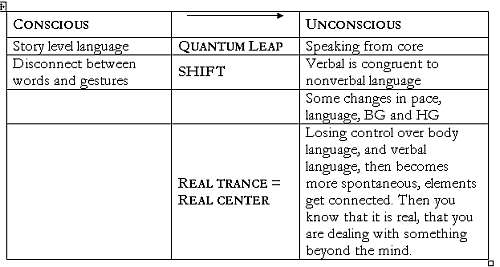
The chart above is inspired by the work of Dr. Dinesh Chauhan, another esteemed member of the medical homeopaths in Mumbai, who provides another excellent resource in his book, A Journey into the Human Core, (Mumbai: Swasthya Homeopathic Healing Center, 2007).
CASE TAKING PROCESS AS A SIMILIMUM
People tend to attract, choose or gather things in their environment which resemble their similimum. Whatever energy comes to you, you become it, and you are that, it is your similimum. They want to be surrounded by that energy. We find that energy in their cravings, relationships, vacations, environment, foods.
Exact matching: for the first time the person meets the true complete similimum in the remedy. Two arrows thrown exactly in the same way – nothingness.
Before the patient receives the similimum, the same state would have been excited by different situations. In psychology, we recollect the acute event. In Homeopathy, we don’t focus on the acute event but on a global state.
The function of the similimum is to make the patient aware of him/herself – the moment of awareness is the moment of cure.
Case taking itself must become the similimum, in that way, it is most healing. It will bring the center/core state out effectively and faster. The case taking provides a mirror of the patient = the similimum. It is individualized, human-centric and witnessing, creating an aura of the similimum to help the state express itself fully. “In this way, the state is fully exposed to the nervous system and the brain, including the limbic system. An automatic, organic, adjustment takes place without the ‘doer’ involved.”
PRESCRIBING
DETERMINING POTENCY
Potency is determined at the passive stage of case taking, where there is an unsolicited level of experience.
ACUTE PRESCRIBING
Treatment of Acute situations.
Acute helps you find the core remedy.
Midpoint between conscious and unconscious (104 degree fevers)
Lose conscious control crystallization of whole state. Entry point of similimum.
If you know his or her remedy – repeat it.
But, if a different state is expressed in an acute state, there has been a change in susceptibility.
Or they have been exposed to a strong external signal. For example: an epidemic.
FOLLOW UP QUESTIONS
1st FOLLOW UP
In the words of Hahnemann: Aphorism 104: Once the totality of the symptoms that principally determine and distinguish the disease case – in other words, the image of any kind of disease – has been exactly recorded, the most difficult work is done. During the treatment (especially of a chronic disease) the medical art practitioner then has the total disease image always before him.
Is there a change related to the core/center ?
Sequence of questions to ask in follow up
- What changes are there in you overall?
- When you took the remedy, did you notice any changes physically, emotionally or in dreams? (homeopathic aggravation)
- Did you notice any new complaints or symptoms? (exteriorization – old symptoms) or aggravation.
- Did you notice any change in your normal physiological function? (excretions, detoxification mechanisms, acute crisis or fever?)
- What happened to [state described, focus, sensations]?
- Now what are your thoughts about your illness? Acceptance of illness/ of yourself/ of situations/ of the whole world?
- What difference has it made in your life?
General follow up questions in sequence:
- How are you feeling overall? What changes in you do you see?
- What difference has the treatment made in your life?
- What was that feeling and how is it now?
- How are you compared to [time period beginning of treatment]?
- What do you mean by better?
- Better means what? By what percent have you improved?
- In what ways are you better?
For children:
What changes have you seen in him/her over the [time period]?
What has changed in her/him?
Ask the patient to describe – “Before” what was that feeling?
- Can the patient observe the state as a third person?
- As an observer, can he/she detach from the state?
- Is the person there yet? = sign of cure.
“FORCES” is a way of measuring improvements in the person.
F – Freedom: Moments of freedom from pain, greater freedom to make choices, to communicate. Question: What is the greater degree of freedom you are experiencing now?
O – Optimism: Lightness, seeing possible positive outcomes, feeling that life has a lot to offer, optimizing the possibilities, trusting. Question: What is the greater degree of hope, lightness, optimism you are experiencing now?
R – Relationships: Improvement in relationships, dysfunctional relationships fall away or are transformed, creating healthy relationships with greater harmony. Question: To what extent have your relationships improved?
C – Chief Complaint: Reduction in the chief complaint symptoms. Question: What is the degree of improvement of your symptoms?
E – Energy and Emergence: increase in energy, awareness, coming out of isolation. Question: What is the degree of spiritual emergence you are experiencing now? What awareness of yourself have you gained?
S – Sensation and Susceptibility: Normalizing of the sensation that the person identifies as being at the core of their suffering. Question: What shift in degree of reactivity to your environment, to events are you experiencing?
Footnotes:
1. A method is a systematic or an established form of procedure.
Origin: late Middle English: ‘prescribed medical treatment for a disease’ via Latin from Greek methodos ‘pursuit of knowledge, or scientific inquiry’ from meta– ‘after’ + hodos ‘way.’
2. A system is the set of correlated principles belonging to the method
ORIGIN Greek sust?ma, from sun– ‘together’ + histanai ’cause to stand.’
3. A technique is a way of carrying out a procedure.
Montreal Institute of Classical Homeopathy
http://www.homeopathymontreal.com/


I really like your comment about being inclusive, not exclusive. This is an important lesson for all homeopaths to learn!
Very nice and understandable explanation of the method. (Essentially the Sensation method?)
Indeed, your method is almost a copy and paste from Dr Sankaran´s Sensacion Method
Yes, Our method is indeed solidly based on the Sensation Method of Dr. Sankaran. We have found this method to be totally in line with Hahnemann’s teachings, extending them to the modern era. Mention should have been made of this fact. I see that the references were left out in error. I will ask to have this corrected. Thank you for bringing this to my attention!
this article is very useful and gives lots of knowledge .thanks for beautiful explanation.
A very detailed write up ,enjoyed the brush up about the method.Thank you