

“Emotional feelings, instead of finding expression and discharge in the symbolic use of words and appropriate behavior must be conceived as being translated into a kind of “organ language.” – Past Maclean, M.D.
1. A. Introduction
Body language is all around us. It is a fascinating subject and a thrilling experience – to observe the motion of the ‘intelligent’ body and to analyze the context in which it is represented. Body language plays a significant role in oral communication. It is powerful and indispensable and now it has become a household word due to its popularity and utility.
The human being is the highly evolved perfect design of nature. His spoken language is the most prized possession, but his silence is no less precious. Hence it is said that “Speech is great, but silence is greater.” It is through communication that a human being SHARES and the body, synchronizing with the sub-conscious mind, gives off very sublet signs through choreography without the use of words. ‘Communication is like a dance,’ states Condon, ‘with everyone engaged in intricate and shared movements across many subtle dimensions, yet all strangely oblivious that they are doing so.’ The wise body opens its gate to an astute observer to fathom inner feelings, emotions, attitudes and ideas.
It is believed that a charming person has a pleasant voice, a dynamic person has a vibrant voice and a confident person an assured voice. Body language is often regarded as a secondary product and its value is underestimated. However, it could be primary, it could project even before words have taken their shape and it could be the only language through which a patient can express himself. The body language is not merely a physical manifestation of the spoken words, but, in fact, it has its own independent interpretation of the feelings, irrespective of the meanings and the spoken words being delivered therein.
1. B. The Dimensions of Body Language
Our bodies are ambassadors of our inner self. They convey more than our tongues. Research has shown that 35% of the messages are carried verbally, while 65% are conveyed non – verbally (Birdwhistell). Mehrabian put forward that communication is 7% verbal, 38% vocal and 55% non-verbal. The truth is that more communication takes place by the use of gestures, postures, position and distance than by any other way.
A human being communicates through verbal and non-verbal language. Exchange of words refers to verbal communication while non-verbal communication refers to all external stimuli other than spoken or written words and includes 1. Bodily gestures 2. Postures 3. Facial expressions 4. Personal appearance 5. Eye contact 6. modulations in voice and 7. The use of space and distancing.
| Our bodies are rarely still. Our feet, hands, eyes and heads are moving all the time. Our expressions change. We pull faces, rub our noses, run our hands through our hair and do all sorts of things which, when taken in isolation, seem very odd. However, what is happening is quite straightforward – our bodies are ‘talking’. We can guard our tongues- but not so easily shut off our body language. |
Body language and kinesics are based on the behavioral patterns of non – verbal communication. Although a developing science, kinesics has added a new dimension to human understanding. Sigmund Freud observed, “He that has eyes to see and ears to hear may convince himself that no mortal can keep a secret. If his lips are silent, he chats with his fingertips; betrayal oozes out of him at every pore.”
1. C. Our Bodies, Emotions and Modern Life
Emotions are basic to human beings. Being emotional is a part of being human. A human being has a rich vocabulary of emotion cues showing how he feels about himself and others. In the realm of emotions, the cues are usually unintentional, involuntary and unconscious. Body language and emotions are almost inseparable as body movement is central to emotional expressiveness. The intensity of emotions charges the non-verbal brain to dictate its commands; the body obediently follows the commands and presents its choreography on the screen.
In view of accelerated tempo of life, the modern man has to face with a pronounced exposure of emotional stress. Today the modern man has become a speed merchant, driving the motor of his life. Chronic time shortage, changing patterns of activity, greater load of information and more active interpersonal relationships – have affected the verbal communication. The need to pay attention to non-verbal one has, hence, considerably increased. One of the major aspects of Body Language is the expression of emotions. Emotions refer to such states as happiness, depression and anxiety, and milder ‘moods’ such as feelings of pleasure and displeasure, varying degrees of excitement or drowsiness, and the arousal and satisfaction of hunger, sex and other drives. There are three components in each case: a physiological state, a subjective experience, and a pattern of non-verbal signals – in the face, voice and other areas.
Emotions are recognized from a whole pattern of non-verbal signals, which are usually consistent with each other and with the expectations created by the context. They provide information about intensity, and about the tense versus the relaxed dimension. A tense person sits or stands rigidly, upright or leaning forward, often with hands clasped together, legs crossed, and muscles tense. In such a case, the hands and feet display the emotions while the face tries to conceal.
Infants have their own ‘language’ to express their emotions and moods. A mother recognizes when her child is happy through facial gestures such as bright eyes, bulging (smiling) cheeks, giggles, squeaks and belly-laughs accompanied by joyful sound (monosyllabic). Whereas, when a child is sick, his mouth is twisted into a grimace, cheeks droop and he utters grunts and growls.
2. A. Elements of visible code:
The elements which are visually perceived and which perform role in communication are collectively termed as “visible code”.
Personal Appearance: Everyone wants to be “in the eye of the beholder.” Everyone is concerned with first impression. Every person has its own aura that vibrates, that pervades, that permeates and that renders its unique message to the outer world.
One’s appearance may put the others into a resistant or even a hostile attitude or induce in them a receptive mood. A physician has to understand how his patient reacts to him: positively, negatively or neutrally. The patient’s appearance and clothing need careful observation. Dirty look, crumpled clothing suggests alcoholism, drug addiction, depression, dementia, schizophrenia etc. Manic patients may wear bright colors, incongruous styles of dress or appear poorly groomed.
Six elements are considered in personal appearance: Clothes, Footwear, Hairstyle, Ornaments, Make-up and Aromas.
Posture: Refers to the way one stands, sits and walks. The movement of the body, the position of hands and legs and other parts of the body reveal individual’s personality-whether he is vibrant, alive and dynamic, nervous and jittery, confident and self-assured, etc. The posture of sitting may exude an air of optimism, or despondency or be indicative of a sense of failure or of inattentiveness. Walking posture may convey whether a person is confident, energetic, withdrawn, diffident or nervous.
Gestures: A gesture is a sign, signal or cue used to communicate in tandem with, or apart from, words. A gesture is the verbal or non-verbal body movement used to express or emphasize an idea, an emotion, or a state of mind. Gesture is defined as ‘visible’ bodily action by which meaning is represented (Kendon, 1983). Each gesture is like a word in a language.
Gestures play a significant role in making the communication effective. A well-timed gesture can drive a point home. Similarly playing with a ring, twisting a key-chain, or clasping one’s hand tightly robs a speaker of the effectiveness of his communication. Sometimes gestures render elementary and short messages such as “yes”, “no”, “come here”, “go there”, “be silent”, etc. However, all oral communications are accompanied by gestures such as shrugging of the shoulders, flourish of the hands, movement of head, etc. In fact, without the accompanying gestures it would be difficult to speak. These gestures add a greater value to what is being said besides exercising a more powerful impact.
Facial Expressions: “Face is the mirror of life.” Our face a. defines our identity; b. expresses our attitudes, opinions, and moods; and c. shows how we relate to others. A face is every human’s visual trade mark, and is therefore, the most photographed part of the human body. Emotionally, the face is mightier than the word. So closely is emotion tied to facial expression that it is hard to imagine one without the other.
| Our face is exquisitely expressive. Its features are incredibly mobile, more so than any other primate. A smile (friendliness), a frown (discontent), raising the eyebrows (disbelief), or tightening the jaw muscles (antagonism) can add to the meaning being conveyed through verbal means. |
A wooden expression on the face may prejudice the listeners and it could also be an expression of parkinsonism, schizophrenia or depression; brightness in the eyes may keep their interest sustained and evoke an enthusiastic response. Biting the lips, blinking the eyes or raising the eyebrows at regular intervals often mar the smooth flow of communication. Anxious patients generally have horizontal creases on forehead, raised eyebrows, widened palpebral fissures and dilated pupils.
Eye Contact: Eyes reveal a great deal about our emotions, convictions and moods. Hess (1975) observes that the eyes give the most revealing and accurate of all human communication signals because they are a focal point of the body and the pupils work independently. Whiteside (1975) describes the eyes as ‘the windows of your soul….. and the mirrors of your heart…… and the gauges showing fleeting feelings and changes.’ One can see the anatomical importance of the eye as “an extension of the brain.” Gazing at another’s eyes arouses strong emotions. ‘The eye can threaten like a loaded and levelled gun; or can insult like hissing and kicking; or in its altered mood by breams and kindness, make the heart dance with joy’ (Emerson).
The eyes can be steely, knowing, mocking, piercing, shifting….. They can level a ‘burning‘ glance or a ‘cold‘ glance or ‘hurt‘ glance or again, they can be wise, knowing, inviting, scary, disinterested, and so on.
Space and Distancing: A fascinating area in the non-verbal world of Body Language is that of spatial relationships or proxemics – the study of people’s appreciation and use of space. Each person maintains a personal territory around himself. He normally does not allow it to be invaded at the time of communication. This has reference also to ‘standing-seated position.’ Space distancing differs from culture to culture, from individual to individual. The amount of space a person needs is determined by his personality.
It is important to observe the way a patient sits in the chair. A puffy, egoistic person having lust for power is not happy with one chair. He may occupy more space by extending his arms. On the other hand, a shy and reserved patient occupies himself in less space.
Modulations of voice: Tone of voice reflects psychological arousal. Speech is an indispensable means for sharing ideas, feelings, and observations and for conversing about the past and future. A significant number of voice qualities are universal across all human cultures.
a) Interpretation of voice
- Speaking loudly and rapidly = Anger or lack of interest in the other person’s view. The speaker has run out of the logical support for his view.
- Clear controlled steady voice = Confidence
- Lively, bouncy, well modulated speech= Enthusiasm. Politeness.
- Lowered volume, reduced pitch, rate and intonation = Negative attitude. Nervousness
- To mumble or gabble = Excitement. Fear
- Hesitation = Lower confidence
- Crying, Moaning and Sighing = Sighing. Silent grief. Complaining nature
- Hiss and boo = Disapproval
- The softer pitch = Friendship
b) Reading mind through laugh
Human laughter varies greatly in form, duration and loudness. One can ‘read’ laughter from the sounds that ensue.
‘Ha-Ha’ is laughter that is genuine, coming straight from the heart. It expresses pure joy and self-fulfillment.
‘He-He’ is mocking laugh, usually issuing from a condescending remark or a joke about a person.
‘Hee-Hee’ suggests a secret giggle or a snigger that is emitted when a person is being cynical or spiteful.
‘Ho-Ho’ communicates surprise, even disbelief, by a person who is critical, protesting, or challenging.
c) Speech and psychiatric illness
Speech may be fast, as in mania or slow, as in depression. Depressed patients may pause for a long time before replying to questions and may then give short answers, producing little spontaneous speech; the same among shy people or low intelligence patients. Sudden interruptions may indicate thought blocking or may be effects of distraction. Rapid shifts from one topic to another suggest flight of ideas, while general diffuseness and lack of logical thread may indicate thought characteristic of schizophrenia.
2. B. Basic modes
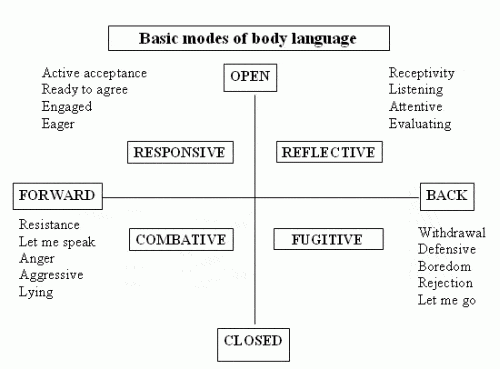
John Mole (1999) gives graphic description of the four basic modes of Body Language.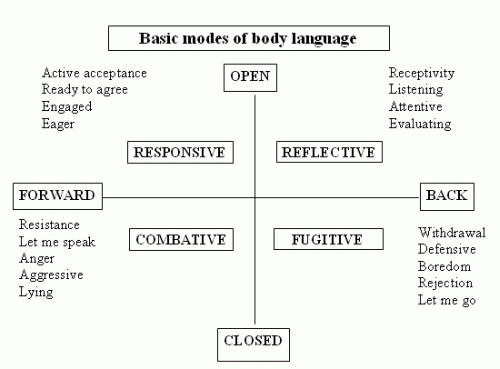
There are 4 basic modes- Open, Closed, Forward and Back. In Open mode gestures indicate ‘open’ attitudes – open palms, open arms, open body; (no physical gestures like crossed arms or crossed legs) and face-to face interaction. Extroverted persons show this mode more. In Closed category fall the most obvious gestures and postures, like crossed arms, crossed legs, body turned away. Introverts fall here more. Forward mode involves postures that indicate activity in communication. Leaning forward, strong eye-to-eye contact, pointing the finger emphatically, loud voice etc. In Back category we find leaning-back postures, staring at the ceiling, doodling, or cleaning one’ s glasses, signalling whether the person is passively absorbing or ignoring the message.
There are four combinations of posture groups in four basic modes. The Responsive mode (Between Open and Forward), The Reflective mode (Between Open and Back), The Fugitive mode (Between Closed and Back) and The Fugitive mode (Between Closed and Back).
| If a homoeopath keeps in mind these basic modes and apply them correctly, it is easy to understand the utility of body language. The remedies could be categorized for the sake of their application. But one must understand that the mode of a patient must be the crucial factor, it must define the personality, it must explore the inner self in an unambiguous and convincing way. |
2. C. Decoding nonverbal messages: some examples
Lifting one eyebrow: disbelief, shock, surprise, feeling of moral/value assault on them, judgement (of a person, what they said, or the situation they find themselves in)
Pointing the finger: emphasis, attacking, assaulting the other person, aggressive move, wants to control the situation between the two people, arrogant, i know more/better than you do
Singing a song / tune: distraction / music–nervousness, unable to relax, feels out of place or not part of what is going on, outside the clique
Enlarging the eyeballs: astonishment– shock, surprise, feeling of moral/value assault on them
Rubbing the nose: puzzlement, wanting time to think or feel more about it, buying time to search for the answer they don’t have at the moment
Shrug the shoulders: indifference–i don’t care, it’s not my responsibility (issue or event that is being discussed or that the person finds herself/himself in), detachment (healthy type in that you know it’s not your business to stick your nose in, or you should not be involved because it isn’t wise/healthy to do so), understanding whatever is the issue/event, it is not mine to get involved with (this is a double-sided comment. If the person is healthy, they realize they shouldn’t be involved. However, if the person is co-dependent/victim personality, they may do this to escape or get out from beneath a controlling/abusive individual/situation).
Tapping of fingers: impatience, hurry up!
Body in motion: anti-rest, nervous (legs crossed, flicking foot back and forth as an example), restless (doesn’t want to sit still for one of a thousand reasons), escape! (Person may feel inadequate, threatened, fears the other individual)
It is important to note that a single gesture may convey many meanings. It is necessary to interpret the gesture in the context of the totality of data and individuality of the patient.
3. A. Body language and Homoeopathy
Homoeopathy recognizes a man as the multi-dimensional, composite entity where mind,
body and spirit are viewed upon through indivisibility. The study of a human being in totality involves paying attention to both verbal and non-verbal communication. It is not always that the patient will speak with a physician in a ‘free’ way. Patient’s nature, his dispositions, his composure, the frame of reference (the environment in which setting physician – patient interaction takes place), the experiences in the life of a patient etc. have a role to play in communication block.
3. B. Homoeopathic Interview
Imagine conducting an interview with a patient behind a two-way a mirror. We wouldn’t have the benefit of responding to their facial expressions and would feel quite unnerved by the experience. Every little frown or smile gives us the caution or confidence to make our next statement and it is a sublime skill which every human being has developed since childhood. In other words, if we do not look at the Body Language and take on interview only through verbal exchange, such an interview would be a dry one. Somehow, the feeling will be that there is no life or soul in the interview.
| Homoeopathic interrogation is an intricate and complex process of making our patients talk; for, the aim is not only to come out with a nosological diagnosis but to understand the patient through his emotions, intellectual faculties, delusions, dreams, life-space account and the kinesics of the patient which add flavor to each response of the patient. |
3. C. Resemblances between Homoeopathy and Body Language
When I compare the two fields of body language and homoeopathy, I am astonished to find some striking resemblances.
1. The concept of totality – One of the warning signals of body language is that it must not be interpreted in isolation. It must be studied in clusters. In homoeopathy also one must study on the basis of totality and not on fragmentary data.
2. The Man behind sickness – It is the Man who moves the body. The whole process of interpretation of body language revolves around the man; homoeopathy too advocates the same principle.
3. Commonality – In homoeopathy data commonality is a universal feature, so also in body language. What is important in both fields is to look for individualistic symptoms / gestures.
4. Contradictoriness – Often the gestures and verbal language do not go harmoniously and in homoeopathy too, anomalies or contradictory symptoms are presented by a patient.
5. Judgment – Judgment plays a pivotal role in both – the study of body language and homoeopathy. The caution is that one must avoid going for prejudgment. One must judge only after gesture – cluster / totality have been perceived.
6. Perceptive field – The whole process of homoeopathic interrogation and patient’s observation of visible code is through sharpening of the awareness by relying on facts.
7. Analytical process – Both body language and homoeopathy extensively utilizes the analytical process in order to derive a concrete reality.
8. From ‘gestures’ / symptoms to a ‘person’ – Just as the symptoms are external manifestations of an internal malady, body language core elements exhibit the internal man which one has to explore.
9. The phenomenological concept – In phenomenon we discuss cause —- effect relationship, chronological sequence, origin, zenith and nadir under time-space continuum. Both body language and homoeopathy utilize the phenomenological concept.
3. D. Utility of Body Language for a Homoeopath
The utility of body language is tremendous for a homoeopath. If verbal language offers only 35 % communication, a homoeopath is at 65 % loss if he pays no attention to the non-verbal communication. Body language is a bridge between mind and body and when a person becomes sick, he represents the sickness through his unique body language. The essence of the sick individual can be understood through the cluster of gestures and postures, being represented consistently. Body language has a definitive place in homoeopathy and has a tremendous potential in redefining the concept of totality.
• One-sided diseases.
• Psychiatric difficulties.
• Semantic difficulties.
• Pediatrics cases.
• Contradictory / ill-defined data.
• Deaf, dumb, imbecile cases.
• Clinical diagnosis of a case
• Understanding ‘inner’ personality in a better way.
• Evaluating mental expressions, dispositions and mental state.
• Giving gradation to mental symptoms by appreciating the associated body language.
• Enriching and simplifying the intricate study of Materia Medica and Repertory.
• Explaining the rubrics with the help of body language.
• Living Materia Medica – adding ‘life’ in the drugs
• Body language serves to act as a facilitator in conversation.
• Body language may unlock the issue under exploration and may unlock, thus, the entire case too.
• Saves the valuable time.
3. E. Homoeopathic Materia Medica and Body language
The study of Materia Medica encompasses within its domain the study of a human being
in totality. It encompasses the study of perceiving MAN in all of its fields, ramifications, and through all angles possible. The study of a human being can’t be a dry subject because human personality is multi-dimensional, manifold, sensitive, vibrant and gives out through so many colours and hues that his study becomes a highly fascinating one.
Each remedy is a wealth of thousands of symptoms, and there are thousands of remedies which, taken together, represent the enormous gamut of human suffering. The thousands of symptoms at emotional, intellectual and physical levels, the clinical information that flows, allow us, with the utilization of various faculties, to regard each homoeopathic remedy, at least the polychrest variety, as a full-blown human being. This is the concept of ‘living‘ Materia Medica. The remedy talks, vibrates, throbs, and shows all human emotions.
Within the span of 200 years enormous work has been added from various sources. Apart from clinically verified data which now outweigh the proving data, we find additions coming from physical appearance (make-up), attire, craving for a particular object, color or issue, linking of gestures which has been observed by a physician in his clinic and the behavioural responses which our patients (their counterpart drugs also) exhibit and the research in various fields which is occurring by leaps and bounds is utilized.
3. F. Linking Remedies with Basic Modes
Some polychrest remedies are presented below by linking their dispositional characters with the basic modes of body language.
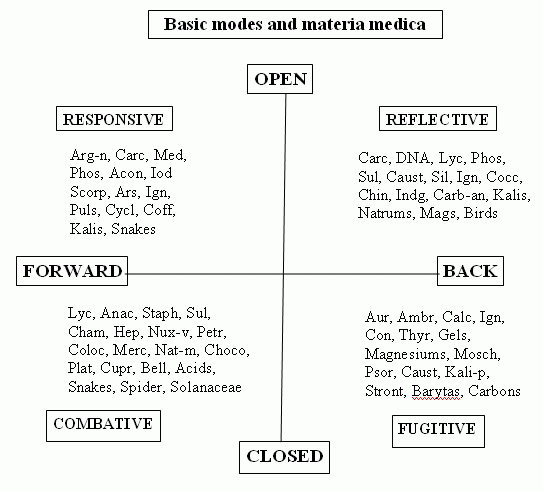
Some drugs of Materia Medica are presented through the study of Body Language. ‘The core rubrics which define the personality of a remedy’ are regarded as parameters to link Body Language. The unifying principle that binds the components of a remedy together is the base as also the pattern of energy fundamental to that specific remedy to understand the body language.
3. G. Linking personality of drugs to Body Language
1. Platina: The core issues concern impression, beauty, sexuality and projecting the self. The energy is utilized for the same and the body assumes the role of showing off.
a) High self image / superiority / Egoistic / Pride: Head high with chin pointing upwards. Look is contemptuous. Legs are crossed and arms folded with erect posture. Giving jerks to neck with eye to eye contact for that moment.
b) Disdain / Arrogance: Contemptuous upward movement of neck with head high and eye-brows raised.
c) Gayness / Beauty consciousness: Appearance – excessive use of ornaments; make-up and dressing, sense of expensive type. Showy type. Also gaudy. Constantly taking care of make-up and hair-style. Hair – style of modern type and usually not suitable to the age of patient.
d) Nymphomania: Sexual eyes. Making lascivious gestures. Looking through. Too much learning forward and blinking of eyes. Kissing, embracing and sexual positions.
2. Lycopodium: Inflated ego, need of more space, more power, taking hold of the situation, encroachment on others and manipulation are the core issues. The inner weakness also gets reflected in body language.
a) Confidence, want of: Eye to eye contact less. Fingers on mouth frequently.
b) Haughty: Eye-brows raised with head tilt back. Blinking. Looking up while
answering.c) Contradiction is intolerant of and anger < contradiction: Frowning. Wrinkling of eye-brows. Direct eye contact with flushing of face. Clenched fist with stroking on table. Pointing index finger frequently. Constantly re-questioning to physician. Continued eye contact with dilatation of pupils, contracted brows Memory, weakness of. Forgets names of places and of closely related persons while talking in interview.
d) Dictatorial: Chin upwards with head backwards. Good eye to ye contact occurs but direct piercing book. Blinking over sensitive issues. Leaning backwards, with one ankle resting on other knee. Commanding voice.
e) Anticipatory anxiety: In waiting chamber: Restlessness. Constantly asking questions to a receptionist. Punctual of time.
f) Boasting: Hands behind head. Head high. Steeping gestures.
g) Superiority complex: Standing up-right, sitting with arms spread apart on chair, hands behind neck, eyebrows, raised, loud, dictatorial voice.
h) Lies, inclination to tell: Touching nose with hand especially at the end of sentence with poor eye to eye contact and robbing of eyes.
i) Malicious: Raising of eye-brow with side glances especially when talking about the person concerned.
3. Lachesis: Tremendous energy. The emotions are at high pitch and must be ventilated. The body synchronizes with the energy and more choreography is represented.
a) Suspicion: Failing to make eye to eye contact. Glancing sideways. Rubbing or touching nose. Frequent cleansing of glasses.
b) Dictatorial: Proud erect body stance with chin forwards. Leaning back with hand behind head. Resting feet on desk. Continued eye contact with less blinking. Stands with erect body and legs apart. While sitting one ankle is resting on the other knee. While answering frequently pointing index finger.
c) Excited: Excessive forward leaning. Dilated pupils. Voice loud and bouncing.
d) Anger-violent: Flushed face. Pointing fingers while talking. Dilated pupils. Anger usually associated with abusive language. Body rigid. Fists clenched. Lips closed and held in a light thin line. Body in motion due to intense emotional energy.
e) Sarcastic: While answering smiling from one corner and raising of eye-brows. Arguing with the physician, aiming to discourage him by certain words.
f) Inquisitive (Children): Constantly asking number of questions. Flash-bulb type of eyes. Handling and desire to know the working mechanism of toys or instruments present over desk.
g) Aggressive: Leaning forward. Finger pointing. Fists clenched. Talks with loud voice as if not interested in other’s view. Encroaches upon others.
h) Loquacity: Jumping from one point to other without head or tail. Voice loud and bouncy. Suffocating other during talk.
i) Exaggerated / Over-enthusiastic: Constantly moving hands while expressing enthusiastic complaints. Appearance – dark. Make-up with use of fluorescent colors in dressing and showy (unsuitable to the age).
4. A. Some suggestions for physicians
• Are you sending the right signals? Just making a few subtle changes can have a significant impact on how you are perceived by others. Create a lasting impression and win peoples respect and trust for a lifetime.
• Simply, be ‘open.’ Be aware of your own body posture. Discover how people truly feel about you.
• Do not cross arms in front of you, or cross your legs away from the person you are talking with.
• Maintain eye contact. Glance away periodically to prevent intimidation but not at crucial moments. Converse at patient’s eye level.
• ‘Touch.’ It helps patient know that you view them as ‘people.’ A pat on the back, a light touch on the shoulder can be reassuring to patients. But beware of its universal application.
• ‘Barriers.’ Masks, safety glasses, gloves, bibs etc. Communicate ‘barrier free’ with the patient.
• ‘Facial expressions.’ Openness, smile, eagerness, interest yet serious and sincere.
• ‘Tone of voice.’ Polite tone. Speak slowly, articulately. Proper enunciation and pronunciation of words.
• ‘Body Movements.’ Avoid excessive, repeated movements of body, legs, hands, fingers etc.
• The FIRST person you need to impact with positive Body Language is not others, but YOURSELF.
4. B. Epilogue
Both nature and nurture (e.g. culture) play a role in body language. Hence ‘movements’ need interpretation. They are highly unique, succinct and individual. They deal with nuance, with feeling, with degree. One has to recognize them. ‘All movements of the body have meaning. None is accidental.’ The specific meaning of body movement may be different from person to person. Sometimes body language may not coincide with verbal language. The interpretation requires high skill and perspective vision. Hence, it is always better to see the body language in conjunction with verbal language and not in isolation; together they comprise a dual dialogue. If they match and are consistent with each other, they strengthen and underscore the meaning.
One swallow doesn’t make a summer and one body language signal doesn’t necessarily make a message. It is estimated that humans are capable of producing more than 650,0000 nonverbal signals. Body language is full of ambiguities. To have clarity, one must focus on the cluster of signals and upon those signals that are persistent, pervasive, repeated and characteristic. The words (i.e. verbal language) themselves are produced by articulated body movements of the vocal tract is also a point to be noted.
Body language opens up new vistas of perceptions heretofore unexplored. The language of symbols, the language of universal symbolism is blended with holistic philosophy of homoeopathy and a homoeopathic physician will miss a lot if he neglects the important information flowing from the cluster of symbols, signs and cues. Hence the issue of ‘non-verbal consciousness’ has a great scope in homoeopathic practice. It is a peep-hole into patient’s hidden conflicts and feelings and will certainly help a homoeopath in knowing an elusive and indefinable mind. The concept of totality which is central to homoeopathic prescribing will be redefined if we include appropriate appreciation of body language. At the same time, a homoeopath must know its limitations and he should be wary of its exclusive clinical application. Body language must be interpreted in reference to the situation, the context, and the culture of the people involved and there can be variations.
————————————————–
Dr. Ajit Kulkarni


Dear Ajit ,
Very nice and informative article indeed . I use hand reading and shaking hands to understand my clients better .
Let us get in touch .
Regards ,
Anand Ghurye
great info. thk u.. 🙂
i am a homeopath but far from the subject …after listening to dr ajits lectures want go deep into the subject ….could u please help me out