
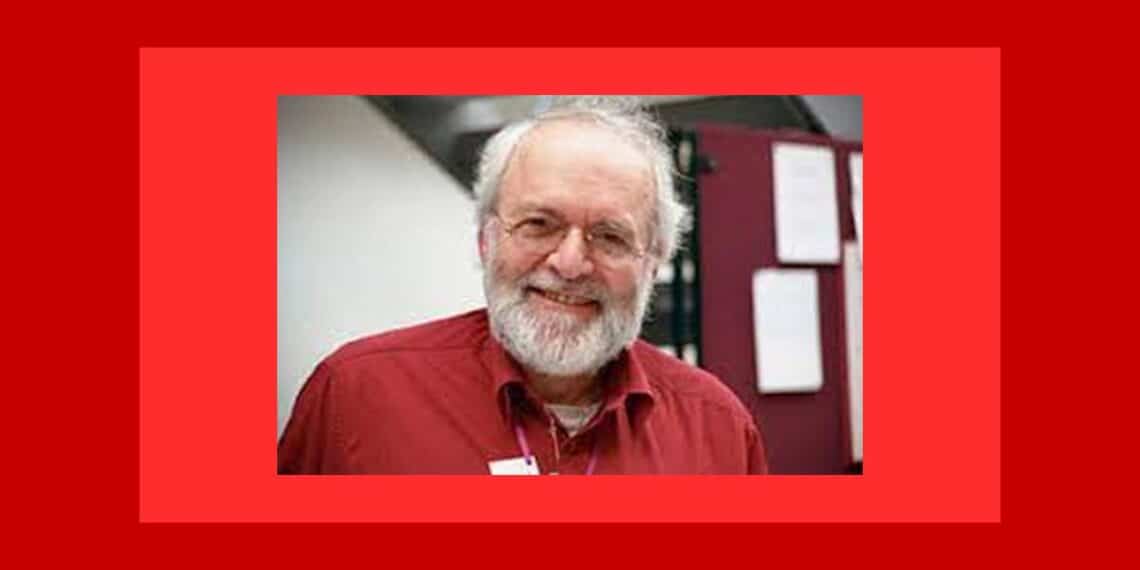
I was lucky enough to be invited by Francis Treuherz, editor of the Society of Homeopaths’ journal, The Homeopath, to come to his house and talk about his work. Francis has been a practising homeopath for many years and also works on the Homeopathic Helpline run by David Needleman.
I started off by asking him about the time he had worked in NHS GP surgeries in London. This had come to an end when Primary Care Trusts no longer funded homeopathic treatment.
“I prefer not to call it a surgery but I worked in NHS primary care for 13 years,” and he handed me one of his prescriptions listing two GP practices he had worked at. “I started off in 1990 in the Marylebone Health Centre where I worked for 3 years. They were still very sceptical of homeopathy, so I went to see an old friend working in Fitzrovia Medical Centre and he got out his diary and said, “When can you start?!” Between these two, I worked 13 years in the West End of London, as well as in two other suburban practices. In one of them I was given a research grant.”
| Referral criteria for HS homeopathy
To raise the level of health of the patients. For medico-legal reasons all referrals should be authorised by a doctor, even if this is just a line in the notes or the computer equivalent. |
[Francis Treuherz, 2000; Homeopathy in General Practice: A descriptive report of work with 500 consecutive patients between 1993 – 1998; Northampton, The Society of Homeopaths. Copies available from [email protected].]
I had presumed that his no longer working in the NHS related to the letter that had been sent to PCTs by a number of sceptical professors http://www.timesonline.co.uk/tol/life_and_style/health/article1827553.ece but it was apparently due to new rules that were brought in by the Blair government. Francis explained, ”
I was working in the NHS from 1990 to 2003 – one, two or even three days a week because at that time, practices had a certain amount of power over their budgets, called fund-holding. The Labour Party changed that and introduced Primary Care Trusts where it became a group of practices that looked after their own budget. So instead of the highest common factor it became the lowest common denominator and alternative medicine was the first to go.”
“Much later on in May 2007, Baum and others wrote that letter to Primary Care Trusts claiming that homeopathy was bunkum and they shouldn’t allow any more referrals. It was a forgery in that they wrote it on NHS headed paper which they did not have permission to use. The Department of Health actually put this error up on their website in October 2007. The crazy thing is that the reprimand never received the publicity that the original letter did.”
“Unfortunately the damage was done.”
The document entitled ‘Homeopathic Services’ – sent to PCT Directors of Commissioning http://dcscience.net/homeopathy_paper_for_nhs_commissioners.pdf
| A document entitled “Homoeopathic Services” which was distributed to Directors of Commissioning earlier this year has caused some confusion because it carried the NHS logo. We would like to clarify that this document was not issued with the knowledge or approval of the Department of Health and that the use of the National Health Service logo was inappropriate in this instance.
The document does not represent any central policy on the commissioning of homoeopathy and PCTs continue to be responsible for making the decisions on what services or treatments to commission to meet their community’s health needs. |
ttp://www.dh.gov.uk/en/Publicationsandstatistics/Bulletins/theweek/DH_079859
I asked Francis his opinion of the constant attacks against the profession.
“It’s a waste of time in some ways. It’s terribly time-consuming because when you get them laughing at us, one doesn’t know whether they are being insulting or whether they really believe it.” “So anyway, I had always wanted to work in the NHS and never imagined that would actually happen. I saw patients who would never have had a chance of getting private treatment. Once I treated a baby with refugee parents, where the case had to be taken via sign language. The mother kept jabbing at the child’s arm and making gestures which I figured out meant it had suffered a convulsion. It seemed after the baby had arrived in the UK, it been given a DPT injection, had a convulsion and became covered in eczema. So I gave the child Sulphur, then a few weeks later the vaccine in potency, and when what I call ‘normal service’ was resumed, she started teething and got Chamomilla.” Francis continued, “I also remember seeing a child who was head-banging and had become uncontrollably sad and violent. The father had a withered arm from an industrial accident, unlikely to be able to work again. The child had begun to do really well with homeopathy and then came the letter that I couldn’t treat them any more. Well, I was in tears as well as the mother.”
“I carried on working in one practice for a long time after the rules had changed and they continued to pay me but when the senior partner died, it ended.”
I pointed out how it must have really helped the practice by taking a load of cases off their hands.
“Absolutely. The referral criteria was about saving the practice money, as well as quality of life for the patients.”
“Such a pity there are not more homeopaths working in the NHS. There is just no good reason to be outlawing homeopathy like this.”
“A little while after I finished college, I went to work in Calcutta and I couldn’t have done the work I did in the NHS without that clinical experience, working with people with which I didn’t share a language and with pathology I wouldn’t have had a chance to see in the UK,” he said.
I wanted to know what it was like working on the Homeopathic Helpline, which is such a valuable service.
“I always wonder how patients get hold of the right remedy when they need it urgently?”
“One of the things about the Helpline is that it has done the homeopathic pharmacies a good turn because homeopaths tell their patients to get a kit from Ainsworths or Helios, so patients are already in possession of remedies in an emergency. I have a pretty good mental note of pharmacies that do homeopathy and where there is a Neal’s Yard but there are some parts of the country that aren’t covered. If somebody needs Pyrogen and they’re up in the Pennines, then they’re stuck. Yet long before the Helpline, in fact I had a patient up in the Pennines with gallstone colic and I described how to do the liver flush and it worked.”
I asked Francis approximately how many calls he and David Needleman got in a day from the Homeopathic Helpline.
“One day there could be 25 calls and on another day 120. But every year there is one day of the year that it goes crazy – just around Christmas when every homeopath is on holiday! Every family in the land is stressed out from having been alone, having been with their relatives, having got flu, a hangover or any combination of the above!”
“And food poisoning or over-eating!”
“The Helpline goes insane,” Francis continued. “They ring up saying they didn’t want to bother us over Christmas but David and I aren’t worried about it, as we are both Jewish.”
You must really have to think fast and ask them the pertinent questions.
“There was one time when I had to think really, really fast. A father called to say his son was having intense pain in the testicles. I don’t know how I knew it but I strongly suspected testicular torsion, where the spermatic cord is twisted, cutting off the blood supply to the testicles. It requires surgery within about 6 hours if the test-icle is to be saved. I told the father to grab some Arnica and take his son immediately to the hospital. I told him not to wait for an ambulance and to give his son Arnica after the operation to heal the trauma and take a dose himself for the shock he would undoubtedly be experiencing. If I was wrong I would apologise but if I was right and the boy didn’t have surgery, we could regret it.”
“Anyway, the father called a week later to inform me I had been correct. The boy had needed immediate surgery and he was fine now and recovering well. The doctors saved that boy’s fertility and the homeopathy helped the recovery with the Arnica.”
“We can help patients get well but doctors are very good at what I call the ‘carpentry and plumbing’, when it’s needed. I don’t mean that in a derogatory sense. Surgery after an accident is quite different from, for example, the removal of tonsils, when we can prevent the need for their removal.”
We then turned to Francis’ work with the Society of Homeopaths and I knew he had been a member for many years.
“I got interested in working for the Society after I left college because when I was young I became secretary for the Synagogue youth club and my father worked in a voluntary capacity managing a Jewish old people’s home. So I was hardwired to get involved in things.”
“When I came back from India, I very soon started editing the Society’s journal at a time when the previous Editor had just become a father – he gave me the files in the hospital waiting room at the last minute! I edited the journal for 7 years, became a board member and this was at a time when the Society didn’t have any staff. We did everything, arranging conferences and seminars, etc. Then we appointed Mary Clarke and gradually other people. After 10 years, I had a rest from the Board as we had passed a rule that people shouldn’t be on it for more than 2 terms of 3 years. After an interval, I came back and became Honorary Secretary for another 6 years and then recently I became Editor of the journal again which I really enjoy.”
“The journal is of a very high standard.”
I then wanted to know where the Society was going with the Single Register, so I asked what the Society’s current position was, now that CORH had been dissolved.
“That is more difficult for me to say because I am not a member of the Board so I can’t make a position statement. The Society is consulting widely on ways to create the Single Register. There are two other forms of public register of which I am aware. The Health Professions Council and the Prince’s Foundation for Integrated Health, Complementary and Natural Healthcare Council (CNHC). I believe that the way forward for us is to become recognized by the NHS and the only way to do that is a Single Register. I rather fancy the idea of a Charter, just as there are chartered physiotherapists, chartered psychologists and chartered architects, surveyors and accountants.”
“No one has thought of that!”
“Well I have thought of it but it seems to me that is one of the possibilities that needs to be investigated. There could be Chartered Homeopaths.”
We now moved on to talk about some of the old homeopathic books Francis had collected over the years.
“I was always interested in books,” he said. When I was a successful patient in the 1970s, I picked up an old Boericke and then I managed to find two first edition volumes of Clarke’s Dictionary of Materia Medica for a fiver. Eventually I managed to get the third volume and it just went from there. I was offered books which were really very cheap.” “I borrowed a book from the British Homeopathic Association Library which I really think they shouldn’t have lent me but I didn’t realise that at the time. It was Hahnemann’s Lesser Writings from 1852. I put it in a bag on the back of my bicycle and at a traffic light, a guy on a motorbike nicked the whole bag! So I never even got it home. At that point I started writing to second hand booksellers (long before we had the internet) to see if I could find a copy somewhere. It took a few years and then one summer I found two! I bought them both – one for me and one for the Library. The then Secretary of the BHA had retired and was called up to be told that a copy had been found!”
“By then I had bought other books people had offered me when I was looking for that one. I got books in all sorts of ways and then eBay came along!”
I never thought of getting old homeopathy books on eBay!
“When I went to lecture in Stockholm, I walked into a bookshop and picked up an Organon translated into Swedish dated 1835! The people I was going to see just didn’t know it existed. I have the Organon in Russian, Hebrew, Finnish, Persian, Polish, Norwegian, Farsi and obviously German, French, Spanish and Italian. It has been translated into loads of languages. I am waiting for the Japanese one as there is homeopathy in Japan.”
“And when I went to Australia, I visited a library of a Benedictine monastery, an hour or two’s drive from Perth into the West Australian desert.”
You found homeopathic books there?!
“Of course!”
“A Benedictine monk called Rosendo Salvado went to Australia to convert the Aborigines to Christianity.
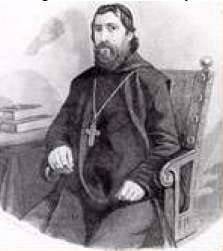
He took the trouble to learn their language, start a school, an orphanage and a farm and look after their wellbeing. When they got sick he gave them homeopathy. We even found a letter from the monastery to a homeopathic pharmacy in London ordering more remedies because it was faster then to get them from London than from Melbourne! We found and old Organon and all sorts of homeopathic books in the monastery library.”
[Francis Treuherz ‘Strange, rare and peculiar: Aborigines, Benedictines and homeopathy’. Homeopathy (2006) 95: 182-286. Illustrated copies available from [email protected].]
Francis then began talking about portraits of Hahnemann.
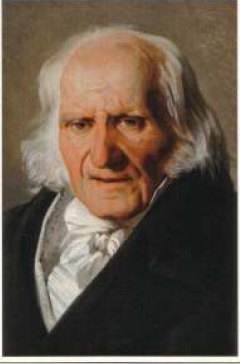
“On the way to the Links 20th Anniversary conference in Heidelberg, I went to the Robert Bosch Institute in Stuttgart, which has a big Hahnemann archive. Their librarians have exchanged duplicate books and stories with me for many years. Anyway, there over the mantelpiece was this full-size portrait of Hahnemann looking like a grumpy old man, quite different from the more idealised pictures and they had apparently found this at an art auction. The artist was named A.J.B. Hesse but no-one knew anything about him, not even my brother, an eminent art historian.”
“The Complementary and Alternative Medicine library and information service at the Royal London Homeopathic Hospital www.cam.nhs.uk have a postcard reproduction of a painting of Hahnemann done by a Russian artist, A.J. Beidemann. Hahnemann is shown up in the clouds looking down at the allopaths. I recommend you go to see it. It’s going to provide the sort of online library service you would get if you were at a university. Only organisations can join.”
I’d love to see that picture and also the library.
Francis had an American policeman’s badge with ‘Hahnemann Guard’ inscribed on it.
“This was a badge from a retired Philadelphia policeman who had sold it on eBay and whose job was to guard the Hahnemann Hospital in Philadelphia.”
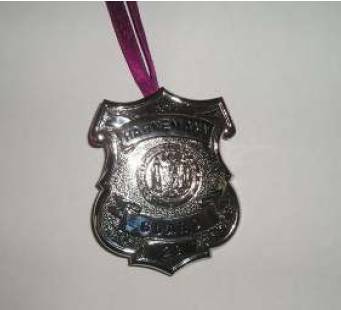
“I got two of these badges and one I sent to my friend, the late Julian Winston in New Zealand,” and he presented a very amusing picture of Julian wearing it. “Julian originally lived in Philadelphia and that was where Boericke and Tafel were. They were the biggest publishers and pharmacy of homeopathy in the USA in the 19th century. They decided to move to California and Julian tried to prevent them throwing away a lot of their old stuff. He failed but because he lived there, he was able to go along to the ‘dumpsters’ and rescue a lot of things.” http://www.homeoint.org/cazalet/boericke/story.htm
I remarked on how wonderful it was to think about the time homeopathy was King in the medical world during the 19th century and how there had been 100 homeopathic hospitals and 220 colleges in America during the 1850s.
On this site you can also see a copy of the original formulation of Hering’s Law http://www.homeoint.org/cazalet/hering/chronicdiseases.htm which was contributed by Francis, as well as the full text of Homeopathy in the Irish Potato Famine: written for the 150th anniversary of the famine in 1996.
He then showed me one of Hahnemann’s wax seals from an envelope that he got on eBay. I saw a little spoon celebrating the Royal London Homeopathic Hospital Centenary dated 1849 -1949 and a medal awarded to a nurse for 40 years service at the RLHH. I was shown samples of people’s writing which were used to diagnose their homeopathic remedy and this was used for the tissue salts.
The interview drew to a close and it was time to take my leave. I had been fascinated to hear about Francis’ life and the interesting stories he had to tell me.
—————————————————-
Francis Treuherz, MA, RSHom, FSHom, lives in London, UK. He has practised homeopathy since 1984 and written many historical and clinical articles, a research report and a book.
The Homeopathic Helpline is a pay per call service that can only be reached from within the United Kingdom. The number is: 09065 343404. Calls cost £1.50 per minute.
Louise Mclean, LCCH MHMA, is a homeopathic practitioner and Editor of Zeus Information Service Zeus Homoeopathy ews Promoting Homoeopathy Around the World!
###


I have in my possession a RLHH silver spoon celebrating the centenary 1849-1949 year. If anyone is interested in buying it then please get in touch.
Do you still have that spoon?
Let me know.