

Introduction
Increased cell growth forming a clone of cells resulting in a malignant, invasive rather fast growing tumour with the capability of migration and metastasis is called cancer. Cancer is not one but many diseases. It is equally found in males and females and highly dependent on the environment and rises dramatically with age. (Walmod 2006).
Cancer accounts for more deaths than heart diseases for persons under 85 years old. One in four deaths is due to cancer in the USA. In the UK, 150 000 people died of cancer in 2005 (Cancer research UK 2008) and The World Health Organization (WHO) estimated cancer to account for 13% of all deaths worldwide in 2005 (WHO 2005).
CAM therapies are popular among cancer patients. A survey showed a range among European countries between 14.8% to 73.1% with homeopathy being in the top (Molassiotis 2005). Homeopathy, like other complementary therapies, has especially been known to complement medical treatment as a support for treating the side effects of conventional treatment, for pain control and emotional issues (Hoffmann 2007, OCCAM 2004). A survey showed that cancer patients mainly have interest in psychological help from Complementary and Alternative Medicine (CAM) (Stevenson 1995). Other findings suggest that side effects from conventional therapy play an important role when CAM is chosen (Haustein 2004). Hirneise (2006) and Montfort (2000) mention side effects from chemotherapy as a reason for patient’s choice of CAM therapy.
Homeopathic treatment used as primary treatment has been criticised for delaying conventional treatment resulting in increased recurrence and death (Chang, Glissmeyer and Tonnes 2006). There is, however, a need to address the actual tumour with for example homeopathic treatment, (comma) where operation is not possible e.g. liver, lung or brain tumours (WDDT 2006).
Historically there is a long tradition of treating cancer homeopathically (Master 2005, Scholten 2006). From the older literature (Jones, Burnett, Clarke and others), success rates above 50% are mentioned. In spite of the encouraging results from the past , homeopaths today may be reluctant to treat serious pathology like cancer (Spinedi 1998). A revival of the old tradition is seen both in Germany and India (Reichenberg – Ullman and Ullman 2004).
In this article, the author seeks to explore if there is evidence of current homeopathic treatment influencing tumour size in human beings.
Literature Search
Journal/Database
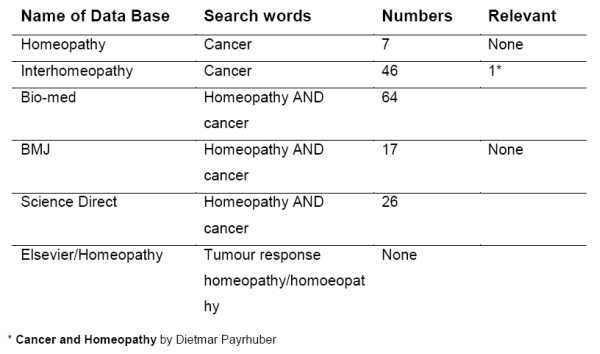
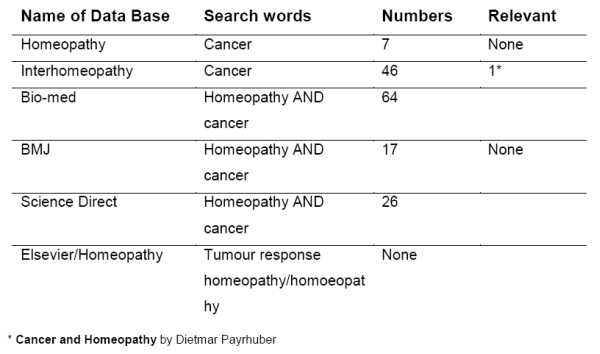
A literature search was carried out in the databases shown in the table below. Search words “Homeopathy AND cancer” (Boo’lean search) were used. Refined search with “Homeopathy AND cancer AND tumour” was then used.
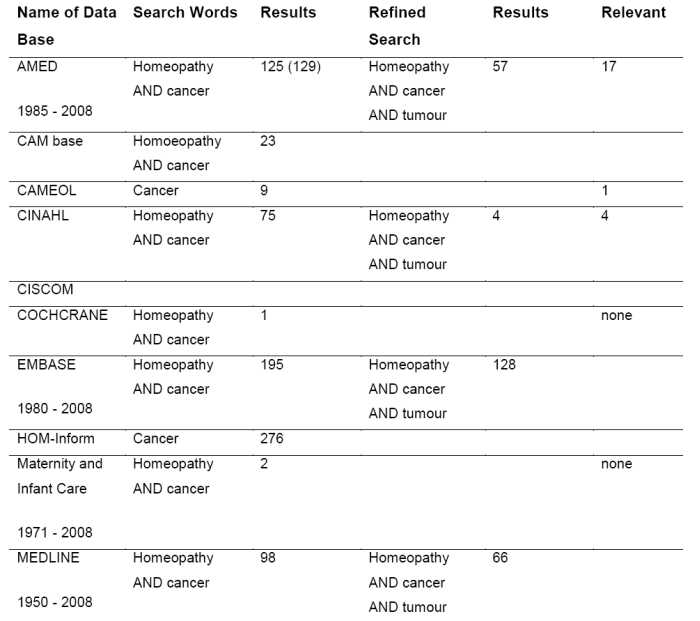
The “Relevant” category only includes articles discussing homeopathy in relation to tumour size, so articles related to the treatment of side effects of conventional treatment (chemotherapy, radiotherapy, hormonal therapy and operation) were excluded. Articles with the main focus on emotional issues arising from a cancer diagnosis were not used.
Published Books
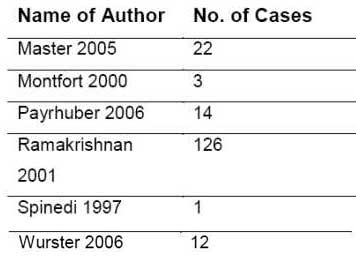
A search in the homeopathic literature (Narayana Verlag) showed books with case stories related to the topic from 5 authors (Master, Payrhuber, Ramakrishnan, Spinedi, Wurster).
Results
Literature was found in the following groups:
- Systematic review
- Chart review
- Case stories
Systematic Review
One systematic review (Milazzo, Russel and Ernst 2006) summarized and critically evaluated the efficiency of homeopathic remedies used as a sole or additional therapy in cancer care. Six trials were included in the study and assessed by Jadad score. Secondary outcome measures included tumour response. The analysis found insufficient evidence to support clinical efficacy of homeopathic cancer treatment.
Chart Review
The results from a chart review concluded homeopathic treatment as a cause of increased recurrence and death of cancer patients (Chang, Glissmeyer and Tonnes 2006).
Case Stories
One hundred and seventy-eight case histories from the following authors were included in the study:
Case studies are known to examine real situations and not to distort naturally occurring behaviour and thus offer good external validity (Lukoff 1998 cited in Thompson 2004). Furthermore, it is argued that clinical cases are the most realistic way to explore a treatment.
Tonelle and Callahan suggest that obtaining knowledge of a healing art should be coherent with the arts underlying understanding and theory of illness. Case stories are traditionally used as knowledge transfer in homeopathy, but often present information in an unsystematic way. The case reports are known to be anecdotal, and improved research quality is suggested by Thompson (2004) by introducing formal case study (FCS) thus improving the reliability and validity.
Thompson mentions the following limitations of a typical homeopathic case report:
- missing rival explanations of change in health status.
- no objective evidence in the form of questionnaire, laboratory findings, etc.
- dependent on notes of the practitioner.
- retrospective allowing for selection of best results and not indicative of the whole practice.
- insufficient details on duration of treatment, follow-up times.
- unchanged symptoms not included in follow-up reports.
Information from 178 Case Studies:
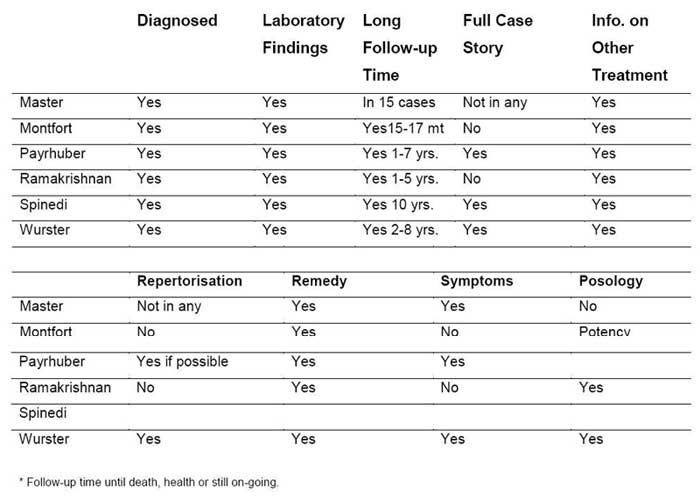
All patients prior to homeopathic treatment had been diagnosed with cancer and there was no doubt of the severity of their conditions. The survival rate was much above standard, resulting in cure of several cases.
Laboratory findings from later stages were included in most cases. The follow-up time varied from a few months (in only a few cases) to 8 years and was generally very long.
In Masters study, the disease process was halted in 5 patients out of the 22 cases and the remaining 17 died from cancer, but with a longer survival rate than expected from the circumstances.
Wursters cases are chosen from the categories difficult to treat or exhausted by conventional treatment. Four cases had metastasis and were given no chance of survival from the conventional perspective. Not all of Wurster’s cases met the criteria of 5 years survival rate, but they were exceptional because no signs of cancer were present in what were considered “hopeless” cases.
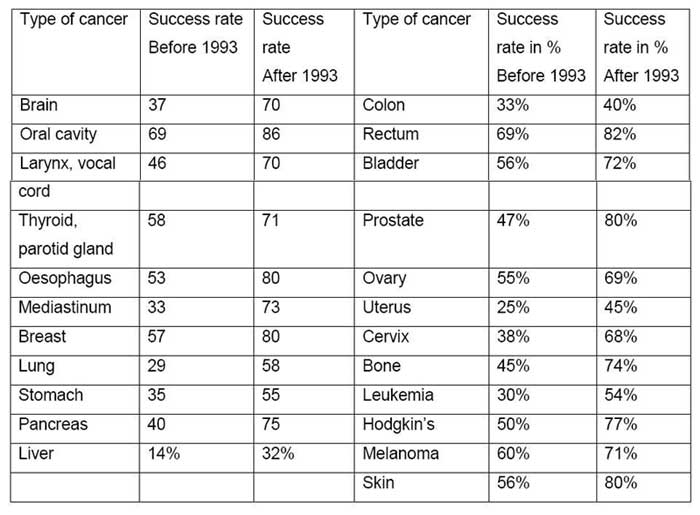
Ramakrishnan includes a statistical chart divided into case stories before and after 1993, demonstrating how a change in method of administrating the homeopathic remedy had affected the outcome. The statistic after 1993 uses “successful” for some cases without meeting the 5 year non-recurrence rate. Success rates are calculated from viable cases, which here mean cases without metastasis. Success rate varies from 30-80, depending on method of administration of the homeopathic remedy and the type of cancer (See appendix III).
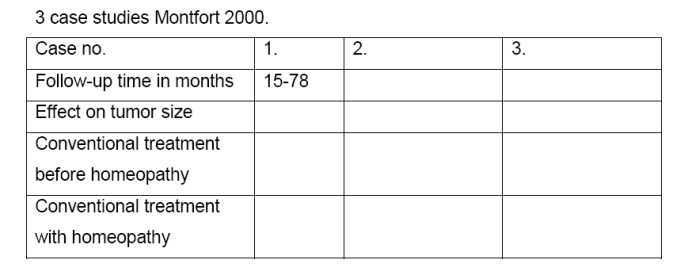
Montfort and Wurster mention surgical operation to be a trigger for recurrence in some cases. This is in line with information put forward by Ann Chir (1998). It is however a theory not fully substantiated by the findings in this study and should be further investigated.
The case studies can be divided into three categories:
1. Increased death rate and recurrence of tumours.
2. Stable condition, no further progress of the cancer e.g. tumour encapsulated.
3. Healing of the cancer condition.
Ramakrishnan, Wurster (2006) mentions that good results with the method were seen in the beginning of treatment but with relapse later on.
There are different views on what is curable by homeopathy (Ramakrishnan, Wurster) with the later showing good results in very severe cases with metastases.
Clinical Trials
No relevant trials were available. Only trials on supportive and palliative treatment is available (Kulkarni 1988, Oberbaum, Yaniv, Ben-Gal 2001, Balzarini 2000, Jacobs, Herman, Heron 2005, Thompson, Montgomery, Douglas 2005).
Discussion
Systematic review
Kuhn (1962) developed the concept of paradigms in science and he argues how the prevailing paradigm sets the scene in science and how it cannot be seen as purely objective. The paradigm determines the questions to be asked and the methods to obtain them. As an example, the systematic review holds RCT to be the best evidence in CAM research, thus in contrast to the experience from several studies (Weatherley, Thompson and Weiss 2006). By leaving out case stories, the systematic review only allows some experience to enter research and thus flaws the knowledge of homeopathic treatment of cancer patients.
Chart review
In a chart review, surgeons propose the danger of non-existing information on CAM therapies used as a primary treatment in breast cancer and conclude that this non-existing information is one reason why operations are refused (Chang et al). As shown later in this study, information from case studies was available in 2006 when the chart review was made. The conclusion is in contrast with other findings on cancer patients’ decision making. These studies show how cancer patients seek information also and especially outside the conventional research area (Verhoef 2004, Ewans, Shaw, Thompson).
The review concludes that homeopathic treatment deprives cancer patients of efficacious conventional treatment. When looking in table 1, overview of patients choosing CAM therapy instead of surgery, homeopathy is not mentioned. A group called “unspecified” consistS of 1 patient. The general statement, that homeopathy instead of surgery is associated with recurrence and death, is not substantiated by the findings in the review.
Retrospective Chart Reviews of existing medical records that are intended as a systematic investigation designed to contribute to knowledge which can be generalized, require prior ethical approval (Human Subjects Research Office; 2008). This is not found in the paper.
Trials
No trials were conducted. Trials comparing conventional versus homeopathic cancer treatment are unethical in life threatening diseases. If homeopathic treatment is promising, patients in control arm are deprived potential benefit and when control arm is known to be efficacious, which it is in the eyes of conventional medicine, patients in test arm are deprived of benefit. Recent research has shown placebo controlled trials to have fundamental problems in testing complementary and alternative medicine (CAM), because specific effects of the homeopathic remedy and the non specific effect from the consultation are interdependent. Thus placebo is no longer only placebo and the measure of absolute efficacy of the homeopathic remedy is not possible. Instead, pragmatic studies comparing untested treatments with conventional treatment with evidence of effectiveness, are put forward as a meaningful way of evaluating homeopathic treatment (Wheatherley Jones 2004).
Cases
The case reports were generally of a very high quality when compared to the limitations normally found in homeopathic cases (Thompson 2004). Precise information on diagnosis was present in all cases. Objective measures in the form of CT-Scan, blood tests and biopsies during the follow-up period were frequently used by all authors except one. Detailed information of duration of treatment was also present in all cases.
Wurster, Spinedi and Ramakrishnan gave very detailed information on the administration of the homeopathic remedy. Payrhuber, Wurster and Spinedy informed about repertorisation and gave very detailed information on symptoms. This helps the understanding and makes the decision clearer to the reader and in general makes case studies more valid (Yin 2003).
All cases were retrospective reports with the allowance of selection bias and therefore the extremely good outcomes cannot be seen as standards (Thompson 2004), but evidence for effect of homeopathic treatment of malignant tumours in humans does exist.
The different views of homeopathic treatment of metastasized cases need to be investigated further and rival explanations of the “miraculous cures looked into. A large number of prospective case studies of high quality is recommended.
The widespread use of CAM leads to the decision makers’ wish to assess efficacy and safety and strengthen the need for relevant research. The assessment methods normally used in conventional medicine are not appropriate. There is a general understanding of the complexity of individualised treatments leading to new methods of investigation. Outcome of the new designs needs to be relevant to patients, practitioners and policy decision makers. (Boon, Verhoef and Vanderheyden 2006)
Comparative studies are recommended by Weatherly-Jones, and FCS are suggested by Thompson.
Conclusion
The literature review shows that evidence of effect of homeopathic treatment of malignant tumours in humans does exist. It seems that present day homeopaths have revived the tradition from older times in spite of the higher level of pollution.
The general standard of the reviewed cases was above average when compared to the normal limitations found in homeopathic case reports.
With the large number of cases and the good results shown, Ramakrishnan’s work is very promising. Future examples carried out by other homeopaths would add to the reliability of Ramakrishnan’s work.
The work carried out by Wurster et al also seems promising, with case studies of a very high quality (Yin).
There seems to be different ideas on what homeopathic treatment can do in metastasized cases. To investigate this further, a large number of prospective case studies of high quality is recommended.
There is a call from researchers (Milazzo et al) and government bodies (House of Lords 2000) to further investigate the anti-cancer effect of homeopathic treatment. This should be done both in a way that is in line with the underlying theories of homeopathy and also in a meaningful way for patients (Tonelle and Callahan). Meaningful evidence for cancer patients is close to the truth of everyday experience and often uses recommendations from friends and family (Verhoef 2004, Ewans, Shaw, Thompson).
Homeopaths have used case studies for more than 200 years as a way to transfer knowledge inside the community and the method is in line with the theory of homeopathy. Case studies serve the purpose of homeopaths and patients as well. However, the case studies need to be refined in order to share knowledge both inside and outside the homeopathic community. Thompson (2004) suggests improved research quality by introducing formal case study (FCS) thus improving the reliability and validity.
Case studies from homeopathy used as a supportive therapy were excluded, which may be seen as a weakness of the study. This strategy was chosen because little or no information about tumour size was revealed (Balzarini et al 2000, Jacobs et al 2005, Oberbaum et al 2001, Rajendran 2004, Thompson 2005).
Awknowledgement.
I thank Kate Chatfield for feedback and comments.
References
BBC webwise (2008) Ask Bruce – How do I search for. [online] last accessed 7-4-08 at URL
Balzarini A. Felisi E., Martini A. (2000) Efficacy of homeopathic treatment of skin readtions during radiotherapy for breast cancer: a randomised controlled trial. British Homeopathic Journal. 89 (1): 8 – 12.
Boon H. S., Verhoef M. J., Vanderheyden L.C. et al (2006) Complementary and Alternative Medicine: A rising healthcare issue. Healthcare Policy. Vol. 1. No 3. pp. 1-24. [online] last accessed 1-5-08 at URL http://www.longwoods.com/product.php?productid=18120
Cancer Research UK (2008) Latest UK Summary – Summary 2004 and Incidence 2005. [online] last accessed 7-4-08 at URL
Chang E.Y., Glissmeyer M., Tonnes S. et al (2006). Outcomes of breast cancer in patients who use alternative therapies as primary treatment. The American Journal of Surgery. Vol. 192. pp. 471 – 473.
Chir A. (1998) Impact of tumor doubling time on the therapeutic strategy: application to so-called synchronous metastases of colorectal cancers. 52(5) pp. 413-20. [online] last accessed 26-10-09 at URL http://www.ncbi.nlm.nih.gov/pubmed/9752479
Currim A.N.(1996) The Collected Works of Arthur Hill Grimmer, Erzabtei St. Otilien: EOS Verlag.
Ewans M., Shaw A., Thompson E.A. (2007).Decissions to use Complementary and Alternative Medicine (CAM) by male cancer patients: information-seeking roles and types of evidence used. BMC. Complementary and Alternative Medicine. Vol. 7. pp [online] last accessed 7-4-08 at URL http://www.biomedcentral.com/1472-6882/7/25
Haustein, K. (2004) Homoeopathie und die Behandlung von Geschwulstkrankheiten. Der Onkologe Volume: 10 (3) pp: 269-275.
Hirneise L. (2006) Chemotherapie heilt Krebs und die Erde ist eine Scheibe. Kernen: Nexus.
House of Lords Select Comittee on Science and Technology (2000) Complementary and Alternative Medicine. London: Stationary Office.
Hoffman C.(2007) Benefits of complementary therapies. Breast Cancer Research 2007, 9(Suppl 2):S9doi:10.1186/bcr1807
Human Subjects Research Office (2008) Retrospective Chart Reviews [online] last accessed 7-4-08 at URL https://eprost.med.miami.edu/
Jacobs J., Herman P., Heron K. et al (2005) Homeopathy for menopausal symptoms in breast cancer surviviors: a preliminary randomized controlled trial. Journal of Alternative and Complementary Medicine. 11(1): 8 – 12.
Jemal A. et al (2007). Cancer Statistics 2007. CA A Cancer Journal for Clinicians; 57: 43 – 66. [online] last accessed 7-4-08 at URL:
Master F. J. (2005) Tumours and Homoeopathy. New Delhi: B. Jain.
Kuhn T. S. (1962) The structure of Scientific Revolutions 3rd. ed. The University of Chicago Press.
Lukoff D., Edwards D., Miller M. (1998) The Case Study as a Scientific Method for Researching Alternative Therapies. Mayo (2007) Cancer survival rate: A tool to understand your prognosis. [online] last accessed 7-4-08 at URL: http://www.mayoclinic.com/health/cancer/CA00049
Milazzo S., Russel N., Edzard E. (2006) Efficacy of homeopathic therapy in cancer treatment. European Journal of Cancer. Vol. pp. 282 -289.
Molassiotis A. et al (2005) Use of complementary and alternative medicine in cancer patients: a European survey. Annals of Oncology;Official Journal of the European Society for Medical Oncology. Apr;16(4):655-63.
Montfort H. (2000) A new homeopathic approach to neoplastic deseases: from cell destruction to carcinogen induced apoptosis. British Homeopathic Journal. Vol 89. pp.: 78 – 83.
Oberbaum M., Yaniv I, Ben-Gal Y. Et al. (2001) A randomized controled clinical trial of the homeopathic medication Taumeel S in the treatment of chemotherapy-induced stomatitis in children undergoing stem cell transplantation. Cancer. 92 (3): 684 – 90.
Office of Cancer Complementary and Alternative Medicine Office (2004) Survey of Practitioners Regarding Alternative and Complementary Medicine. [online] last accessed 7-4-08 at URL
Payrhuber D. (2006) Homoeopathie und Krebs. Moeglichheiten zu Heilung. Salzburg: Payrhuber.
Polyani M. (2008) Personal knowledge. In: Swayne J. Truth, proof and evidence. Homeopathy and the medical paradigm. Homeopathy. Vol. 97 pp.: 89 – 95.
Rajendran E. S. (2004) Clinical Case Histories. Homeopathy as a supportive therapy in cancer. Homeopathy. Vol. 93 pp.:99 – 102.
Ramakrishnan A. U. (2001) A Homoeopathic Approach to Cancer. St. Louis: Quality Medical Publishing.
Reichenberg – Ullman and Ullman (2004). Two pioneers in the homeopathic treatment of cancer.(Healing with Homeopathy). Townsend Letter for Doctors and Patients [online] last accessed 13-3-08 at URL
Scholten J. (2006) in Payrhuber D. Homoeopathie und Krebs. Moeglichheiten zu Heilung. Salzburg: Payrhuber.
Spinedi D. (1997) Die Krebshandlung in der Homoeopathie. Semninarmitschriften Band 1: Bad Imnau, Juni 1997. Kempten: Cheiron Verlag.
Spinedi D. (1997) Die Krebshandlung in der Homoeopathie II. Semninarmitschriften Band 2: Locarno,September 1997. Kempten: Cheiron Verlag.
Stevenson C. (1995) Surveys in complementary therapies: assessing the needs of people with cancer. Complement Ther Nurs Midwifery. Aug; 1 (4):110-112.
Swayne J. (2008) Truth, proof and evidence Homeopathy and the medical paradigm. Homeopathy 97, 89 – 95.
Thompson E. A., Montgomery A., Douglas D. et al (2005) A pilot, randomized, double-blinded, placebo-controlled trial of individualized homeopathy for symptoms of estrogen withdrawal in breast-cancer survivors. Journal of Alternative and Complementary Medicine. 11(1): 13 – 20.
Thompson T. D. B. (2004) Can the caged bird sing? Reflections on the application of qualitative research methods to case study design in homeopathic medicine. BMC Medical Research Methodology. 4:4 [online] last accessed 13-3-08 at URL http://www.biomedcentral.com/1471-2288/4/4
Thompson T. D. B., Weiss M. (2006).Homeopathy – what are the active ingredients? An exploratory study using the UK Medical Research Council’s framework for the evaluation of complex interventions. BMC Complementary and Alternative Medicine. 6:37 [online] last accessed 13-3-08 at URL http://www.biomedcentral.com/1471-2288/4/4
Walmod P. S. (2006) Det Sundhedsvidenskabelig Fakultet. Københavns Universitet. Cancer forelaesning ppt. [online] last accessed 7-4-08 at URL http://www. plab.ku.dk/psw/cancer_forelaesning.ppt
Weatherley-Jones E., Thompson E. A., Thomas K. J. (2004) The Placebo-controlled trial as a test of complementary and alternative medicine: observations from research experience of individualised homeopathic treatment. Homeopathy. Vol. 93 pp.: 186 – 189.
WDDTY (What Doctors Don’t tell You) (2008) Surgery: Cancer op fails to clear tumour cells in 70 per cent of patients [online] last accessed 7-5-08 at URL
WDDTY (What Doctors Don’t tell You) (2009) Lung cancer: – The drugs that don’t work [online] last accessed 25-10-09 at URL
World Health Organization (2005) Cancer. [online] last accessed 7-4-08 at URL
Wurster J. (2006) Die homoeopathishe Behandlung und Heilung von Krebs und metastasierter Tumore. Buchendorf bei München: Verlag Peter Irl.
Appendix I
Appendix II
List of databases/websites:
CAMEOL
Interhomeopathy http://www.interhomeopathy.org
Narayana Verlag http://www.narayana-verlag.de/index.php/cPath/52_146
The Cochrane Library
Appendix III
Success rates in of Ramakrishnan’s cancer cases.
———————————————————


There seem to be the miracle cures but how and why is not really clear.