
ABSTRACT: The aim of this work was to analyze the effect of the homeopathic solution Sulphur on some radish growth variables. Five dynamizations (potencies) of Sulphur were used (5 CH,12 CH, 30 CH, 200 CH and 1 MCH) on a centesimal scale. Treatments were carried out in vases outdoors and the homeopathic solution was applied weekly. The fresh and dry matter mass of the shoot and the root system, the average length of the root system, the average plant length, the length of the largest leaf and the root diameter were analyzed. The application of Sulphur improved the general conditions of the plants in practically all the studied variables, when compared with a control. The dynamizations 5 CH, 12 CH, 30 CH and 1 MCH showed better responses. The control and the dynamization 200 CH were the treatments that presented the most negative results. The results suggest that the homeopathic Sulphur can be an alternative to improve the productivity and appearance of commercial agricultural products, with substantial reduction in agricultural input.
Key words: dynamization (potentization), Raphanus sativus L.
Introduction
The basic principle of homeopathy, according to Samuel Hahnemann (1755 to 1843), is the use of dynamized (potentized) solutions prepared from animal, vegetable or mineral substances, or sick tissues. For homeopathy, the disease or the unbalance is seen as an energetic unbalance and not as the action of the virus, bacteria and others (Bonato, 2002). The homeopathic solution promotes the re-establishment of the plants through improvement of their natural defenses. The use of homeopathy in agriculture was made official in 1999 (Brasil, 1999). Now homeopathic science is being used efficiently in the control of plagues (Fazolin et al., 2000), diseases (Verma et al., 1969; Kumar, 1980; Khanna e Chandra, 1983), to increase the active principles in medicinal plants (Carvalho 2001; Castro, 2002), plant detoxification for metals as aluminium (Rocha et al., 2002; Moretti et al., 2002) and copper (Almeida, 2002), increasing plant growth rate and productivity (Castro, 2002). This suggested the idea of verifying the applicability of the homeopathic solution Sulphur in some variables of the radish, for growth and productivity.
Material and methods
The experiment was conducted in the Didactic and Experimental Garden of Departamento de Biologia da Universidade Estadual de Maringá, from September 3 to October 25, 2002.
Obtaining the homeopathic solutions
The main Sulphur solutions were obtained on a centesimal scale from a suitable pharmaceutical laboratory (Farmácia Homeopática João Vicente Martins- Maringá -PR).
Application of the homeopathic solution
The treatments consisted of applications of 5 homeopathic dynamizations of Sulphur 5 CH, 12 CH, 30 CH, 200 CH and 1 MCH) and water used as control. The Sulphur was applied in the proportion of twenty drops (1.5mL) per water liter. Each vase received 100mL of the solution every seven days.
Performance of the experiment
Radish seeds were sown directly in 3-liter vases, receiving, as substratum, soil, decomposed bovine manure and sand in the proportion of 3:2:1, respectively. Ferralsols originating from the Didactic and Experimental Garden were used.
After one week, the plants were thinned, leaving just two plants per vase. Soluble fertilizers were not used during the experiment. The data were collected for 31 days. The experiment was carried out according to double-blind methodology, i.e. the experimenter and the applicator ignored the dynamization of the solution that was being applied.
Statistics
The experimental delineation was entirely in randomized blocks, with 4 repetitions. The treatments consisted of 5 Sulphur dynamizations on a Hahnemannian centesimal scale, in addition to the control. In the qualitative tests, the averages were compared using the Scott-Knott test at 5% probability.
As regards the quantitative variables, the models were chosen based on the significance of the regression coefficients using the “t” test at 5% probability.
Obtaining the data
Data collection was made every 7 days. Evaluations were always made in the same afternoon period.
Quantified variables
Length of the largest leaf
Evaluation of leaf length was made weekly. The measures were taken starting from the beginning of the petiole to the leaf apex.
Plant height
Determination of plant height in each phase was made measuring the distance between the base of the stem and maximum plant height.
Fresh matter of the shoot and the root system
The plants collected on the 31st day after being sown had their shoots and root system highlighted, with the aid of scissors, and immediately weighed on an analytic scale.
Dry matter of the shoot and the root system
After the fresh matter of the shoot and the root system was weighed, the material was placed in a kiln (70°C) at constant mass and then weighed on an analytic scale.
Results and discussion
Effect of Sulphur on leaf length
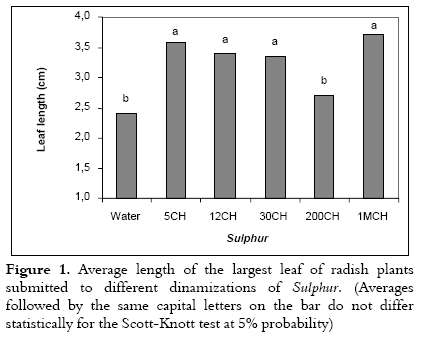
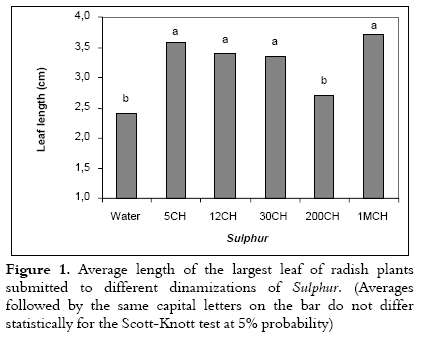
Average leaf length was influenced by the application of the homeopathic solution Sulphur
(Figure 1). The dynamizations 5 CH, 12 CH, 30 CH and 1 MCH showed longer average leaf length in relation to dynamization 200 CH and to the control (water). It was observed that the plants responded differently when several dynamizations of the same solution were applied. In several situations, the homeopathic solution also inhibits leaf growth (Castro, 2002). It should be emphasized that, starting from the dynamization 12 CH, according to the “Avogadro´s Number” (6.02 x 10²³), physical molecules of the solution do not exist, only energy (Schembri, 1992).
Effect of Sulphur on plant height
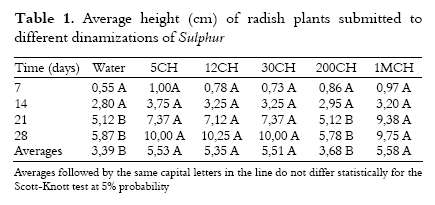
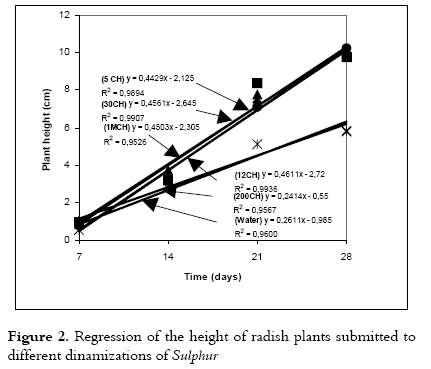
Plant height was influenced by different dynamizations of the homeopathic solution, except 7 and 14 days after sowing (Table 1).
Three weeks after sowing, it was verified that the treatments 5 CH, 12 CH, 30 CH and 1 MCH presented height significantly higher than the control
Effect of the homeopathic solution Sulphur 261 and the potency 200 CH. This behavior was practically identical to that observed for leaf length (Figure 1). The same tendency occurred for plant height at 21 and 28 days and in the general average (Table 1). It was observed that the growth alterations reflected the alternation of responses to the dynamizations. Alteration due to increasing dynamizations has been verified in many experiments (Davenas et al., 1988). In homeopathic science, it is common to observe the same solution causing very different effects in accordance with the dynamization, sometimes stimulating a lot, other times stimulating very little. This has been observed in clinical practice from the time of Hahnemann (Godoy, 1988; Castro, 2002). Fazolin et al. (2000), for example, verified this when carrying out an experiment seeking the control of Cerotoma tingomarianus in beans. The homeopathic solution Ignatia decreased the consumption of bean leaves by Cerotoma tingomarianus in the decimal dynamizations D5 and D15 and increased consumption in the dynamizations D9 and D29. The same phenomenon was observed using silver nitrate in the dynamizations D24 and D26, which increased the growth of wheat seedlings, while the intermediary dynamization D25 depressed the growth of the seedlings (Pongratz et al., 1998). This phenomena is still not explained by science, but it is believed to be related to existing rhythmic movements in nature, and also to the law of similitude that occurs between the applied homeopathic solution and the organism that receives it (Vithoulkas, 1980; Godoy, 1988).
According to the regression equations in Figure 2, the homeopathy Sulphur demonstrated much higher angular coefficient values for the dynamizations 5CH, 12 CH, 30 CH and 1 MCH than for the control and the dynamization 200 CH.
This means that all the dynamizations (except for 200 CH) determined increase in the growth rate of the radish plants and suggests, in this case, that the homeopathy Sulphur interferes positively, accelerating plant metabolism. This fact was also observed by Castro (2002) in the application of Phosphorus in beets.
Effect of Sulphur on root diameter
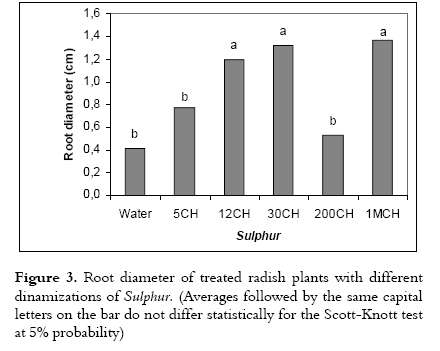
The application of the homeopathy Sulphur in the dynamizations 12 CH, 30 CH and 1 MCH increased the average diameter of the radish roots significantly in relation to the control and the dynamizations 200 CH and 5 CH (Figure 3). The behaviour presented here was similar to that observed for the first described items. The average root diameter of the plants treated with 12 CH, 30 CH and 1 MCH was approximately 3 times greater than the control. This result is of great importance, because the applied homeopathy resulted in larger roots, leading to higher productivity and higher commercial value of the product. Again, it was observed that different dynamizations caused different results. When there is a similitude between the homeopathic solution and the organism, the vital energy responds, opposing the energy of the medication to a test of its own energy (Hamly, 1979).
However, when there is no similitude between the homeopathic preparation and the organism there can be disorder in the metabolic system of the plant, resulting in several negative growth and development aspects of the plant.
Effect of Sulphur on the mass of the fresh matter of the shoot and the root system
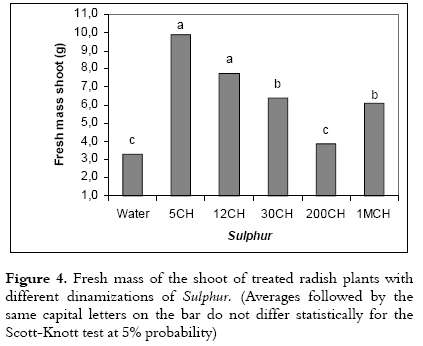
Both the mass of the fresh matter of the shoot and the root system were influenced significantly by the different dynamizations of Sulphur (Figures 4 and 5).
The application of Sulphur at potency 5 CH resulted in a large increase in the production of the shoot fresh matter, standing out among the other studied dynamizations and arriving at values approximately three times higher than the control and the dynamization 200 CH (Figure 4). The potencies 12 CH, 30 CH and 1 MCH also increased the mass of the shoot fresh matter and differed statistically from the control and the dynamization
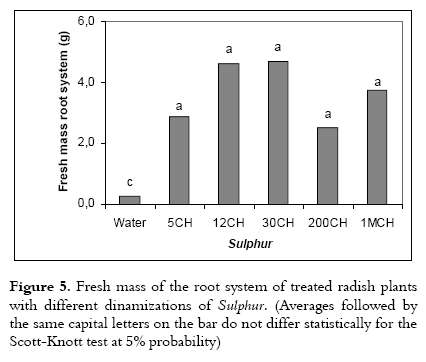
The application of Sulphur, independent of the studied dynamization, resulted in a large increase in the fresh matter mass of the root system, when compared with the control (Figure 5). The difference was 10 to 20 times greater in relationship to the control. Cymbopogon citratus plants treated with Sulphur 30 CH presented a reduction in the mass of the shoot fresh matter, differing statistically from the control (Castro, 2002).
Effect of Sulphur on the mass of the shoot dry matter and the root system
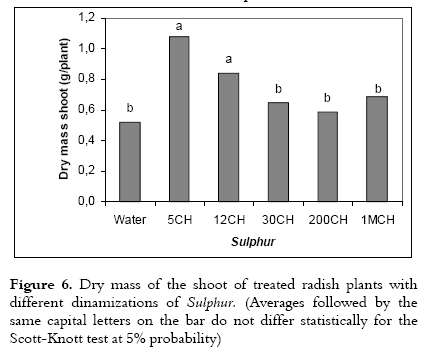
The radish plants that received Sulphur at potencies 5 CH and 12 CH presented a larger increment in the mass of the matter of the shoot (Figure 6), while the control and the other studied dynamizations did not differ statistically from each other. The plants treated with Sulphur 5 CH presented more than twice the mass of the dry matter of the shoot when compared to the control.
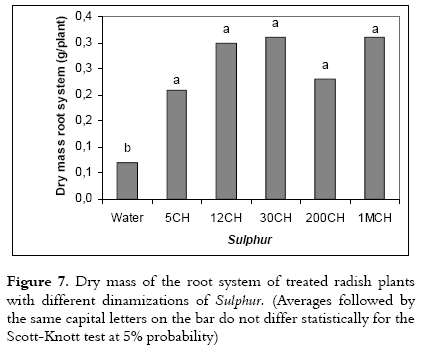
The production of dry matter in the root system was identical to that observed for the mass of the fresh matter, i.e. all the dynamizations presented significantly higher dry mass values of the root system (approximately three times higher) in relationship to the control (Figure 7). The variable mass of the dry matter should be preferred to the mass of the fresh matter because it is less subject to environmental factor fluctuations.
It is interesting to note that, even with the adversity of the abiotic and biotic factors (the plants grew outdoors), the homeopathic Sulphur was efficient and improved the general characteristics of the plants.
References
ALMEIDA, M.A.Z. Resposta do manjericão (Ocimum basilicum L) à aplicação de homeopatia Viçosa. 2002,
Dissertação (Mestrado)- Universidade Federal de Viçosa, Viçosa, 2002.
BONATO, C.M. Como funciona a homeopatia. Conselho Regional de Medicina Veterinária – CRMV PR. In:
Agroflorestas O “Tao” da produtividade, n. 5, Ano II, Out/Nov/Dez, 2002.
BRASIL. Instrução normativa nº07, de 17 de maio de 1999. Dispõe sobre normas para a produção de produtos orgânicos vegetais e animais. Diário Oficial [da República Federativa do Brasil], BrasÃlia, v.99, n.94, p. 11-14, 19 maio 1999. Seção 1.
CARVALHO, L. M. et al. Disponibilidade de água, irradiância e homeopatia no crescimento e teor de partenolÃdeo em artemÃsia. 2001. Tese (Doutorado em Fitotecnia) – Universidade Federal de Viçosa, Viçosa, 2001.
CASTRO, D. M. Preparações homeopáticas sobre o crescimento de cenoura, beterraba, capim-limão e chambá. 2002. Tese (Doutorado em Fitotecnia)- Universidade Federal de Viçosa, Viçosa, 2002.
DAVENAS, E. et al. Human basophil degranulation triggered by very dilute antiserum against IgE, London, v. 333, p. 816-818, 1988.
FAZOLIN, M. et al. Utilização de medicamentos homeopáticos no controle de Cerotoma tingomariannus Bechyné (Coleóptera, Chrysomelidae) em Rio branco, Acre. pesquisahomeopatica/embrapa.htm). Acesso em 28/04/00.
GODOY, M. As potências em homeopatia: escala de dinamizações de frequencial ascendente. Revista de Homeopatia, São Paulo, v. 53, n.3, p.101-105, 1988.
HAMLY, E. C. A arte de curar pela homeopatia: o Organon de Samuel Hahnemann. 1.ed. São Paulo: Prol, 1979.
KHANNA, K.K.; CHANDRA, S. Control of fruit rot caused by Fusarium roseum with homeopathic solutions. Indian Phytopathol., New Delhi, v.36, 1983, p. 356-357.
KUMAR, R., S. Effect for certain homeopathic medicines on fungal growth and conidial germination. Indian Phytopathol., New Delhi, v. 33, p. 620-622, 1980.
MORETTI, M.R. et al. Efeito de diferentes dinamizações homeopáticas de AlCl3 no comprimento da raiz principal de plântulas de milho. In: XI ENCONTRO ANUAL DE INICIAÇÃO CIENTÃFICA, 2002, Maringá. 2002.
PONGRATZ, W. et al. Highly diluted agitated silver nitrate and wheat seedling development: effect kinetics of process of successive phases. In: SCHULTE, J., ENDLER, P. C. (Ed.). Fundamental research in ultra high dilution and Homeopathy. Dordrecht: Kluwer Academic Publishers: 1998. p.143-154.
ROCHA, M. et al. Efeito de Sulphur UltradiluÃdo sobre a respiração de Ãpices Destacados de Zea mays (Milho). In: MOSTRA ACADÊMICA DE TRABALHOS DE AGRONOMIA, 6, 2002, Londrina. Anais… Londrina, UEL, 2002. p. 98.
SCHEMBRI, J. Conheça a Homeopatia. Belo Horizonte: Rona Editora, 1992.
VERMA, H.N. et al. Homeopathic and pharmacopeial solutions as inhibitors of tabaco mosaic virus. Indian Phytopathol., New Delhi, v. 22, p. 188-193, 1969.
VITHOULKAS, G. Homeopatia: ciência e cura. São Paulo: Cultrix, 1980.