

Introduction
In the UK, a vituperative debate has arisen over whether complementary and alternative medical (CAM) therapies should be included within the National Health Service.1 Homeopathy is arguably the most controversial form of CAM, not least because a highly publicised Lancet meta-analysis of clinical trials comparing homeopathy to allopathy dismissed the former as having no effects beyond placebo.2 This paper’s clear bias and methodological flaws,3-7 seemingly escaped most in the conventional medical community and the media,8 who are equally unaware of the many published fully peer-reviewed papers showing that homeopathy can indeed have effects beyond placebo.9-13 So, it is not surprising when twelve of the UK’s top medical scientists signed a letter to The Times calling for the cessation of CAM funding by the National Health Service (even though it is abundantly clear many conventional medical practitioners already avail themselves of adjunctive CAM therapies)14, but also accusing homeopathy of being ‘an implausible treatment’.15
The origin of this attitude is due in no small part to increasing demands that all therapeutic procedures be subjected to double-blind placebo-controlled trials (DBRCTs),16 according to the precepts of Evidence-Based Medicine (EBM).17,18 This could be considered hypocritical given that many of the drugs and procedures currently used in orthodox medicine have yet to be clinically confirmed by EBM.19 Apart from an almost inquisitorial overemphasis on the supremacy of one particular kind of evidence,18 the problem is how the meaning of the phrase ‘placebo effect’ is taken.
If in trials homeopathy works no better than a sugar pill, it is deemed ineffective. But the placebo effect has always been part of every doctor’s kitbag, and is enshrined in the Hippocratic Oath.14 Also homeopaths say their therapy encourages the body to heal itself, suggesting at the very least a more humane appreciation of the placebo effect.20
But with none of the original material substance left, sceptics want to know how a highly diluted homeopathic remedy can exert any effect, let alone a therapeutic one.21 Clearly, homeopathy poses serious challenges to conventional bioscience’s dominant materialistic paradigm, and will continue to be regarded as delusional, cynical ‘quackery’, or at best the ‘placebo effect’.2 Yet, one of the most recent studies performed under the same Swiss-inspired Program of Evaluation of Complementary Medicine (PEK) that produced the flawed Lancet meta-analysis, found that the ‘effectiveness of homeopathy can be supported by the clinical evidence’.22
It is this attitude that it should not work, therefore it cannot, which acts as one of the main hindrances to the integration of homeopathy into conventional medical practice. Another is many homeopaths’ distrust of anything to do with conventional science and medicine. Thus, for true integration to occur, homeopathy and conventional medicine will have to achieve some common ground.14
quantum theory, VITALISM, AND SYMPTOM EXPRESSION
The similarity in discourse
Conventional biomedicine is reductionist. This means sickness and disease are comprehended primarily in terms of pathological cellular biochemistry, as caused by external agents (viruses, bacteria, etc) or internal imbalances (e.g., genetic abnormalities). Treatment is therefore geared towards ‘fixing’ the problem by eradicating these causative disease factors, usually with powerfully toxic substances whose long-term side-effects can compromise the homeostatic immune system.
Homeopathy on the other hand, considers that ‘In the healthy condition of man, the spiritual vital force…. retains all parts of the organism in admirable harmonious, vital operation as regards both sensations and functions….‘23 In other words, it is holistic. From conventional medicine’s reductionist view-point, the Vital Force (Vf) is treated with contempt because ‘…it doesn’t have any identifiable source… obey any kind of (physical) law, it can’t be defined; it is simply postulated ad hoc to explain whatever effects or alleged effects need explaining: it can’t be pinned down or put to the question; its function is to provide the illusion of meaning without substance….it can’t be disproved because it is too amorphous and vague a concept.‘24
However, complex systems are known to self-organise, are open, and possess a wholeness that cannot be attributed solely to any particular part or sub-system.25 Non-deterministically, the Vf might be an emergent property of billions of living cells, which generates an all-pervading field that by feedback so organises the totality’s elements, it reinforces itself. This field would not originate in any one cell or body part, and being the resultant of the whole organism, resists any dissipative entropic influence. 26
Such a holistic view of the Vf bares phenomenological comparison with certain conclusions derived from quantum physics.27, 28 Thus, the Vf is thought not to be directly ascertainable: it is observed indirectly through the symptoms it produces.23 Similarly in quantum theory, the wave function (a multi-dimensional mathematical descriptor of a quantum system’s state) may only be inferred from the effects it produces in our reality.28, 29 This is through no fault in observation but depends more on the multi-dimensional mathematical language used in describing wave functions.30 As a result, trying to visualise a quantum state in our usual 3-D terms31, 32 leads to loss of information: one reason why entanglement in quantum theory seems so paradoxical. 28
Entanglement in a quantum system occurs if its seemingly separate parts are so holistically matched, measurement of one part of the system instantaneously (i.e., not limited by the speed of light and therefore without classical signal transmission) provides information about all its other parts, regardless of their separation in space and time, or their size.33 This last point addresses naïve criticisms34 often levelled at those who use quantum theory to explain the therapeutic effects of homeopathy/CAMs.35-43
In addition, more modern interpretations of quantum theory resolve such paradoxes as entanglement by taking the quantum state of a system not as an objective ‘thing-in-itself’, separate from us, but as a subjective representation of what we can know about it.44-49 Thus, apart from predicting a quantum system’s evolution in time, the wave function is also telling us something about the irreducible relationship between the observer and the observed quantum system. Also, a generalised form of quantum theory has recently been formulated called Weak Quantum Theory (WQT),50 which develops the idea of ‘macro-entanglement’ and uses it to explain not only phenomenological problems arising out of information theory and psychology,50 but also the therapeutic process in homeopathy35-37 and CAMs.41 The subsequent development of this idea51 leads to ways of considering macro-entanglement that explains significant correlations found between the brain functions of spatially separated pairs of human subjects.52, 53
In this context, Walach54, 55 and others56 have demonstrated clear correlations between remedy and placebo groups during double blind homeopathic provings; observations which are difficult to account for other than in terms of macro-entanglement between the two groups.36, 57 While purely physical entanglement between macroscopic objects seems unlikely, generalisation of the concept could be used to help explain certain observed correlations in human relationships. Although a sufficient but not a necessary condition for applying entanglement ideas to the problem of how homeopathy might work, it leads to a metaphorical use of concepts with an otherwise unique meaning in physics.57, 58 It should be stressed that this use of quantum mathematics has yet to be rigorously proven.
The Vital Force as a quantum entity
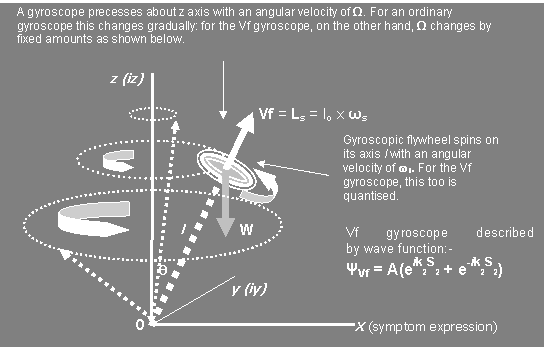
Based on the discourse similarity between the Vital Force and a quantum entity’s wave function, i.e., it is only inferable from the symptoms it produces,23,28 a new metaphor imagines the Vf as a quantised precessing gyroscope.59 This means the Vf’s spinning ‘flywheel’ slows discreetly, so that precession about an imaginary vertical axis also changes by fixed amounts. Quantised precession (i.e., a hypothetical ‘angular momentum’ vector Vf rotates in the x-iy plane: figure 1) arises by initially defining ‘Vf shift operators’, similar to the angular momentum shift operators from the physics of
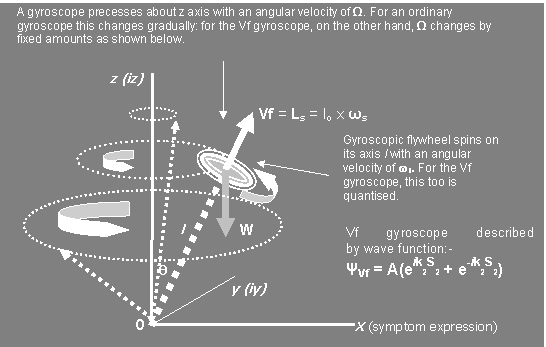
Figure 1. Schematic of the Vf gyroscope: a real gyroscope in 3-D space precesses around the z-axis sweeping out gradually increasing ‘orbits’ in the x-y plane. The metaphorical Vf gyroscope precesses in fixed quantised ‘orbits’ as shown and the y and z axes are complex. Symptoms are observed along the real x axis.
electrons in atoms.60 Vf shift operators were derived from complementary combinations30 of primary and secondary symptoms, experienced by the patient; observed by the practitioner.59 Thus, ‘diseases’ and ‘remedies’ are simply factors that increase or decrease the Vf’s strength by quantised amounts.
A Vf ‘wave function’, ?Vf, then relates Vf quantised precessional motion solely to observed secondary symptoms, S2, (i.e., ?Vf = A(eik2S2 + e–ik2S2)),59 and used to illustrate some of homeopathy’s empirical ‘laws’, e.g., bi-phasal action of remedies,61 and resonance effects among remedy provers and associates.62 A therapeutic analogue of the time-dependent Schroedinger equation60 was derived, and used to investigate the practitioner’s effect on the patient’s Vf during therapeutic PPR entanglement.63 Manipulating the Vf wave function further allowed remedies and diseases to be understood as ‘torques’ that respectively accelerate or brake the speed of rotation of the Vf gyroscope’s ‘flywheel’.64 Thus, if gyroscopic precession is a metaphor for Vf symptom expression, then eradication of symptoms by the remedy corresponds to an accelerating ‘remedial’ torque on the Vf ‘flywheel’, slowing precession.
Metaphorical motion in imaginary spaces
Precession of the Vf ‘gyroscope’ occurs in a mathematically complex plane. This means that only the x axis in Figures 1 and 2 is real: the y and z axes are complex.30 The ‘orbits’ represent different Vf states: the larger the precessional trajectory of the vector Vf, the greater the strength of Vf symptom expression. However, as with any quantum entity (e.g., an electron in an atom), transitions between the different states represented by these trajectories may be thought to occur instantaneously not gradually.
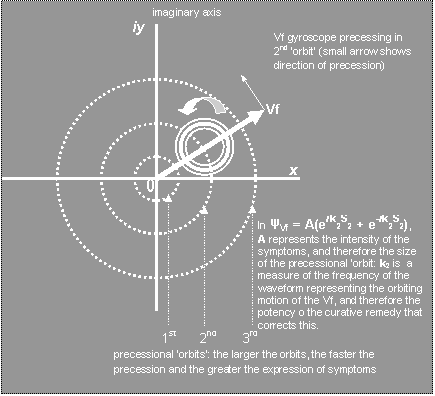
real axis along which symptoms are expressed
Figure 2. View of the Vf gyroscope in Figure 1, looking down the imaginary iz axis.
It follows that when the Vf ‘gyroscope’ is not precessing (i.e., its axis of rotation is co-linear with the complex z-axis), it is not producing symptoms, i.e., S2 = 0. Consequently, the larger the ‘orbit’ of Vf precession, the greater the degree of observed symptom expression along the real x axis (representing our four space-time dimensions are conflated into one) in figures 1 and 2. Thus, by precessing in a 3-D complex space defined by one real and two complex axes, the Vf may be imagined as a 6-D (i.e., four real plus two complex dimensions) rotating entity, precessing when disturbed, and producing observable effects in our reality experienced as symptoms. In future better mathematical treatments of these ideas might be realised using the multi-dimensional algebras of spinors65 and Lie groups.66
The effect of the similar homeopathic remedy
In previous papers,59, 63, 64 wave functions were derived for the vital force and the curative homeopathic remedy. These were:-
?Vf = A(eik2S2 + e–ik2S2) = 2Acosk2S2, and
?Rx = e–ik2?S2,
where i = ?-1, S2 is the totality of secondary symptoms, and ?S2 is the change in secondary symptoms wrought by the curative remedy. The constant A relates to the intensity of the wave form, which in turn relates to the strength of symptom expression by the Vf, and so to the sizes of precessional ‘orbits’ shown in figures 1 and 2. The constant k2 relates to the energy and ‘moment of inertia’ of the Vf ‘gyroscope’, and expresses the ‘frequency’ of the Vf wave function ?Vf. But this constant also appears in the wave function of the curative remedy, ?Rx and relates to the remedy’s ability to bring about this change in secondary symptom expression, by increasing the energy and ‘moment of inertia’ of the Vf.
The previous paper64 also made the point about the ‘torque-like’ action on the Vf of remedies and diseases; the remedy as an accelerating ‘torque’, and the disease as a braking ‘torque’. Thus, disease can be represented as the remedy’s mirror image, or mathematically, its complex conjugate,30 i.e.
?Dx = ?Rx* = eik2?S2
Consequently, just as k2 relates to both the potency of the homeopathic remedy and its power to cure by providing an accelerating torque, it also expresses the power of the disease over the Vf as a braking torque. Therefore, the curative remedy at the correct potency exactly cancels out the disease, i.e.,
?Dx X?Rx = eik2?S2 X e–ik2?S2 = e0 = 1.
In addition, this paper64 proposed that the ‘torque-like’ therapeutic effect of the curative remedy could be understood as the rate of change of the patient’s vital force with symptoms, derived by differentiating the Vf wave function with respect to S2, i.e.,
if ?Vf = A(eik2S2 + e–ik2S2) = A(2cosk2S2), then d?Vf/dS2 = T = -2Ak2sink2S2
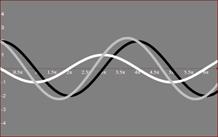
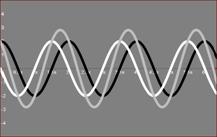
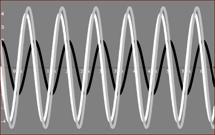
This led to some rudimentary insight into the torque-like action of the remedy was gained by graphically representing, ?Vf (black curve), d?Vf/dS2 (white curve), and their sum ?Vf + d?Vf/dS2, generating a series of diagrams representing how ?Vf and d?Vf/dS2 interact to produce ?Vf + d?Vf/dS2 for different k2 values, three of which are shown below.
a b c
Figure 3. Plots of the Vital Force wave function, ?Vf = 2Acosk2S2 (black curve), the remedial torque,
d?Vf/dS2 = -2Ak2sink2S2 (white curve), and the combination, ?Vf + d?Vf/dS2 = 2Acosk2S2 – 2Ak2sink2S2 (grey curve), where A = 1, and (a), k2 = 0.5; (b), k2 = 1; and (c), k2 = 2. Note how as k2 increases, so do the frequencies of the wave forms, and the grey curve peak amplitude and position with respect to the black and white curves: at low k2 the grey curve is like the black curve, while at high k2 the grey curve is more like the white curve (see reference 64).
This analysis considers only the initial effect of the torque on Vf: it does not take into account how long the torque is applied, and what happens after its action ceases.
It is interesting to re-examine the wave function for the curative remedy which is given as:-63, 64
?Rx = e–ik2?S2 1
Using Euler’s transformation,30 equation 1 may be rewritten in polar form as:-
?Rx = cos k2?S2 – isin k2?S2 2
This shows that ?Rx consists of real and imaginary parts. So it should be possible to contemplate remedy action in more than just physical terms, with the imaginary part of ?Rx representing the remedy’s less physically tangible effects, e.g., perhaps on mental and emotional levels. Now, as k2 tends to 0 (i.e., at very low potency and the remedy becomes more material), the imaginary term,
– isin k2?S2 disappears, while the real cos k2?S2 term tends to a maximum. So, as k2 approaches zero, ?Rx » cos k2?S2 and the remedy may be considered to act physically. At high k2, the real term disappears and the imaginary term increases to a maximum so that ?Rx = –isin k2?S2. The remedy is now acting mainly non-physically (which does NOT mean it exerts no physical effect). This wave function depiction of the curative remedy, allows its action on the whole person to be followed.
TOWARDS UNIFYING HOMEOPATHY AND CONVENTIONAL MEDICINE
The periodicity of wave functions
Depicting the Vf, remedy, and remedy torque as wave functions, implies a certain periodicity in their properties and behaviour. Such periodicity can indeed be exhibited by the Vital Force in its expression of symptoms; their strength varying according to periodic modalities, such as the time of day, etc.
Interestingly, there is some experimental evidence that biologically active substances at different serially diluted potencies will have periodic effects on their substrates. For example, Schiff reports alternating effects of different ultra-diluted potencies of anti-immunoglobuline E (aIgE) on the decoloursation of stained basophils, in most cases when the aIgE had been diluted and agitated beyond molecular existence:67 some potencies enhance decolourisation while others retard it. Schiff claims this as evidence for the water memory effect.
Accordingly, k2 values determine the periodicity of the Vf and remedy wave functions. As this constant is also associated with remedy potency (inversely proportional to material dose), it is interesting to investigate the possible effects of very low remedy k2 values on the periodicity of ?Rx.
From the previous section, we know that at low k2 values, the remedy wave function approximates to ?Rx » cos k2?S2. Now, the cosine function can be represented algebraically as the power series:-68
cos x = 1 – x2/2! + x4/4! – x6/6! +….(-1)nx2n/(2n)! 3
As x becomes very small, the values of the higher powers of x effectively vanish. Therefore, for small x, equation 3 approximates to :-
cos x » 1 – x2/2! 4
Similarly, for small values of k2, the remedy wave function, ?Rx approximates to:-
?Rx » 1 – [k2?S2]2/2! 5
Equation 5 is no longer a periodic: it is now a parabolic function (see steep and shallow white curves in figure 4: the steepness is determined by the value of k2).
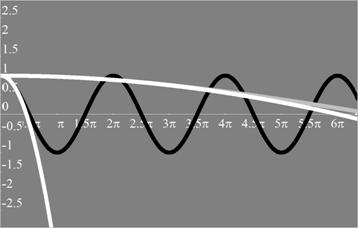
Figure 4. Plots of the real part of equation 2 (?Rx = cos k2?S2: k2 = 1; black curve: k2 = 0.075; shallow grey curve), and equation 5 (?Rx » 1 – [k2?S2]2/2!: k2 = 1; steep white curve: k2 = 0.075; shallow white curve).
Thus, for small values of k2, the shallow grey (equation 2) and white (equation 5) curves in figure 4 are virtually indistinguishable. Only as k2 grows does the difference between the grey and white curves become apparent. This theoretical finding may help illustrate essential differences between the homeopathic and the conventional medical approaches to the action of remedies.
The effect of remedy potency
Homeopathic philosophy maintains that a remedy becomes more potent the more it is diluted and succussed.69 This means that even at only moderate potencies (greater than 12c and 24x), homeopathic remedies possess little or no molecules of the original material substance, yet a remedy of higher potency should have a more profound effect on the Vf than one of lower potency.
The conventional medical approach to the action of remedies predicts otherwise: the less of the remedy’s material substance is actually present, the weaker its effect in curing the disease (in conventional medicine, the idea of an all-pervading Vital Force is considered moribund: its nearest equivalent is the homeostatic immune system). This could be represented in figure 4 by the grey curve, i.e., equation 5. Its parabolic shape means it crosses the x axis only once, after which it never returns, regardless of the value of k2. However, its response to a remedy at low k2 (or potency, in this case in a material dose) approximates to the extended white curve in figure 4. Thus, the form of the remedy function ?Rx shown in equation 5 could be said to represent the predictions of conventional medicine concerning the effect of highly diluted remedies, i.e., that the weaker the drug dose in material terms, the less effect the drug has on the homeostatic immune system. However, the form of the remedy wave function ?Rx in equations 1 and 2 represents the predictions of homeopathy, i.e., ultra-highly diluted remedies can still affect the Vital Force.
There is the possibility that just as equation 5 is an approximation to equation 2, so the predictions of conventional medicine are not so much in contradiction to homeopathy but might represent an approximation of much wider ranging implications concerning the effects of remedies at different dilutions, as predicted by homeopathy. If so, it might be possible to construct from basic principles a mathematical metaphor of conventional medicine’s homeostatic immune system that delivers similar predictions as the approximated form of the remedy wave function ?Rx represented by equation 5. Again, this comes with the proviso that there are as yet no rigorous mathematical proofs or lemmas for the use of such inherently physical ideas in these essentially biomedical/therapeutic contexts.
A mathematical metaphor for the homeostatic immune system
Conventional medicine has no concept of an all-pervading Vital Force. In homeopathy, the goal of treatment is to help the Vital Force to throw off the disease (e.g., as in the Vf gyroscopic metaphor). In contrast, conventional medicine recognises a homeostatic immune system but its drug regimes are less concerned with supporting it and more concerned with alleviating symptoms. In homeopathy, this is believed to be the cause of conventional drug side-effects, as the Vital Force reacts against the drug’s initial suppression of symptoms.61
This line represents n, the totality of symptoms expressed by Is: those to the right are disease symptoms, while those to the left are remedy ‘side-effects’.
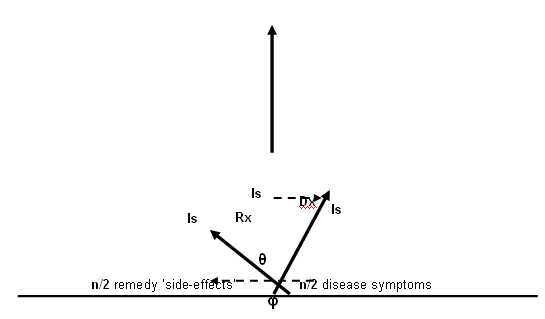
Figure 5. Force diagram metaphor for the homeostatic immune system Is disturbed by disease and remedy.
This situation in conventional medicine is represented simplistically by figure 5. Here, a disease ‘vector’ (Dx) acts on a homeostatic immune system ‘vector’ (Is) by ‘deflecting’ it through angle ?. A drug ‘vestor’ is then prescribed (Rx) to alleviate symptoms, correcting the original angle of deflection, only to produce side-effects, and a deflection in the opposite direction by angle ?. might be simply represented in terms of a mathematical metaphor based on a force diagram (figure 5). The box below gives a simplified mathematical derivation of the action of a homeostatic immune system under these circumstances.
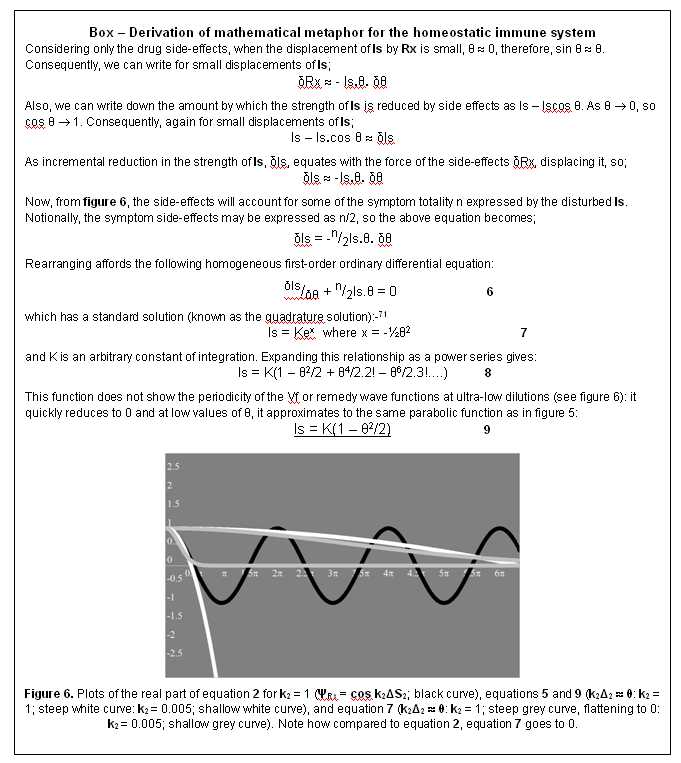
We see a close mathematical correspondence between equations 5 and 9 if ? (in the above box) bears a similar relationship in conventional medicine to the expression of drug side-effects by the homeostatic immune system, as k2S2 and k2?S2 in homeopathy have to the expression of and changes in secondary symptoms by the Vital Force and the curative remedy respectively. Thus, the mathematical metaphors used to represent the Vf and the homeostatic immune system approximate for very low drug potency (i.e., for values of k2 << 1 when a remedy/drug exists in material molecular form), suggesting that homeopathy and conventionalmedicine should predict similar outcomes for the effects of remedies/drugs given in material doses. Only when the remedy is becoming ultra-diluted, and according to these metaphors do the predictions of conventional medicine and homeopathy diverge.
Conclusions
The aim of this paper has been to show that a perceived similarity in discourse between homeopathy’s concept of a Vital Force and quantum theory’s notion of a wave function, could be the starting point for a much needed rapprochement between conventional medicine and homeopathy.
As others have pointed out,72, 73 however, such correspondences are not yet grounded in rigorous mathematical proofs or lemmas. Particularly, more detailed treatments are needed to flesh out the meaning of wave functions and hypothetical spaces used in therapeutic contexts, so that macro-entanglement of patient, practitioner and remedy can indeed be treated as if it were a generalised quantum system. Such elaboration will hopefully appear in later papers. Meanwhile, further development of a simple mathematical metaphor of the Vital Force as a quantised gyroscope, provides insights into the action of the curative homeopathic remedy over a large potency range.
This metaphor depicts the Vital Force and the curative remedy as periodic wave functions. It turns out that at low potency (i.e., the remedy is at a physical material dose), they approximate in such a way as to lose their periodicity and therefore deliver predictions concerning the effects of highly diluted remedies that are in line with those of conventional medicine, i.e., they should have little or no effect.
In order to expand on this conclusion, another simple metaphor was proposed, in which the conventional medical notion of a homeostatic immune system was treated as a simple force vector, Is, deflected by disease and remedy vectors. Thus, disturbance one way elicits symptoms of disease, while the disturbance the other way elicits symptoms of the remedy, i.e., ‘side-effects’. The mathematical treatment of this simple metaphor generates a solution whose interpretation is conventional medicine’s conclusion concerning the lack of efficacy of highly potentised substances. This, however, is the same conclusion drawn from the Vital Force gyroscopic metaphor when it is approximated.
Parallels could be drawn here with the relationship between Newtonian and Einsteinian mechanics: the latter delivers the former when it is suitably approximated to velocities much smaller than light.44 Thus Newton does not contradict Einstein: rather Newtonian mechanics is an approximation of Einsteinian mechanics, applicable at low velocities only. Similarly, it could be that there is no contradiction between conventional medicine and homeopathy: rather conventional medicine may perhaps be better understood as an approximation of homeopathy when remedies are given at low potencies in material doses. Thus, although only a preliminary metaphor based on several admittedly unproven assumptions, more sophisticated mathematical treatments than the ones presented here might in the future provide a platform for the possible unification of conventional medicine with homeopathy. Given the increasing scepticism being directed at homeopathy, it would indeed prove ironic if conventional medicine turned out to be a subset of a much broader paradigm that included homeopathy. “Graecia capta Romam victricem captum subducit” – “Captured Greece leads conquering Rome captive.”74 One should always dream….
ACKNOWLEDGEMENTS
The author wishes to express his deep gratitude to Ms Barbara A Drillsma-Milgrom for all her help, encouragement, patience, forbearance and inspiration in the preparation of this manuscript.
†This is part 10 in a series of papers entitled Patient-Practitioner-Remedy (PPR) entanglement.
‡Address: Department of Chemistry, Imperial College London, South Kensington, SW7 2AZ, UK; e-mail: [email protected]
Bibliography
1. a; Smallwood C. The Role of Complementary and Alternative Medicine in the NHS. London: FreshMinds, 2005.
: b; Ernst E. The Smallwood report: method or madness? Br J Gen Prac 2006;56:64-5: c; The Smallwood Report on the role of CAMs in the NHS, Focus Altern Complement Ther 2006;11:14-18, and comments therein.
2. Shang A, Huwiler-Muntener K, Nartey L, Juni P, Dorig S, Sterne JA, Pewsner D, Egger M. Are the clinical effects of homeopathy placebo effects? Comparative study of placebo-controlled trials of homeopathy and allopathy. Lancet 2005;366:726-32.
3. Fisher P. Homeopathy and The Lancet. Evid Based Complement Alt Med 2006;3(1):145-7.
4. Bell IR. All evidence is equal, but some evidence is more equal than others: Can logic prevail over emotion in the homeopathy debate? J Altern Complement Med 2005;11:763-769.
5. Frass M, Schuster E, Muchitsch I, et al. Bias in the trial and reporting of trials of homeopathy: A fundamental breakdown in peer review and standards? J Altern Complement Med 2005;11:780-782.
6. Kienle H. Failure to exclude false negative bias: A fundamental flaw in the trial of Shang et al. J Altern Complement Med 2005;11:783.
7. Peters D. Shang et al. Carelessness, collusion, or conspiracy? J Altern Complement Med 2005;11:779-780.
8. Editorial. The end of homeopathy. Lancet 2005; 366: 690
9. Linde K, Clausius N, Ramirez G, et al. Are the clinical effects of homeopathy placebo effects? A meta-analysis of placebo-controlled trials. Lancet 1997;350:834-843.
10. Mathie RT. The research evidence base for homeopathy: A fresh assessment of the literature. Homeopathy 2003;92:84-91.
11. Van Wassenhoven M. Priorities and methods for developing the evidence profile of homeopathy: Recommendations of the ECH General Assembly and XVIII Symposium of GIRI. Homeopathy 2005;94:107-124.
12. Bellavite P, Ortolani R, Pontorollo F, Piasere V, Benato G, and Conforti A. Immunology and homeopathy. 4. Clinical studies – Part 2. Evid-based Complement Alt Med 2006. Advanced access, 31/07/2006; doi:10.1093/ecam/nel046, and references therein.
13. Bellavite P, Ortolani R, Pontorollo F, Piasere V, Benato G, and Conforti A. Immunology and homeopathy. 4. Clinical studies – Part 1. Evid-based Complement Alt Med 2006;3:293-301, and references therein.
14. Murcott T. The Whole Story: Alternative Medicine on Trial? Macmillan (New York) 2005.
15. Baum M, Ashcroft F, Berry C, Born G, Black J, Colquhoun D, Dawson P, Ernst E, Garrow J, Peters K, Rose L, Tallis R. Use of ‘Alternative’ Medicine’ in the NHS. The Times (London), 19/05/07.
16. See Ernst E. Integrated Medicine: good intentions, poor logic? J Roy Soc Health 2006;126(5):206-7 and references therein.
17. Rosenberg W, Donald A. Evidence-based medicine: an approach to clinical problem solving. BMJ 1995; 310(6987): 1122-1126.
18. Holmes D, Murray SJ, Perron A, and Rail G. Deconstructing the evidence-based discourse in health sciences: truth, power, and fascism. Int J Evid Based Healthc 2006;4:180-6.
19. Goodman NW. Who will challenge evidence-based medicine? J R Physicians 1999;33:249-251.
20. See Ernst E. ‘Towards a scientific understanding of placebo effects’ in Understanding the Placebo Effect in Complementary Medicine: Theory, Practice, and Research. Ed. David Peters, Churchill-Livingstone (Harcourt Publishers Ltd), London, 2001, pp 17-29.
21. Milgrom LR. Is homeopathy possible? J Roy Soc Health 2006;126(5):211-18 and references therein.
22. Bornhoeft G, Wolf U, von Ammon K, Righetti M, Maxion-Bergemann S, Baumgartner S, Thurneyson A, and Matthiessen PF. Effectiveness, safety, and cost-effectiveness of homeopathy in general practice – summarised health technology assessment. Forsch Komplementärmed 2006; 13(suppl 2): 19-29.
23. Hahnemann H. Organon of Medicine, edition 6B, translated and revised by Hochstetter K, Editorial Universitaria, Santiago, Chile, 1977; par 9, p49.
24. Campbell A. Specifically key ideas in alternative medicine: website, http://www.acampbell.org.uk
25. Milgrom LR. Vitalism, complexity, and the concept of spin. Homeopathy 2002; 91: 26-31.
26. Hyland ME. A connectionist theory of asthma. J Clin Exp Allergy 1999; 29: 1467-1573.
27. Gernert D. Towards a closed description of observation processes. BioSystems 2000;54:165-80.
28. Auyung SY. How is Quantum Field Theory Possible? Oxford, UK, Oxford University Press,1995.
29. Milgrom LR. Towards a new model of the homeopathic process based on Quantum Field Theory. Forsch Komplementärmed. 2006;13:167-173 (DOI:10.1159/000093662).
30. See, Spiegel MR. Schaum’s Outline of Theory and Problems of Complex Variables. New York, USA, McGraw-Hill, 1999. Complex numbers are numbers of the type a + ib where a and b are real and i = ?-1, which is imaginary.
31. Abbott EA. Flatland: A Romance of Many Dimensions. Princeton University Press , USA, 2005.
32. Pickover CA. Surfing Through Hyperspace: Higher Universes in Six Easy Lessons. Oxford University Press, Inc, USA, 2001.
33. Landau LJ. Experimental tests of general quantum mechanics. Lett Math Phys 1987;14:33-40.
34. A search of the Internet will reveal a plethora of sceptical sites condemning homeopathy and the use of quantum theory to explain it, e.g., .
35. Milgrom LR. Patient-practitioner-remedy (PPR) entanglement Part 4. Towards classification and unification of the different entanglement models for homeopathy. Homeopathy 2004; 93: 34-42.
36. Milgrom LR. Journeys in the country of the blind: entanglement theory and the effects of blinding on trials of homeopathy and homeopathic provings. Evid Based Complement Alt Med 2006: doi:10.1093/ecam/nel062.
37. Walach H. Entanglement model of homeopathy as an example of generalised entanglement predicted by weak quantum theory. Forsch Komplementärmed Klass Naturheilkd 2003;10:192-200.
38. Hyland ME. Entanglement and some heretical thoughts about homeopathy. Homeopathy 2005;94:105-6.
39. Hankey A. Are we close to a theory of energy medicine? J Altern Complement Med 2004; 10: 83-86.
40. Hankey A. A “Maddox Effect”? A reason to adopt time series protocols in tests of homeopathic remedies. J Altern Complement Med 2005; 11: 759-61.
41. Walach H. Generalised entanglement: a new theoretical model for understanding the effects of complementary and alternative medicine. J Altern Complement Med 2005;11:549-59.
42. Hyland ME. Does a form of “entanglement” between people explain healing? An examination of hypotheses and methodology. Complement Ther Med 2004;12:198-208.
43. Hankey A. CAM modalities can stimulate advances in theoretical biology. Evid. Based Complement Alt Med 2005;2:5-12.
44. Gribbin J. Q is for Quantum. Weidenfeld and Nicholson, 1998.
45. Al-Khalil J. Quantum: a guide for the perplexed. Weidenfeld and Nicholson, London, 2003.
46. Cramer JG. Quantum Non-Locality and the Possibility of Superluminal Effects. Proceedings of the NASA Breakthrough Propulsion Physics Workshop, Cleveland, OH, August, 1997.
47. Bohr N. Can a quantum mechanical description of physical reality be considered complete? Phys Rev 1935;48:609-702.
48. Zeilinger A. Quantum experiments and the foundations of physics. Talk given to the Brookhaven National Laboratory, February 28, 2001.
49. Zeilinger A. Quantum teleportation and the nature of reality. 2004, Available at: http: //www.btgjapan.org/catalysts/anton.html.
50. Atmanspacher H, Roemer H, Walach H. Weak quantum theory: complementarity and entanglement in physics and beyond. Found Phys 2002;32:379-406.
51. Gernert D. Conditions for entanglement. Front Perspect 2005;14:8-13.
52. Grinberg-Zylberbaum J, Delaflor M, Attle L, Goswami A. The Einstein-Podolsky-Rosen paradox in the brain: the transferred potential. Phys Essays 1994;7:423-8.
53. Wackermann J. Dyadic correlations between brain functional states: present and future perspectives. Mind Matter 2004;2:105-22.
54. Moellinger H, Schneider R, Loeffel M, et al. A double blind randomized homeopathic pathogenic trial with healthy persons: comparing two high potencies. Forsche Komplementarmed Klass Naturheilkd 2004; 11: 274-80.
55. Walach H, Sherr J, Schneider R, Shabi R, Bond A, Rieberer G. Homeopathic proving symptoms: result of a local, non-local, or placebo process? A blinded, placebo-controlled pilot study. Homeopathy 2004; 93: 179-85.
56. Dominici G, Bellavite P, di Stanislao C, Gulia P, Pitari G. Double-blind placebo-controlled homeopathic pathogenic trials: symptom collection and analysis. Homeopathy 2006; 95: 123-30.
57. Milgrom LR. Entanglement, knowledge, and their possible effects on the outcomes of blinded homeopathic provings. J Altern Complement Med 2006; 12: 271-9.
58. Milgrom LR. Are randomised controlled trials (RCTs) redundant for testing the efficacy of homeopathy? A critique of RCT methodology based on entanglement theory. J Altern Complement Med 2005;11: 831-38.
59. Milgrom LR: Patient-practitioner-remedy (PPR) entanglement Part 7. A gyroscopic metaphor for the vital force, and its use to illustrate some of the empirical laws of homeopathy. Forsch Komplementärmed Klass Naturheilkd 2004; 11: 212-23.
60. Atkins PW, Friedman RS. Molecular Quantum Mechanics, 3rd edition. Oxford, UK, Oxford University Press, 1997.
61. Coulter HL. Homeopathic science and modern medicine: the physics of healing with microdoses. Berkeley, California, USA, North Atlantic Books, 1981.
62. Sherr J. The Dynamics and Methodology of Homeopathic Provings. West Malvern UK, Dynamis Books, 1994.
63. Milgrom LR. Patient-practitioner-remedy (PPR) entanglement Part 8. ‘Laser-like’ action of the homeopathic therapeutic encounter as predicted by a gyroscopic metaphor for the vital force. Forsch Komplementärmed Klass Naturheilkd 2005; 12: 206-13.
64. Milgrom LR. Patient-practitioner-remedy (PPR entanglement. Part 9. ‘Torque-like’ action of remedies and diseases on the Vital Force (Vf), and their consequences for homeopathic treatment. J Alt Complement Med (accepted for publication).
65. Cartan E. The Theory of Spinors. Mineola, New York, Dover Publications, Inc, 1981
66. Lipkin HJ. Lie Groups for Pedestrians. Mineola, New York, Dover Publications, Inc, 2002.
67. Schiff M.The Memory of Water: Homeopathy and the Battle of Ideas in the New Science, London, Thorsons (HarperCollinsPublishers), 1995, p26-28, and references therein.
68. Franchi JR. Maths Refresher for Scientists and Engineers. Chichester, John Wiley and Sons, 1997, pp36.
69. See reference 24, paragraphs 269-273, p190-198.
70. Clapham C. Oxford Concise Dictionary of Mathematics, 2nd Edition, Oxford, Oxford University Press, 1996, p3.
71. See reference 69, p128-129.
72. Weingärtner O. The Homeopathic Mechanism from the Viewpoint of a Quantum Mechanical Paradoxon. J Alt Complement Med 2005; 11(5): 773-774.
73. Weingärtner O. Homeopathy and Quantum Field Theory. Forsch Komplementärmed Klass Naturheilkd 2006; 14: 140.
74. Oxford Dictionary of Latin Words and Phrases, Oxford, Oxford University Press, 1998, pp72.
FIGURE LEGENDS
Figure 1. Schematic of the Vf gyroscope: a real gyroscope in 3-D space precesses around the z-axis sweeping out gradually increasing ‘orbits’ in the x-y plane. The metaphorical Vf gyroscope precesses in fixed quantised ‘orbits’ as shown and the y and z axes are complex. Symptoms are observed along the real x axis.
Figure 2. View of the Vf gyroscope in figure 1, looking down the imaginary iz axis.
Figure 3. Plots of the Vital Force wave function, ?Vf = 2Acosk2S2 (black curve), the remedial torque, d?Vf/dS2 = -2Ak2sink2S2 (white curve), and the combination, ?Vf + d?Vf/dS2 = 2Acosk2S2 – 2Ak2sink2S2 (grey curve), where A = 1, and (a), k2 = 0.5; (b), k2 = 1; and (c), k2 = 2. Note how as k2 increases, so do the frequencies of the wave forms, and the grey curve peak amplitude and position with respect to the black and white curves: at low k2 the grey curve is like the black curve, while at high k2 the grey curve is more like the white curve. (reference 64).
Figure 4. Plots of the real part of equation 2 (?Rx = cos k2?S2: k2 = 1; black curve: k2 = 0.075; shallow grey curve), and equation 5 (?Rx » 1 – [k2?S2]2/2!: k2 = 1; steep white curve: k2 = 0.075; shallow white curve).
Figure 5. Force diagram showing the homeostatic immune system Is disturbed by disease and remedy.
Figure 6. Plots of the real part of equation 2 for k2 = 1 (?Rx = cos k2?S2; black curve), equations 5 and 9 (k2?2 » ?: k2 = 1; steep white curve: k2 = 0.005; shallow white curve), and equation 7 (k2?2 » ?: k2 = 1; steep grey curve flattening to 0: k2 = 0.005; shallow grey curve). Note how compared to equation 2, equation 7 goes to 0




Dear Dr. Milgrom,
Many many thanks for this great article. You have nicely explained the VF with the help of Quantum Physics.Congratulate you for this article as it is great scientific evidence to the scientist in conventional medicine. I request you to send this article to Editorial Board of Lancet> Please ask them to disprove this explanation of Vital Force.Also send this article to scientific Board of United Kingdom and American Medical Board of Scientific Research In Clinical Medicine. At least they will try to give approval to Homeopathic Science and give serious look to its theory.I am Clinical Biochemist so it is little difficult for me to understand details.But I appreciate the way you have explained as a great Physicist.
Kind Regards,
Dr. N.V.Pai