
Introduction
Plant parasitic nematodes are among the most devastating pathogens of food, cash and fiber crop, causing an estimated 77 billion dollar crop loses annually and the majority of the losses are caused by root-knot nematodes1-7.
Root- knot disease reduced plant growth, leaf yield and leaf protein content significantly. The use of effective chemical pesticides causes the problem of residual toxicity in the treated plants, which results in reduced palatability of the leaves to the feeding silkworm larvae, reduction in growth of the larvae and also in silk production. A number of effective chemical pesticides have been extensively used by farmers7-12. An indiscriminate use of plant resources for nematode control has also created a problem for bio-diversity conservation13.
To overcome this situation, it has been observed in previous experiments that the use of Cina on mulberry reduced root-knot disease and enriched the sericulture industry7,11,12,14,15. The crude 90% ethanolic extract of the flowering meristems of A. nilagirica (1mg/ml concentration) and its potency are marketed by homeopathic pharmacists as Cina7,11,14.
Here, in this field and silkworms rearing trial, we are trying:
- · To further confirm the effects of Cina-soaked-globules on root-knot disease caused by Meloidogyne incognita (Kofoid & White) Chitwood of mulberry in the naturally infected field condition.
- · To find out the effects of leaves of Cina treated infected plants on the leaf consumption and growth of silkworm larvae (Bombyx mori L.),
- · To find the effective rate of rearing (ERR%) [in the rearing house] which directly increases silk production for commercial purposes.
Materials and Methods
Design of the study
The following events were considered during field trial and silkworm rearing:
· Site selection for the field experiment
· Estimation of the nematode population for field trial
· Estimation of total area of root-knot infected field
- · Demarcation for experimental field trial
- · Division of experimental field within the demarcated area
- · Preparation of demarcated experimental field
- · Replication of experimental field
- · Selection and collection of mulberry
- · Planting of mulberry cutting
- · Estimation of growth period of planted mulberry cuttings before treatment
- · Division of plant groups and plots of the demarcated experimental field
- · Division of different batches
- · Pruning of mulberry
- · Preparation of mother tincture for treatments
- · Preparation of potentized drug, Cina
- · Preparation of control medicated globules (without Cina)
- · Preparation of test and control solutions before treatments
- · Mortality test
- · Treatments
- · Analysis of residues
- · Assesment of root-knot diseases
- · Statistical analysis for experimental field trials
- · Hatching and brushing 1st stage silk worm larvae
- · Division of batches for silkworm rearing
- · Daily record of food supply, larval weight and others observations
- · Harvesting of cocoons from rearing house
- · Statistical analysis for rearing trials
· Estimation of the nematode population before treatment
· Preparation of medicated Cina globules
· Site selection for experimental rearing trial
· Collection of seed for silkworm rearing
A map or plan giving details of the experimental field trial
Total area of root-knot infected field- 5.6 acre
|
||||||||||||||||||
Site of the experimental plots
The field experiment was carried out at the Sriniketan Sericultural
Composite Unit, Government of West Bengal, India where temperature was
28 + 5°C and relative humidity was 75 + 5%. During experimental trials,
there were same climatic conditions on the field.
Estimation of the nematode population
- · Soil and root samples4,11,14-17 were taken at random from a mulberry firm spreading over an area of 5.6 acre of land with a view to determine the extent and intensity of Meloidogyne incognita (Kofoid & White) Chitwood infestation at the beginning of the experiments in order to start the treatments with the same population levels.
- · The nematode infected experimental field (0.04acre) was divided into two areas; one was infected untreated with Cina (Control) and other was infected treated with Cina. This root-knot infected experimental field was replicated thrice in space (within the demarcated area)5-7,10,11 and hence, total area of naturally nematode infected and demarcated experimental field for trials, were 0.16 acre. During experimental trials, there were the same climatic conditions on the field.
Preparation of demarcated experimental field
Both the naturally infected fields were prepared by removing weeds, irrigating water and interchanging among the demarcated experimental field soils for uniform distribution of manure and nematodes2-11,17. It was already mentioned that both the naturally infected experimental fields were replicated thrice within the demarcated land space (covering total area 0.16 acre). It was estimated by regular soil sampling2-11,17. The experimental field trials were randomized in the infested field by using a completely randomized block design within demarcated area.
Method of sample collection
The experimental field trials were randomized in the infested field by using a completely randomized block design within demarcated area. Regular sampling of soil (at least 40 random sampling; 200g of soil in each sample collected by making a hole of 1.8 cm wide and 6 cm deep) was done to assess the M. incognita population for confirming more or less uniform distribution of manure and nematodes4,7,18-21.
Plantation of mulberry cutting
Mature three years old mulberry cuttings, Morus alba L. , Cv.’S1‘(average 25cm length and 20g fresh weight) were collected from the same sericulture field and planted with a gap of 45 cm throughout the experimental fields where there were no difference in soil and there were the same climatic conditions on the experimental field. The planted mulberry cuttings were allowed to grow for a period of three months. Regular rhizospheric soil and root sampling (at random) were done for estimation of nematode population during this three months growth period of mulberry in both the fields3,5,6,15,-16. At least 80 random rhizospheric soil samplings ( 200g in each sample ) were collected from rhizospheric root soil area of root ( 10-15cm X 10-15cm ) and at least 40 random root samplings ( 2g fresh root in each sample ) were collected from newly formed roots (or gall roots ) for determining the intensity or presence of nematodes in both the experimental fields as well as replica also5,6,11,17,18.
Estimation growth period and nematodes population
After three months growth of mulberry, M. incognita population was estimated in the rhizospheric soil16,17 as well as roots6-10,15-17 (at least 40 random samplings in each area) of mulberry plants in each areas of experimental mulberry field. Total demarcated area of root-knot infected experimental fields including replica were 0.16 acre. The M. incognita infected mulberry plants achieved growth of 50-60 cm in height.
Division of groups and plots
All the infected mulberry plants were divided into 16 plots (20 plants / plot), each measuring the area of 2.5-03 acre.
The mulberry plants were divided into two-plant groups:
· One was infected untreated with Cina (control) plants and
· Another was infected treated with Cina plants.
The plants groups were again divided into different batches (4-plots / batch and 20 plants / plot).
The batches were:
· Infected untreated with Cina (Control),
· Infected CinaMT treated,
· Infected Cina 200C treated and
· Infected Cina1000C treated.
At first all the plants were pruned, manured with NPK and irrigated every 7 days. Before starting treatment with Cina, rhizospheric soil was interchanged among the plants within the demarcated experimental field to keep the nematode infestation as uniform as possible in the naturally infected field4-11. After pruning, the plants were allowed to grow for a period of 104 days when their root-knot disease was assessed. Both the naturally-infected- experimental field trials were replicated three times in the demarcated space and there was a relation to previous one (covering total area 0.16 acre).
Root-knot disease
Rhizospheric soil and root sample were taken at random from all the 16 plots of each plant group that consisted of infected plants including replicas. Meloidogyne incognita populations (10 samples / plot in each plant group) were estimated in the rhizospheric soil15,16 as well as roots2-11,16,17,20 of infected mulberry plants. Total number and surface area of leaves of all plant groups were counted11,14. Total number of root-galls / plant were counted in the fresh roots of mulberry plants4-7,17-20. The total protein content (fresh) of the leaf and root samples (10 at random sampling / plot) from the 16 plots of each plant group including replicas, were determined18-20. All the data from all experiments were compared for statistical analysis by analysis of variance (ANOVA). In this field trial, sacrifices of mulberry plants were not done due to well reported pathological characters from our previous experiments 4-11,14,15.
Preparation of homeopathic mother tincture
Air-dried and powdered flowering meristems of Artemisia nilagirica (Clarke) pamp were extracted with 90% ethanol at room temperature (25 + 2°C) for 15 days and were filtered for collecting extract. Later, the ethanol from the extract was removed by evaporation at room temperature (25 + 2°C). The residue was dried in a dessicator over anhydrous calcium chloride. The crude residue was dissolved in 90% ethanol at 1mg/ml concentration and was formed into homeopathic mother tincture of A. nilagirica called CinaMT (Original solution or crude extract)7,11,14.
Preparation of potentized drug
- · The homeopathic mother tincture of A. nilagirica, (Cina MT) was diluted
with 90% ethanol (1:100) proportionate in a round vial7,11,14.
- · The vial was filled up to two-third of its space, tightly corked.
- · 10 powerful down ward strokes of the arm were then given.
This process of mechanical agitation is called succession. This is the 1st centesimal potency marketed by the homeopathic pharmacist under the name of Cina 1C. All the subsequent potencies were prepared by further diluting each potencies with 90% ethanol in the same proportion (1:100) and the mixture was given 10 powerful down ward strokes7,11,14,21,22. In this way potencies up to Cina 200C and Cina 1000 C were prepared.
Preparation of medicated Cina globules
- · Cina homeopathic potencies in liquid form can be kept in globules. A vial is filled up to two-thirds of its empty space with sucrose globules of a particular size.
- · A few drops of a liquid potency of Cina are poured into the vial to just moisten all the globules.
- · The vial is corked and then shaken so that all globules are uniformly moistened.
- · The cork is loosened and the vial is turned upside down to allow excess liquid to drain out.
- · After keeping the vial in the inverted position for nine to ten hours, the vial is turned upright, well corked and kept in a cool dry place away from light.
- · The dry globules were then kept in a vial. Medicated globules are known to retain their properties for many years7,11,21,22. In this process the drug soaked globules, Cina MT, Cina 200C and Cina1000C were prepared.
- · A vial is filled up to two-third of its empty space with sucrose globules of a particular size.
- · A few drops of 90% ethanol are poured in to the vial to just moisten all the globules.
- · The vial is corked and then shaken so that all globules are uniformly moistened.
- · The cork is loosened and the vial is turned upside down to allow excess liquid to drain out.
- · After keeping the vial in the inverted position for nine to ten hours, the vial is turned upright, well corked and kept in a cool dry place away from light.
- · The dry globules were then kept in a vial to retain their properties for many years7,11,21,22.
Preparation of control globules
In this process the 90% ethanol soaked control sucrose globules were prepared7,11,21,22. The control globules were prepared in the same way for comparison to the preparation of medicated Cina globules which were prepared with the 90% ethanol.
Preparation of (Cina-) test solutions
The drug soaked globules of Cina MT,Cina 200C and Cina 1000C were then mixed with sterile distilled water in the proportion of 7.2 mg globules / ml of water7,11,21,22.
Preparation of control solution
The 90% ethanol soaked globules were then mixed with sterile distilled water in the proportion of 7.2 mg globules/ml of water and the control solution was prepared for comparison to the preparation of test solutions7,11,21,22.
Mortality test
Four sets of cavity block with 1ml distilled water containing 50 larvae (J2) of M. incognita were taken; one set was treated as control and other three were treated as treatment set. To assess the direct effect of Cina test solution, the water was removed by pipette from all the treatment sets, and immediately replaced by 1ml of test solutions: Cina MT, Cina 200C and Cina 1000C (7.2 mg globules/ml concentration) were added respectively. To assess the direct effect of control solution, the control set received 1 ml of control solution and was observed at 30 minute intervals for a period of 12 hours exposure period at room temperature (25±2°C)6,11,14,16,23. This mortality test was replicated five times. It was noted that both the control (without Cina) and treatment (with Cina) set received sucrose globules7,11,21,22.
Treatment
· Forty five days after pruning of mulberry plants, all the treatments were done by foliar spray @ 10ml/plant (7.2mg/ml concentration) once daily for 15 days with Cina– test solutions (Cina MT, Cina 200C & Cina 1000C) and control solution respectively.
- · Treatments were given in such a way that all the leaves of the plants were completely sprayed with solutions. During spraying, the soil surface underneath each plant was covered with polyethylene sheet4,6,7,11,12,14,15,21. All the CinaMT, Cina 200C and Cina 1000C treated groups received 10ml/plant test solutions (7.2 mg Cina globules/ml concentration) respectively.
- · The infected untreated with Cina (control) groups were similarly treated 10ml/plant control solutions (7.2mg- 90% ethanol soaked globules/ml concentration) 4,7,11,12,14,15,22 .
- · It is noted that the infected untreated with Cina (controls), were not untreated, but treated with the solution made from sugar pills soaked in the alcohol medium. The infected untreated (control) was only treated with the solutions made from sugar globules in the alcohol medium (i.e. without medicine Cina ). At forty four days after the last treatment all the parameters of growth and nematode infection were recorded for each group.
Analysis of residue
A thin layer chromatography plate (TLC) was made with silica gel24. Mulberry leaves, collected one day after the last treatment were homogenized in a blender and extracted with ethanol. The residue was applied at one end of the plate as a small circular spot. The initial spot should be compact for reproducible Rf values and zones should always be placed at the same distance from the surface of developer24. Here, the residues run in thin layer chromatography plate (TLC) with the standard from the Cina- test substances. The test substances were Cina MT, Cina 200C and Cina 1000C7,10,11,14, 24.
Site selection for experimental rearing trial
The site for rearing house was Sriniketan Sericultural Composite Unit, Government of West Bengal, India (with 27±2°C and 70 + 5% RH) 4-12,25.
Collection seed for silkworm rearing
The eggs or seeds of a mother moth of the multivoltine ‘Nistari’ race(Bombyx
mori L.) were collected from “Regional Sericultural Research and Training Institute, Berhampore-742101, India” 4-12,25.
Rearing of silkworms
Hatching and brushing 1st stage silk worm larvae
In the rearing house, silk worm larvae were hatched and hatching rate was 91%. We then brushed the 1st stage silk worm larvae in the rearing tray4-12,25. The larvae were kept inside the rearing chamber of the rearing house at 27±2°C and 70 + 5% RH.
Division of batches for silkworm rearing
The larvae were divided into 4- batches (120 number / batch) and reared 5-11,14,15,25.
The larvae of:
· Batch-I were fed with the leaves of infected untreated with Cina (control) plants,
· Batch-II with the leaves of infected CinaMT treated plants,
· Batch-III with the leaves of infected, Cina 200C treated plants and
· Batch-IV with the leaves of infected Cina 1000C treated plants.
Daily record of food supply, larval weight, harvesting of cocoons and others observations –
Fresh leaves were given to the larvae 4 times daily. Mulberry leaves were used for feeding one day after the last treatment with Cina. The fresh weight of the larvae and that of the leaves served were recorded daily for each batch until the larvae started spinning. The consumption of fresh leaves [ ( Fresh leaves served – Dry leaves residues – Fresh leaves initially consumed ) X Moisture loss ], number of feeding and number of feeding day to cocoon formation, number of escaping feeding during moulting, moulting span days and mortality rate were recorded. The fresh silk gland weight ( before start of spinning ), starting time to spinning, span of spinning, harvesting of cocoons, fresh cocoon weight, fresh shell weight, silk layer ratio (Shell weight / Cocoon weight X 100 ) i.e. SR% and effective rate of rearing ( Number of cocoon harvested / Number of silk worm hatched X 100 ) i.e. ERR% were determined 7,10,11,14,15,25. For statistical analysis by ANOVA, ten mature 5th instar larvae for fresh silk gland weight and ten cocoons for shell (weight fresh) were dissected out in each of the treatment batches including replica of all treatment batches5-11,25.
Statistical analysis
Here, all the data from experimental field trial and silkworm rearing were used for statistical analysis by one way analysis of variance (ANOVA, Duncan’s multiple range test) with the help of bio-statistic expert26.
Single factor analysis of variance follows the following steps:
· Crude sum of square for total- CSStotal.
· Correction factor- C.F.
· Sum of Square- SS total.
· Crude sum of square for treatment- CSStreatment.
· Sum of square for treatment- SStreatment.
- · SS(Error or random variation) =SS(total) – SS(treatment) = ST2 – SV2 = SE2.
· Follow the ANOVA F- Table.
· Calculated F-ratio.
· Critical Difference-C.D.
· If difference between any two treatment means is less than C.D., then the
said two treatments are equivalent, and if greater they are not equivalent. All the data from field and rearing trial compare with or at the latest have significant difference level of P<0.01 and P<0.05 from ANOVA table respectively.
Results
From statistical analysis
The results of all the demarcated experimental field and rearing- trials were same (at the latest significant difference level of P<0.01 and P<0.05 respectively by ANOVA). Bio-statistic expert used all the average data (mean with standard error of the difference between means of replicates) from the four demarcated experimental field and rearing- trials. Here, the data of first demarcated experimental field and rearing- trial were presented (in the form of Table1, Table 2 and Table 3).
Estimation of the nematode population from field trial
Initial nematode populations
The initial nematode populations [Meloidogyne incognita (Kofoid & White) Chitwood], stretching over an area of 5.6acre of mulberry plantation, were 1579±53 J2 per 200g of soil and 820±85 J2 per 2g of root.
Nematode populations before treatment (Day-0)
The nematode populations in the demarcated 0.16 acre, were 1930±12 J2 per 200g of soil and 635±25 J2 per 2g of root [before treatment (Day-0)].
Mortality test
It was observed that Cina had no toxic effects on nematodes mortality within the exposure period of 12 hours at room temperature (25±2°C). For this reason, no data were presented in the results section.
Analysis of residue
There were left no toxic residues of Cina in all the infected Cina-treated plants by thin layer chromatography plate (TLC).
Assesment of Root-knot disease
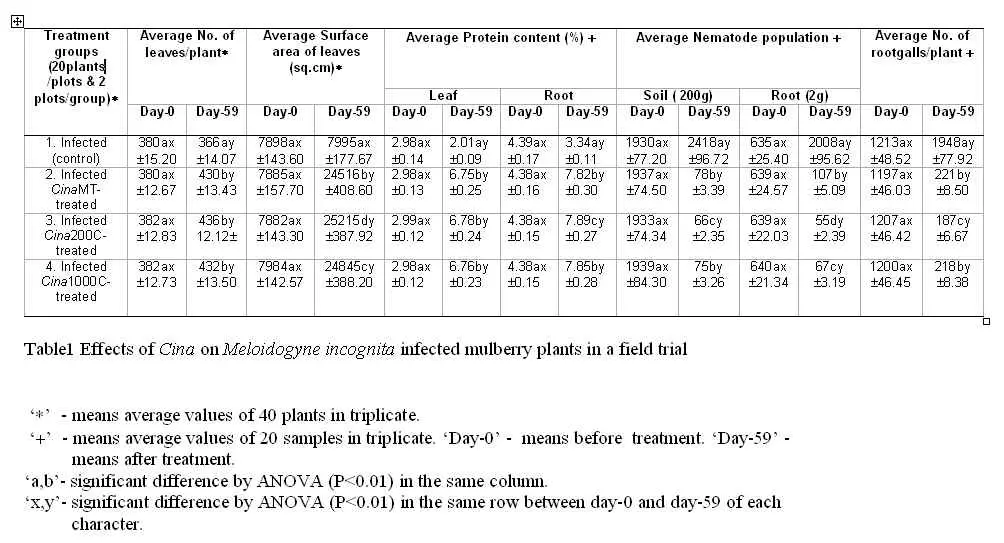
Table1 shows the effects of Cina on Meloidogyne incognita infected mulberry plants in a field trial (P<0.01 by ANOVA).
- · All infected plants treated with Cina showed increase in number and surface area of leaves and higher protein content (fresh) in leaves and root than infected untreated with Cina (control) plants.
- · In all infected Cina treated plants, the population of root-knot nematodes decreased significantly in rhizospheric soil and as well as in roots than infected untreated with Cina (control) plants.
- · The number of root galls also decreased significantly after Cina treatment.
- It is interesting that treatment effects were the most pronounced with Cina 200C.
Assesment of Rearing of silkworms
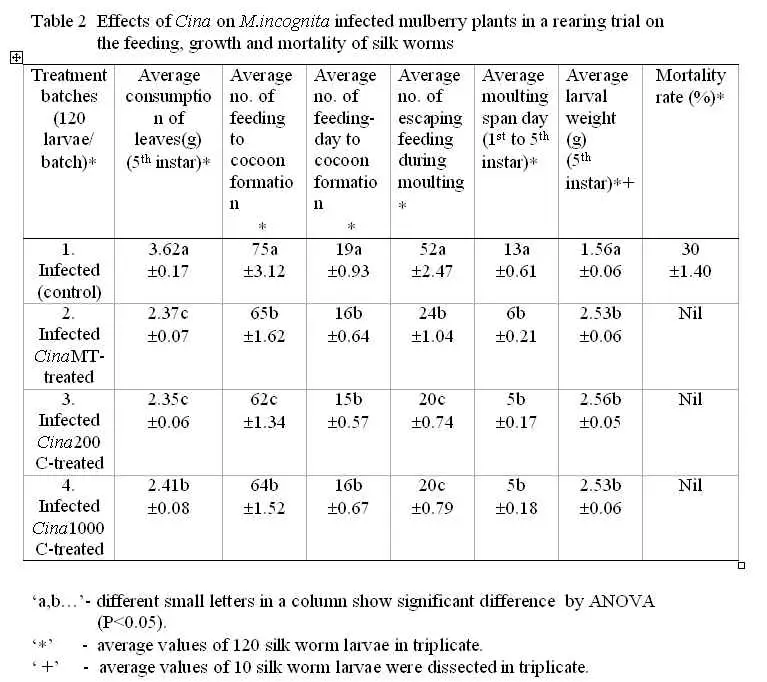
Table 2 shows the effects of Cina on the M. incognita infected mulberry plants in a rearing trial on the feeding, growth and mortality of silkworms (P<0.05 by ANOVA).
- · The average consumption of leaves by the 5th instars, average number of feeding to cocoon formation, average number of feeding day to cocoon formation, average number of escaping – feeding during moulting and average moulting span days were lesser for Cina treated plants than for the infected untreated with Cina (control) ones.
- · The average mortality rate was nil with all Cina treated plants and 30% with infected (control ) ones. However, the average fresh weight of the 5th instars larvae were higher with Cina treated plants than with infected untreated with Cina (control) one.
Assesment of Silk production and Effective Rate of Rearing
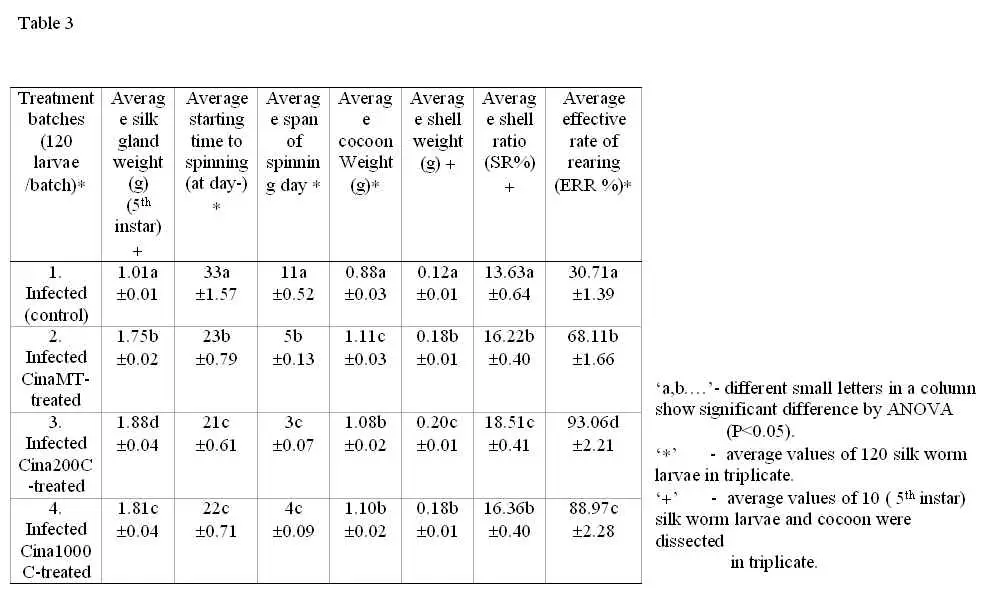
Table 3 shows the commercially increased silk production by effective treatment with Cina on the feeding of M. incognita infected mulberry leaves in a rearing trial (P<0.05 by ANOVA).
- · The average fresh silk gland weight, average fresh cocoon weight, average fresh shell weight and average shell ratio ( Shell weight / Cocoon weight X 100) were higher with Cina- treated plants than with infected untreated with Cina (control) one.
· It is interesting that the shell ratios were higher in the plants treated with Cina than with the infected untreated (control) ones.
- · It is also notable that average starting time to spinning day and average span of spinning day ( i.e. duration of span ) were fewer with the Cina treated plants than with infected untreated with Cina ( control ) ones.
- · Average effective rate of rearing (ERR%) were higher in all Cina treated groups.
- Once again the homeopathic drug Cina is confirmed as cost effective and capable of reducing root-knot disease as well as improving the nutritive value of the treated leaves of infected plants7,9,11,12,14.
- · From this field trial, we once again confirm that Cina also improves the nutritive value of the treated leaves7,11,12,14,15 which directly influences the consumption of leaves, number of feedings and number of feeding days to cocoon formation, and indirectly affects the moulting stage in all the Cina treated groups from these trials.
- · Due to ill development of infected untreated (control) batches, larvae took more time to moult, which is demonstrated by the number escaping feeding during moulting7,11,12,14,15.
- · Higher nutritive value of treated plants contributes to higher growth of silkworm larvae, silk gland weight, cocoon weight and shell weight, which increase silk production significantly7,11,12,14,15 for commercial purposes.
- · The improved health of the larvae, cocoon weight, silk gland and shell weight from the Cina treated groups of the infected plants might have resulted in the shorter starting time to spinning , the span of spinning and the total elimination of the mortality rate22,23,25. Cina is too dilute to contain drug molecules7,11,12,15,22. Naturally, the drug might not have affected the nematode directly7,11,12,14,15 and for this reason, no mortality occurs.
- · The effective rate of rearing (ERR% ) is very high in all Cina treated treatment batches, which enriches the sericulture industry in many ways, especially for commercial purposes.
- · The mulberry leaves did not contain any toxic residues of the Cina test substances as determined by the thin layer chromatography (TLC). It is reported that Cina at ultra high dilution has physical basis in the form of charge transfer interaction and altered rate of tumbling in the specific part of the molecules of the diluents medium14,115,22.
- · Rather, the drug Cina might have induced natural a defense response against nematode parasites in the test plants, and has conferred a defense response on the growing larvae4-12,14,27,28.
- · It is surprising that all infected Cina treated plants not only are less affected by nematodes, but also have better growth than the infected untreated with Cina (control) plants7,11,12,14,15.
- · From these results, one might assume that Cina acts as a fertilizer. Our explanations are that we used Cina as a foliar spray and it is already been observed from our previous experiment that the Cina treatment effects on healthy plants in order to confirm the positive effect on growth than healthy and infected untreated with Cina (control) groups7,11,12,14,15 .
- · The positive effects of growth may be responsible for defense resistance against pathogens7,11,12,14,15,27,28. We can say that Cina might have induced synthesis of many new proteins which have stimulated increased photosynthesis rate, stomatal activity7,11,12,14,15,27,28 and water retention capacity of Cina treated plants4,6,7.
- · The positive effects of growth on infected Cina treated plants may not only be responsible for defense resistance to the nematodes pathogen, but may also improve growth of silkworm larvae and silk gland weight, cocoon weight, shell weight and effective rate of rearing (ERR%)25 which increase silk production for commercial purposes. It is proven from the result that silk production is higher in all the Cina treated groups than in the infected untreated with Cina (control) groups.
Conclusion
These results once again suggest that certain plant diseases might be effectively controlled by the potentized cost effective homeopathic medicine Cina, at an extremely low dose, and that Cina also increases silk production and effective rate of rearing commercially which directly enriches the sericulture industry as well as the agriculture sector. Cina is easily available, is non-phytotoxic, a non-pollutant and helps conserve biodiversity.
Acknowledgements
The work described here has been supported by Rtd. Prof. N.C.Sukul, Dept. of Zoology, Visva-Bharati and Joint Director, Sriniketan Sericultural Composite Unit, Sriniketan, Govt. of West Bengal and Mr. Achintya Mondal, Secretary, BIMS, BMS&BIMLS,West Bengal,India. Lastly, for help in statistical analysis we are immensely indebted to Dr. Tapan Mondal, Asst. teacher of Secondary School. Sri Basudev Mondal, Assistant English-Teacher of Kanchannagar D.N.Das High School, Kanchannagar, Burdwan, who has revised the English of the manuscripts.
References
1 Sasser JN, Freckman DW. Crop protection: systemic and persistent effect of neem. Pro.of 25th Ann Meet Soc Nemat (abst), Orlando, Florida 1986; 32.
2 Datta SC. Possible use of amaranth as catch crop for root-knot nematodes intercropped with mulberry. J Environ & Sociobiol 2005b;2(2&3):61-65.
3 Datta SC. Possible use of amaranth as catch crop for root-knot nematodes intercropped with okra. Phytomorphology 2006b; 56(3&4): 113-116.
4 Datta SC. Mulberry disease : a problem in sericulture. SEBA NEWSLETTER 2007; 4(1): 7-10.
5 Datta SC, Datta (Nag) R. Intercropping amaranth with mulberry for managing root-knot nematodes and improving sericulture. Sericologia 2007a; 47(3): 297-302 .
6 Datta SC, Datta (Nag) R. Increased silk production by effective treatment of naturally infected root-knot and black leaf spot diseases of mulberry with acaciasides. J Environ & Sociobiol 2007b; 4(2): 209-214.
7 Datta SC, Datta R. Potentized Artemisia nilagirica extract Cina) increases silk production and effective rate of rearing in a field trial. Hpathy Ezine, at July, 2008.
8 Paul A, Sinhababu SP, Sukul NC. Effect of Meloidogyne incognita infected mulberry plants and their treatment with nematicides of feeding silkworms, Bombyx mori L. Sericologia 1995; 35:577-581.
9 Datta SC. Plant parasitic nematodes- an agricultural problem and its solution. The Visva-Bharati Quartery 2005a; 11 (3&4): 89-100.
10 Datta SC, Sinhababu SP, Sukul NC. Improved growth of silk worms from effective treatment of mulberry diseases by Acacia auriculiformis extract. Sericologia 1997; 37(4): 707-712.
11 Datta SC, Datta (Nag) R. Liquid homeopathic medicine Cina enriches sericulture industry. J Environ & Sociobiol 2006a; 3(1): 55-60.
12 Sukul NC, Ghosh S, Sukul A, Sinhababu SP. Amelioration of root-knot disease of lady’s finger plants by potentized Cina and antonin. Homeopathy 2006; 95: 144-147.
13 Halfter G. Biodiversity conservation and protected areas in tropical countries. In Biodiver Sci and Dev Towards a New partnership (eds) Dicastri F and Younis T USA: AB Inter in associated with IUBS 1996 pp.212-223.
14 Datta SC. Effects of Cina on root-knot disease of mulberry. Homeopathy 2006a; 95(2):98:102.
15 Sukul NC, Sinhababu SP, Datta SC, Nandi B, Sukul A. Nematotoxic effect of Acacia auriculiformis and Artemisia nilagirica against root-knot nematodes. Allelopath J 2001; 8:65-72.
16 Christie JR, Perry VG. Removing nematodes from soil. Proc Helm Soc Wash 1951; 18:106-108.
17 Sukul NC. Soil and plant nematodes. West Bengal State Book Board Publisher 1987, pp1-271.
18 Das S, Sukul NC. Biochemical changes of some crop plants due to root-knot nematode infection. Proc Nat Symp of New Dimension in Parasitology, Allahabad, India 1986.
19 Lowry OH, Rossebrough NJ, Farr AR, Randall RJ, Protein measurement with the Folin-phenol reagent. J Biol Chem 1951; 193: 265-275.
20 Chatterjee A, Sukul NC. Total protein of galled roots as an index of root-knot nematode infestation of lady’s finger plants. Phytopathol 1981; 31:372-374.
21 Anonymous. The American Homeopathic Pharmacopoeia. 9th edn, Philadelphia, USA: Boericke and Tafel 1920.
22 Sukul NC. High Dilution pharmacology and Homeopathy 1997.
23 Fenner LM. Determination of nematode mortality. Plant Dis Rep 1962;46:383.
24 Consden R, Gordon AH, Martin AJP. J Biol Chem 1944; 38:224.
25 Krishnaswamy S, Narasimhanna MN, Suryanarayana SK, kumararaj S. Manual of sericulture, vol 2 silkworm rearing. Agri Services Bull 15, FAO, Rome 1972.
26 Duncan DB. Multiple range and multiple F tests. Biometrics 1955; 11:1-42.
27 Klessig, Daniel F, Malamy J. The salicylic acid signal in plants. Plant Mol Biol 1994; 26:1439-1458.
28 Datta SC, Datta (Nag) R. Defence resistance of okra against root-knot disease by bio-nematicides. Proc Zool Soc, Kolkata, India 2006b; 59(2):
75-82.
Table Legends
Table1 Effects of Cina on Meloidogyne incognita infected mulberry plants in a field trial
- · Details of Publications of Subhas Chandra Datta :
1.” Improved growth of silk worms from effective treatment of mulberry diseases by Acacia auriculiformis extract” by Subhas Chandra Datta, Santi Prasad Sinhababu & Nirmal Chandra Sukul in 1997- Sericologia 37 (4): 707-712.
2.”Acaciasides and root-knot nematode extract suppress in tomato” by Subhas Chandra Datta, S.P.Sinhababu, N. Banerjee, K.Ghosh and N.C. Sukul in 1998- Indian J. Nematol. 28 (i): 1-5.
3.” Meloidogyne incognita extract reduces Meloidogyne incognita infection in lady’s finger plants” by Subhas Chandra Datta, R. Datta (Nag) S.P. Sinhababu & N.C.Sukul in 1998- Proceedings of the National Seminar on Environmental Biology, Edited by A.K. Aditya & P. Haldar, Visva-Bharati University, Daya Publishing House, Delhi: 205-209.
4.”Relative Attractiveness of Four Species of Vegetable Crops for Meloidogyne incognita” by Subhas Chandra Datta, Rupa Datta (Nag),Anirban Sukul, Nirmal C. Sukul and Santi Prasad Sinhababu in 2000- Environment & Ecology 18 (1): 233-235.
5.” Nematotoxic effect of Acacia auriculiformis and Artemisia nilagirica against root-knot nematodes” by N. C. Sukul, S. P. Sinhababu, Subhas Chandra Datta, B.Nandi and A.Sukul in 2001. Allelopathy Journal 8(1): 65-72.
6.”Plant Parasitic nematodes – an agricultural problem and its solutions” by Subhas Chandra Datta in2005a. Visva-Bharati Quarterly, 11 (3&4), 89-100.
7.”Possible use of amaranth as catch crop for root-knot nematodes intercropped with mulberry” by Subhas Chandra Datta in 2005b. J. Environ. & Sociobiol., 2 (1&2): 61-65.
8.”Effects of Cina on root-knot disease of mulberry” by Subhas Chandra Datta in 2006a. Homeopathy, 95 (2): 98-102.
9.”Possible use of amaranth as catch crop for root-knot nematodes intercropped with okra” by Subhas Chandra Datta in 2006b, Phytomorphlogy, 56 (3&4): 113-116.
10. “Liquid homeopathic medicine Cina enriches sericulture industry” by Subhas Chandra Datta and Rupa Datta(Nag) in 2006a, J. Environ.& Sociobiol., 3 (1): 55-60.
11. “Defence resistance of okra against root-knot disease by bio-nematicides” by Subhas Chandra Datta and Rupa Datta(Nag) in 2006b, Proceedings of the Zoological Society, 59 (2) : 75-82.
12.”Mulberry disease : A problem in sericulture” by Subhas Chandra Datta in 2007. SEBA Newsletter, Environment & Sociobiology,4 (1):7-10.
13.”Intercropping amaranth with mulberry for managing root-knot nematodes and improving sericulture” by Subhas Chandra Datta and Rupa Datta(Nag) in 2007a. Sericologia, 47(3):1-6.
14.”Increased silk production by effective treatment of naturally infected root-knot and black leaf spot diseases of mulberry with acaciasides” by Subhas Chandra Datta and Rupa Datta(Nag) in2007b. J Environ & Sociobiol., 4(2):209-216.
15.”Analyzing ‘Teaching Quality’ of a teacher in a school” by Subhas Chandra Datta in 2007. Parsadbarta, West Bengal Board of Secondary Education, 34: 16-20.
16.”Potentized Artemisia nilagirica Extract (Cina) Increases Silk Production and Effective Rate of Rearing in a Field Trial” by Subhas Chandra Datta and Rupa Datta in 2008. Hpathy Ezine, at http://www.rediffmail.com/cgi-bin/red.cgi?red=www%2Ehpathy%2Ecom) July, 2008.
- · Research area and Interest:
Environmental biology, Plant protection, Plant pathology, Entomology, Sericulture, Biochemistry, Parasitology, Tissue culture, Allelopathy, Nematode control & Homeopathy.