
ABSTRACT:
Here presented is the culmination of my work to date on 500 plus
cases of an immune compromise disease currently considered
universally fatal, regardless of treatment approach. The pathological
mutant corona “FIPV” virus is a world-wide phenomenon in domestic
cats which in USA alone, kills at least 820,000 cats per year, mostly
cats under 3 yrs of age, by inducing the cat’s immune system to
attack and kill the cat, using a (neutrophilic) granulomatous
inflammatory process in multiple ways.
The disease has been difficult to address by homeopathy because:
* the symptoms are extremely variable according to what organ systems
are attacked,
* the cause (and thus maintaining cause) of the disease is little
understood by vets or homeopaths, leading to incorrect remedy
selections,
* it is generally diagnosed only when terminal with a very weak life
force, making it hard to meet the need for high potency to overcome
strong disease quickly without aggravation
and because
* the speed of death from this disease can be mere days from
diagnosis, leaving no time to obtain a selected remedy much less
ensure it is the correct one.
It is a daunting combination. Some new approaches are
presented here which have proven more effective against the various
forms of FIPV disease, and which help to overcome these difficulties.
A system of classical remedy selection with supporting nursing, new
procedures, techniques and illness-specific nutrition is presented,
which has made a dent in the problem over the many cases seen. It has
also led to new rubrics and the combined approach is one I recommend
here for other homeopaths to use against FIP.
This article addresses WHY FIP is difficult for a homeopath to
address, and how to overcome that challenge. It includes examples
using the new Fibonacci potencies, an approach to correct remedy
selection for FIP disease presentations and suggested new rubrics
useful in FIP. It is hoped that this will help more homeopaths to
help the huge numbers of affected cats who otherwise die. This is an
illness in which only homeopathy is known to have succeeded to date.
Variability and changeability of symptoms in FIP:
Symptoms vary so much that even the veterinary profession divides the disease into several separate forms. It helps to know what is behind each form inducing symptoms:
* “Effusive” abdominal FIP presents with blood plasma leaked into the abdominal cavity from compromised blood vessels due to granulomatous inflammation. This puts direct pressure on the kidneys, bladder and digestive system by the sheer volume of fast-accumulating effusion fluid. The cat is starving from loss of blood plasma carrying nutrients and has difficulty digesting food or performing any body functions needing blood. Vital fluid loss and emaciation are key here and in the next two forms.
* “Effusive” Thoracic FIP – Blood plasma leaks into the thoracic cavity. The pressure at the ribcage and diaphragm prevents expansion to accommodate the increasing leaked plasma, resulting in pressure on the heart and lungs, and the cat has difficulty breathing. Starvation is also evident from loss of blood plasma.
* “Effusive” combination FIP has the same sticky, clear yellow effusions fluid of leaked plasma, but into both upper and lower body cavities.
* “Dry” FIP has a blood profile similar to the above forms of “wet” FIP. However the presence of granulomatous inflammation affects other tissues besides than blood vessels, eg. making granulomas within gut walls or in the lung walls or in focal points in the liver or kidneys or eyes or anywhere else and in any combination. Presenting symptoms, apart from emaciation, are in accordance with what granulomas are forming and where. For example, lung granulomas make the lungs too stiff to move in and out and the cat struggles to breathe. Intestinal granulomas which can be the entire length of the intestines, are inoperable and prevent food digestion. Eye lesions cause blindness, and so on. Granuloma-related rubrics are not readily available in current repertories for internal granulomatous inflammation, focal granulomas or massive granulomas. Most dry FIP also has, or leads to, non-regenerative anemia and jaundice. Uveitis and granulomatous eye inflammation are common. It helps to check for them regularly and plan a remedy in advance to have it on hand – as these symptoms can become life threatening overnight in the cat.
* “Neurological” FIP involves granulomatous inflammation of the nerves. This can attack the nerves anywhere, causing paralysis or seizures and symptoms are in accordance with which nerves are being affected. For example, limbs paralysed or seizing, eye pendulum seizures, head seizures becoming body seizures, or all limbs paralysed with seizures elsewhere – and various combinations – and these can become so severe as to cause grand mal seizures lasting several minutes, many times per day, with death after continuous seizure.
* Combination FIP. Cats or kittens may have all three forms of FIP, though usually one predominates at a time. Changes are fast and may be frequent. The homeopath needs to be ready to respond to wet FIP changing to dry FIP then to neurological FIP then back to dry FIP, all in less than a week, each with different complications.
What needs to be realized by the homeopath, is that the presenting symptoms are less relevant than the cause of the presenting symptoms. For example, in dry FIP it is less relevant that there is abdominal or lung tumor, than that it is a granulomatous tumor involving neutrophil granulomas. (Neutrophil granulomas start with a different immune system defect than eosinophilic granulomas, and seem to need different remedies.) So an eosinopilic granuloma rubric is not useful here. It helps to remember that these FIP granulomas are like scabs. They are layers of scab tissue in the wrong places.
Examples may illustrate:
A typical kitten with effusive abdominal FIP (which is the most common form in kittens) looks like this: (This is Stacey’s “Annie”, from Portland OR, with permission)
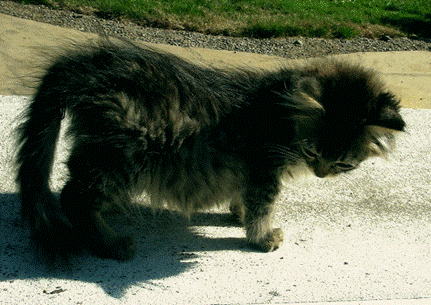
Her little abdomen is full of leaked vital fluid from blood vessels, her back is “swayback” from the load, and if felt, sticks up proud of the muscle that should surround it but is missing. Her whole demeanor is nowhere near that of a healthy playful kitten. Cats with FIP also tend to scrunch their eyes thus: (Annie again):
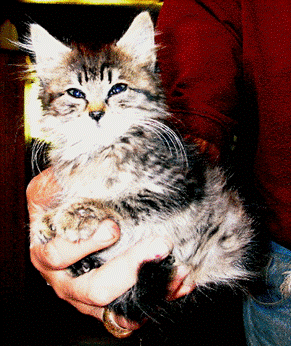
There is nothing in any of the typical symptomology to tell the homeopath that the bloated abdomen, hot with fever is not “hot swelling” but is filled with “vital fluid” causing emaciation despite potentially ravenous appetite, and that the fever is remittent in type, only present when the virus is replicating. One needs to know enough about the pathology to use those facts in repertorizing, and thus arrive at the correct group of possible remedies. (Till now, this form of FIP has led most homeopaths to remedies like Apis and the case is then lost.) A correct typical rubrics list will lead to Wet FIP remedies like Cinchona officianalis, Lycopodium clavatum, Baryta carbonica, Sulphur and others, using key issues causing the symptoms and then differentiated mainly on the MIND symptoms and modalities, especially time of day and issues related to emaciation.
It does not help to look for the cat’s innate constitutional type, to select a remedy against this illness. The cat’s constitutional remedy can be useful as a supporting remedy option, as an intercurrent remedy but not as the main simillimum to overcome the FIP disease. FIP does not integrate with the constitution as it is an immune compromise illness. The disease energy of FIP goes off on its own as a “one-sided disease” and needs a disease remedy separate from the remedy that matches the cat’s constitutional type.
For this reason constitutional aspects need to be excluded from the remedy selection symptoms except where there is a variation from what is normal for the cat. That variation needs to be included. For example, if a normally friendly cat is hiding somewhere – that is relevant.
Problematic vs good veterinary involvement:
One cannot not always rely on the vet’s assessment of the cat with FIP. This disease has been misunderstood since its discovery in the 1960s and vets tend to know what they learned in vet school. Granulomas are typically mistaken for cancer, and abdominal effusion of blood plasma is often treated as a worm infestation. Early FIP is assumed to be a cold or flu even though the high fever (104-105F) is not normal for that. Even when FIP is eventually diagnosed, the most common response is to recommend euthanasia and/or to inject antibiotics and steroids with more to be given at home. These approaches are adverse to survival. Prednisone is almost a death sentence to the FIP cat. They rarely survive due to the speed of the disease once diagnosed. The few that do, need Thymus 6C, pantothenic acid, Vit B6, Ascorbic acid and Moducare to undo the steroid damage, along with homeopathy that initially addresses the drug damage as part of the disease picture, then adapts to the changing disease picture.
Where vets are invaluable, is in buying time to help a cat by homeopathy, such as with Subcutaneous fluids, and with draining of the effusion fluid as needed – usually once, sometimes twice during an effusive FIP case. The results of blood tests are also very helpful. For example if the neutrophil (Segs) count is high and/or Doehle bodies are present in them, the homeopath can know that granuloma activity is underway, even if it is not palpable as a granuloma. If BUN (blood urea nitrogen) and CK (creatinine kinase) are both low, you know the cat is about to become emaciated if it is not already. If potassium is low, the food can be mixed with pedialyte and Subcutaneous fluid can be given daily to ensure hydration. If Red blood cell shape variation is too high, one can assume anemia from toxic food such as garlic, alfalfa or yucca – and be sure to correct that before the typical FIP anemia makes it even harder to breathe. In other words the blood tests can speak for the cat, to tell the homeopath what actions to take for support and also what symptoms to include in repertorizing.
All these clues are added to understanding of the pathology and to know why a symptom exists, so as to select a suitable rubric to cover it. If the cat is having breathing difficulty, it matters whether that is due to fluid pressure of leaked blood plasma in the thoracic cavity – or whether it is due to lung granuloma physically preventing the lungs from flexing, as they must to inhale and exhale. Since the cat cannot describe it to you, the pathology tells you instead. If the homeopath bears in mind what the symptoms are and what causes them, then it is easier to find the right remedy.
Strong disease suppresses weak disease:
The laws of homeopathy show themselves well in this disease. One often sees the situation where a stronger disease (FIP) suppresses a lesser disease, and where once the FIP is overcome, the lesser disease emerges and needs to be handled as well. This is quite common in FIP, as the causes of FIP include stress and other diseases are perceived by the cat’s system as stresses to the system.
Example : (Annie again):
Annie had a history of what her owner called upper respiratory infection (URI or Cat flu which is very common in kittens) prior to getting FIP. Her particular case of FIP responded to the main remedy Sulphur, with an intercurrent dose of Lycopodium clavatum, Lycopodium being her Innate Constitutional Type (ICT), and a good support for her liver and digestion which were compromised. Annie made good progress and within 2 weeks was playing again like a kitten and I thought her on the mend. That was true for the FIP only, the abdominal effusive FIP was gone. The next day however, the owner contacted me as she had wondered if Annie would make it through the night and had been up with her using a Ferrum Phosphoricum protocol (See protocols at end) to help oxygenate till I could be reached. (I work by email).
Annie’s type of “hairball-looking cough” was an immediate flag to indicate she had Bordetella bronchiseptica (B.B.) and on further questioning the client, it turned out that was indeed her prior illness, rather than ordinary cat flu before FIP struck. B.B. was emerging now that the FIP was beaten, having been suppressed during the FIP.
B.B. is a silent pneumonia in cats which is considered universally fatal in kittens under 6 months, though it does respond to homeopathy. So when FIP was overcome and BB emerged from its suppressed state, Annie was treated for Bordetella bronchiseptica and was fine within a week. Here is a picture of her several months later, showing no signs of her ordeal:
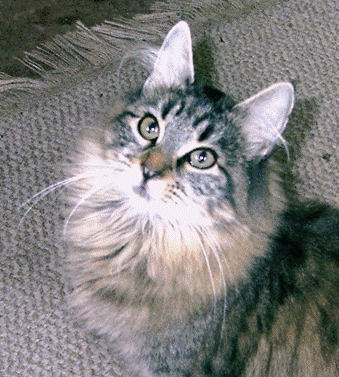
It is suggested that case history make use of careful questioning concerning prior illnesses, so that the homeopath can be ready for any overnight emergence of a potentially serious illness once the FIP is overcome, and also ensure remedy availability as that can be critical to survival.
C potencies versus fibonacci series potencies:
Most of my cases of FIP at about 2 per week since 2003, were managed using C potencies, until the Fibonacci series (“F” series) of potencies was developed and presented in Hpathy newsletters by Dr Joseph Rozencwajg. (Hpathy newsletter October 2008 & September 2009). This year I changed exclusively to using “F” series starting with 8C and working up as needed through the series, 13C, 21C, 34C, 55C, 89C, 144C. These are made from a 6C by the client, as there is no time to buy ready-made F series potencies for FIP (FIP kills in days). Even after a minimum of cases, it is clear that this is a huge advantage in timing and depth of action over the prior use of C potencies. (I did try LMs at one point and they did nothing good in FIP.) I’ll illustrate with two cases:
The first used regular C potencies and was a simple case, the kind one can win on regular C potencies. If there are complications, regular potencies might handle one, seldom two, otherwise the disease outruns the homeopathy and the case is lost. It is a good example of the most typical case seen, wet FIP, matching Cinchona officianalis.
The second case used F series potencies and the cat responded in about half the time. The remedy also covered a long list of complications without losing the case. This is a good example of the other extreme, and how to respond quickly to complications and the remedy changes needed.
Relatively “straight-forward” wet FIP case using c potencies:
Jesse’s Mantis was diagnosed in early 2003 with wet FIP when I first started working with this illness, and as a hairless cat, he shows clearly what wet FIP looks like in his “Before and After” pictures. [He has remained healthy since then.]
His photos happen to be dated and show how long the effusion fluid took to be remedied using ordinary C potencies of Cinchona officianalis, starting at 30C and working through 200C and 1M. Note also the prominent backbone and hip bones, the eye expression in the “before” picture and that he has to be carried, since he is too weak to stand.
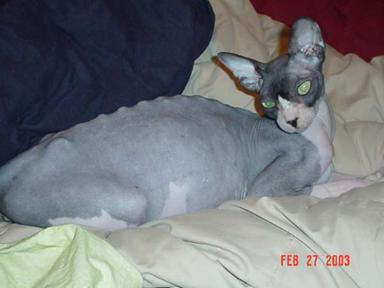
After three and a half weeks of very intensive nursing, Mantis, (below) looks a picture of health again. Note the backbone area muscle is back where it belongs in the after picture, and there is a healthy alert expression in the eyes.
Because Mantis regenerated muscle before losing all the effusion fluid, I knew he would soon be fine, and indeed in 3 weeks, he was healed, no more fluid. He had abdominal effusive FIP, and it came right, and that was it. No complications, though the nursing care needed was extremely intensive for three weeks which is normal in any FIP case (this needs to be stressed to the client).
Cats who lose the effusion fluid but do not regenerate the lost muscle, are metamorphosing to another form of FIP, they are not on the mend yet. This is useful for homeopaths to know, so they can start looking for symptoms of one of the other forms of FIP and start planning a remedy accordingly. The next case will illustrate that.
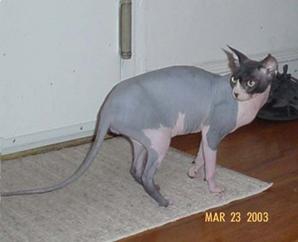
To my knowledge, Mantis is the longest known survivor of FIP to date. He has been healthy since homeopathy restored his health as pictured above.
Metamorphosing between forms of FIP is common in FIP cases, and it makes the cases a lot more challenging for owner and homeopath. Very fast response is needed to changing symptoms, as they change drastically and in a life threatening or very unpleasant way, such as sudden non-regenerative anemia accompanied by jaundice, vomiting and inability to digest food as happened in this case:
Very complex case of wet-then-dry FIP with several complications, using fibonacci series of potencies:
Debra’s Newton is the first case of FIP handled using F series potencies. It turned out to be an exceedingly complex case, and it was a most pleasant surprise as a survivor case. It was a wild and terrifying roller coaster ride and is quite a testament to the efficacy of the F series of potencies.
Debra Lamana’s Newton, 3 yrs old, healthy, in Jan 2009:
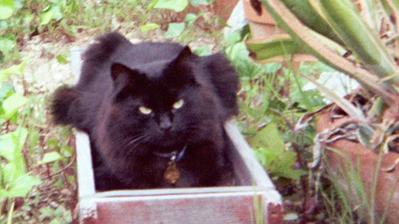
Newton was the third cat of the household to get FIP, the others having died, and Newton came my way with the owner looking for a compassionate alternative to lethal injection euthanasia.
Early FIP symptoms:
Three year old Newton was seen by the vet 24 April 2009 for decreased appetite and fever. Blood tests were done including “FIP antibody” which was negative. The problem for homeopaths:
FIP typically starts with a fever and inappetance, and several typical blood work signs, all of which were present for Newton in April in his lab tests. The homeopath should be familiar with these early symptoms, the blood values and their significance in FIP so as to get started before the terminal diagnosis is made some months later. In April, Newton’s FIP was not recognized as such, a sadly typical situation. A collection of early FIP features can be hard to find. Newton’s is typical, in owner wording:
“Inappetance and weight loss started even before the April vet visit for the
first negative FIP PCR. Newton would slow down on his eating and go through
several days of lethargy- sleeping what seemed like round the clock for
several days. Mood changed to seeming depressed. Yet he would seek me out
for lots of affection/attention. Wanted lots of reassurance. Then he would
perk up-sometimes without meds for several weeks and the cycle would start
again. I did not want to keep putting him on antibiotics so I would wait it
out with him for several days, to see if he would resume eating on his own
and most times he would.” ” With April 2009 symptoms of inappetance and lethargy, also Fever of 102-103.
Newton has always been a picky eater but he would slow down to not eating
for several days which led me to take him to the vet.” Baytril injection for fever 4-28-09 (Newton is allergic to Clavamox /vomits almost immediately) “He was given Baytril 22.7 mg tabs x 1 week for suspected infection causing fever. Abdominal X-ray taken to rule out ingestion of object causing inappetance. No blockage detected.”
Using this early history would give the homeopath an extra 2 months to work with. Instead the vet visit two months later had this result:
“7-06-09 Vet visit for inappetance, abdominal fluid build-up (just starting
to show), lethargy – sleeping round the clock for 3 days. FIP PCR and
Abdominal Centesis test positive for FIP. Vet insists on euthanasia next
day. ”
TYPICAL EARLY FIP LAB WORK:
An in house FIP test done that same day (Apr 24, 2009) and came back negative for FIP.However all the FIP signs are indeed there:
Custom Profile Results Ref Range
Alk Phosphatase 18 0-62 u/l
ALT (sgpt) 45 28-100 u/l
AST (SGOT) 19 5-55 u/l
CK 36 ** (Low) 64-440 u/l
GGT 2 0-6 u/l
AMYLASE 1147 520-2060 U/L
LIPASE 73 10-195 U/L
ALBUMIN 2.8 2.3 – 3.9 G/DL
TOTAL PROTEIN 8.9 (High) 5.9-8.5 g/dl
GLOBULIN 6.1 (HIGH) 3.0-5.6 G/DL
TOTAL BILIRUBIN 0.1 0.0-0.4
DIRECT BILIRUBIN 0.1 0.0-0.2
BUN 13 (low) 15-34
CREATININE 1.2 0.8 -2.3
CHOLESTEROL 84 82-218
GLUCOSE 142 (*) 70-150
CALCIUM 8.8 8.2 -11.8
PHOSPHORUS 4.0 3.0 – 7.0
TC02 14 13-25
CHLORIDE 120 111-125
POTASSIUM 4.0 3.9 – 5.3
SODIUM 154 147-156
A/G RATIO 0.5 0.4 – 0.8
B/C RATIO 10.8
INDIRECT BILIRUBIN 0.0 0.0 -0.3
NA/K RATIO 39
HEMOLYSIS N
LIPEMIA INDEX N
ANION GAP 24 13-27
T4 2.0 0.5 – 5.8
T3 75 52-182
All other results were “pending” on the day but later the FIP antibody was phoned as ‘negative” at that time. FELV was negative at that time. FECoV = negative.
End of results
Interpretation is important to the homeopath. FIP is a mutant form of gut corona FeCoV (Feline enteric Corona Virus), which all cats have, the test being being negative for both FeCoV and FIP was (incorrectly) used to rule out FIP here. The blood work otherwise “screams” that this is FIP in a 3 yr old cat:
* High globulin and especially with high protein as well, is very specific for FIP, either the wet, dry or neurological form.
* Also, albumin is too low for a cat fed a high protein diet. All these signs are typical in FIP.
Putting these with the very low CK and BUN values:
* A very low CK (or CRK) for creatinine kinase occurs when there is no muscle activity to speak of because the muscle is wasted/wasting. In a cat with FIP, the cat has to burn its muscles for energy because the blood protein is all leaked out and no longer available. Whether the protein (blood plasma) is excreted (dry FIP) or accumulated in a body cavity (wet FIP) it is gone. Only muscle is there for protein fuel, the food cannot be utilized. So this is behind the low CK in FIP.
* A low BUN (blood urea nitrogen) compared to normal or low compared to how that cat’s normal looked before, is significant. This, like the low CK, is due to muscle loss. There is no protein in the blood to speak of, to be nitrogenous leftovers (the N in BUN is for nitrogen from protein metabolism) to be handled by kidneys. The blood is low/devoid of needed protein food as it all leaked out of the blood vessels due to FIP. Again this is not normal in young cats and is indicative of FIP. Add in that Newton was emaciated, had no energy, had fever that came and went, and it is hard to justify a negative FIP reading. The “antibody FIP tests” used are useless as they look for corona virus of any kind, not for FIP-sepecific corona virus.
Instead the FIP diagnosis was made 2 months later at the terminal stage, at which point he had these additional diagnostic features:
* FIP-PCR (Polymerase Chain Reaction, a DNA test for corona virus) positive test “for FIP”.
* Effusion fluid withdrawn for diagnostics showed the typical FIP-only features of: large volume, yellow, clear, sticky, high-globulin fluid.
* Nasal granuloma was present and visible (though not recognized as such by the vet, who labelled it “some kind of lesion”).
* Muscle marasmus and general emaciation
* Hind end weakness
* Inability to digest food ( Abdominal xrays were taken-not useful).
* Dehydration (signs of which were already there in April in a relatively low potassium reading)
* High fever (FIP has recurrent fever during which the virus replicates in macrophage blood cells).
Missing Diagnostics here, which assist FIP diagnosis include:
* High Neutrophil count (aka Segs)
* Doehle bodies (basophilic granulomatous bodies) inside neutrophils on microscopy.
* Macrocytes that look “spongy”
These neutrophil and macrocyte lab results are especially relevant in FIP as the “toxic neutrophils” are the cause of the granolomatous inflammation as well as the actual granulomas. The FIP virus multiplies itself in macrocytes, making them look spongy, and then commandeers the neutrophils by preventing the controls for neutrophil numbers in the body from working.
This information can hopefully help other homeopaths to see an FIP problem without needing a vet’s diagnosis, so as to get a head start on the body damage caused, reduce the pandemic number of annual deaths (820,000 per year in USA for example) to something a lot less.
Newton’s case:
After the vet advised euthanasia on the above diagnosis, his owner sought a compassionate way to ease death rather than the chemical injection route the vet offered. Instead I suggested Cinchona officianalis (China) 30C be started soon as possible on 28 July, as a first step, this potency being handy locally.
I also advised a vet be found to drain the abdomen of excess fluid, to buy time. That is amazingly hard to do as most vets want nothing to do with cats who have diagnosed (hence terminal to them) FIP and the list of excuses not to help, is very long.
After China 30C, Fibonacci series was used and progression was made to China 34C, then 55C, then 89C, and 144C.
Some first aid measures were also needed to get some aspects under fast control in this late stage case:
* Ferrum phos protocol was used for high fever.
* Combined vomiting and diarrhea was handled with Arsenicum album, and a change of food plus slippery elm syrup, and feline gut health supports (pumpkin, rice bran, bifidus, PABA).
* Foods such as baby food meat with supplements added was hand-fed every 2 hrs.
* Subcutaneous hydration daily was instituted.
* A once only Intravenous drip of Vitamin C was used.
* Moducare, 1 capsule a day supplement was added for enhancement of immune system TH-1 activity (innate immune system enhancement).
The mobile vet in the area finally agreed to the draining procedure, and drained off most of the fluid, 600 ml, but also recommended a supplement (amino-biplex), which was added to the regime. This turned out to be a disaster in the making due to feline toxins in it. Toxins speed FIP disease damage and are all too common in “feline supplements”.
It is my finding that the slightest feline toxin makes FIP so much worse, that it will often lose the case. Newton started vomiting right away and could not stop. He was vomiting at every attempt to feed or drink. The new vet gave Nux-v which made it a lot worse. I advised Bach rescue remedy followed by Phosphorus 30C vomiting protocol (reference below) which took several hours to get the situation under control, after removal of the offending supplement from the routine. I also suggested making a remedy in 30C from the offending supplement as a detox – which was done, but only one dose was used.
The cat was near terminal as a consequence of this error, and terminal management was again discussed, however the F series China saved the day.
By 6 Aug when China 89C was started, Fluid accumulation had stopped, only about 9 days after beginning the remedy. (Compare with 3 weeks in the prior case.) No case previously had overcome fluid buildup in so few days.
China 89C was dosed several times more than needed in one day due to a misunderstanding and a serious aggravation resulted with fever and fast shallow breathing. The too frequent dosing coincided with the cessation of fluid accumulation and also with the change from wet FIP to dry FIP. A sign this was due to happen was the reduction of fluid without regaining muscle first.
Homeopaths need to avoid aggravation with the new F series, especially as they work so much faster, and can very quickly reach the stage needing tapering. They aggravate very sharply if dosed too often – even if it is the same dose rate as was needed the day before. The remedy may need tapering soon after the first 2 or 3 doses. Clients also tend to dose again and again when things are going well, due mainly to the allopathic approach of doing just that – for example allopathy says “dose the antibiotic regularly, do not stop when you see improvement”. It is difficult for an owner under extreme stress to pick up a totally new concept of not dosing when the remedy is working. Yet that needs to be stressed even more with F series than regular C potencies, as they work faster than expected. (Maybe we shall get used to that!)
The aggravation was managed by using Aconitum napellus 200C and China 89C, in one drop aqueous doses, alternating every 3 hrs, My rationale was to undo the aggravation while still not losing momentum in the case. In FIP if one loses momentum one usually loses the case.
I also had not realized till days later that the FIP was changing from wet FIP to dry FIP and the entire symptom picture had changed suddenly, literally overnight. The new symptom picture looked like this :
* No more abdominal fluid
* Nose congestion, discharge and scabs …. lesion was worse (In hindsight this would have been a clue that it was changing if watched more carefully)
* Fur loss around neck (later turned out to be due to a neoprene collar – toxic)
* Fur loss on top of head (later turned out to be from flame retardant under couch – toxic)
* Orange (pale) blood in stool
* Lower limbs give way
* Nauseated all day
* Hiding under the couch
Aur Met was chosen based on:
MIND – HIDING – himself
NOSE – COMPLAINTS of nose – Internal nose
NOSE – CONGESTION
NOSE – DISCHARGE – crusts, scabs, inside
NOSE – DISCHARGE – crusts, scabs, inside – right
NOSE – DISCHARGE – crusts, scabs, inside – yellow
NOSE – INFLAMMATION – Inside
NOSE – INFLAMMATION – Tip
EXTREMITIES – GIVE WAY – Lower limbs
Newton now looked this way, no effusion fluid but skin and bones, very weak:
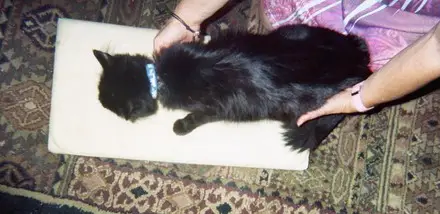
Aurum was used for a day or so while I re-analyzed the entire rapidly changing, worsening case.
Next day new symptoms added were:
* Vomiting and Diarrhea
* Pale upper palate
* Obvious distress
* Jaundice around eyes
* Yellow gums
* Blocked bladder, unable to urinate
* Crying
I recognized this as fast moving dry FIP, no more wet FIP at this point, and that the nose “lesion” was indeed a granuloma, and there would likely be others internally. This put me in awkward territory for repertorizing (too few appropriate rubrics for granulomas) and I reverted to the method of using a lot of rubrics to see if that would bring up the right remedy, as key issues did not have ideal rubrics.
Here is what I used to come up with Plumbum. I offer this long list to demonstrate a way around the lack of granuloma rubrics, and to give an example of how I arrived at suitable FIP remedies over the past years (so as to develop some FIP related rubrics based on cured cases).
The rubrics containing Plumbum are asterisked in the first set.
- MIND – DESPAIR – recovery, of – convalescence, during
- MIND – HIDING – himself
- *STOMACH – APPETITE – wanting
- STOMACH – APPETITE – wanting – accompanied by – nausea
- STOMACH – APPETITE – wanting – diseases – severe disease; after
- STOMACH – APPETITE – wanting – thirst – without
- STOMACH – IRRITATION – accompanied by – vomiting
- *STOMACH – NAUSEA – anxiety – with
- STOMACH – NAUSEA – jaundice; with
- STOMACH – VOMITING – accompanied by – Face – pale
- STOMACH – VOMITING – accompanied by – Skin; yellow discoloration of
- *STOMACH – VOMITING – afternoon – 14-15 h
- *STOMACH – VOMITING – constant
- *STOMACH – VOMITING – inclination to
- *STOMACH – VOMITING; TYPE OF – bile
- *STOMACH – VOMITING; TYPE OF – food
- *STOMACH – VOMITING; TYPE OF – gray
- *ABDOMEN – DROPSY – ascites
- *ABDOMEN – EMACIATION of muscles of abdomen
- ABDOMEN – LIVER and region of liver; complaints of – accompanied by – anemia
- RECTUM – DIARRHEA – jaundice; during
- *BLADDER – PAIN – Neck of bladder
- *BLADDER – PAIN – Neck of bladder – burning
- BLADDER – PAIN – urination – during – agg.
- *SKIN – DISCOLORATION – yellow
- *GENERALS – ANEMIA – accompanied by – emaciation
- GENERALS – ANEMIA – accompanied by – vomiting
- GENERALS – CONVALESCENCE; ailments during
- *GENERALS – EMACIATION
- GENERALS – FOOD and DRINKS – food – aversion – convalescence; during
- *GENERALS – REACTION – lack of – convalescence, in
I also looked at these separately, as I am a great believer in the notion that mind symptoms must be covered well – and indeed these also pointed to Plumbum:
- MIND – ANXIETY
- MIND – BROODING
- MIND – CONTRARY
- MIND – DELUSIONS – place – different places at a time; of being in
- MIND – EGOTISM
- MIND – FEAR – approaching; of – others; of
- MIND – FEAR – strangers, of
- MIND – OBSTINATE
- MIND – QUARRELSOME
- MIND – SENSITIVE
- MIND – SENSITIVE – touch, to
- MIND – SENTIMENTAL
- MIND – TOUCHED – aversion to be
- STOMACH – VOMITING; TYPE OF – gray
- GENERALS – LASSITUDE
Then next day I did it all from scratch and used these:
- MIND – ANGUISH
- MIND – COMPANY – aversion to – alone amel.; when
- MIND – COMPANY – desire for – evening
- MIND – COMPANY – desire for – friend, of a
- MIND – DEATH – desires
- MIND – LAMENTING
- MIND – LOOKED AT; to be – evading the look of other persons – spoken to; when
- MIND – MOOD – changeable
- MIND – MORNING
- MIND – MOROSE – morning
- MIND – OBSTINATE
- MIND – SENSITIVE – touch, to
- MIND – SHRIEKING
- MIND – SHRIEKING – rage; during
- EYE – OPEN lids – wide open
- EYE – WILD look
- RESPIRATION – ANXIOUS
- RESPIRATION – DIFFICULT – drinking – agg.
- RESPIRATION – DIFFICULT – periodical
- SKIN – TOUCH – agg.
- GENERALS – ALONE; being – amel.
- GENERALS – ANEMIA – accompanied by – emaciation
- GENERALS – ANEMIA – corpuscles; from reduced red
- GENERALS – ATROPHY – Muscles; of – progressive
- GENERALS – CHANGE – symptoms; change of
- GENERALS – CHANGE – symptoms; change of – rapid
- GENERALS – DYSTROPHY – Muscles; of
- GENERALS – EATING – after – agg.
- GENERALS – EMACIATION – progressive
- GENERALS – EMACIATION – rapid
- GENERALS – FOOD and DRINKS – food – aversion
- GENERALS – LOSS – fluids, of
- GENERALS – NIGHT
- GENERALS – PERIODICITY
- GENERALS – QUIVERING
- GENERALS – RUBBING – gently – amel.
- GENERALS – SENSITIVENESS – Body oversensitive; whole
- GENERALS – VOMITING – agg.
- GENERALS – WEAKNESS – excess, after any
I still came up Plb each time.
- MIND – ANGUISH
- MIND – COMPANY – aversion to – alone amel.; when
- MIND – COMPANY – desire for – evening
- MIND – COMPANY – desire for – friend, of a
- MIND – DEATH – desires
- MIND – LAMENTING
- MIND – LOOKED AT; to be – evading the look of other persons – spoken to; when
- MIND – MOOD – changeable
- MIND – MORNING
- MIND – MOROSE – morning
- MIND – OBSTINATE
- MIND – SENSITIVE – touch, to
- MIND – SHRIEKING
- MIND – SHRIEKING – rage; during
- EYE – OPEN lids – wide open
- EYE – WILD look
- RESPIRATION – ANXIOUS
- RESPIRATION – DIFFICULT – drinking – agg.
- RESPIRATION – DIFFICULT – periodical
- SKIN – TOUCH – agg.
- GENERALS – ALONE; being – amel.
- GENERALS – ANEMIA – accompanied by – emaciation
- GENERALS – ANEMIA – corpuscles; from reduced red
- GENERALS – ATROPHY – Muscles; of – progressive
- GENERALS – CHANGE – symptoms; change of
- GENERALS – CHANGE – symptoms; change of – rapid
- GENERALS – DYSTROPHY – Muscles; of
- GENERALS – EATING – after – agg.
- GENERALS – EMACIATION – progressive
- GENERALS – EMACIATION – rapid
- GENERALS – FOOD and DRINKS – food – aversion
- GENERALS – LOSS – fluids, of
- GENERALS – NIGHT
- GENERALS – PERIODICITY
- GENERALS – QUIVERING
- GENERALS – RUBBING – gently – amel.
- GENERALS – SENSITIVENESS – Body oversensitive; whole
- GENERALS – VOMITING – agg.
- GENERALS – WEAKNESS – excess, after any
I stressed the remedy was only to be given if Newton wanted it, as I wished to avoid further aggravations. I have no clue how cats know this, but somehow cats do know what a remedy is about, and refuse remedies that will aggravate or which are not right for them. It is very important to use this feature of feline dosing, and not to force a remedy on a cat.
17 Aug: This time we used Plumbum 6C to make 8C, and used the Fibonacci series from 8C.
[Please see the papers by Dr Rozencwaj referenced above for details on the use of this potency series.]
Other emergency procedures were used:
* Cantharis 30C to overcome urinary blockage from struvite crystals, every 15 min. as needed – which was for an hour, then a break, then again for several doses.
* A blue light was used to help with the bilirubin build-up from jaundice. I had no idea if this would work on a black cat even though his skin is white. The cat liked it and moved to get the light where he wanted it. He used it for a couple of days then refused it when he was much improved. Typically it caused some short-term diarrhea as the bilirubin was eliminated.
* Pet-tinic supplement for anemia finally arrived and was added.
* Lycopodium clavatum 30C was used intercurrently as a back-up to the Plumbum initially, until we saw the Plumbum was really working well as the main remedy.
* High volume Subcutaneous hydration was used to help flush the bilirubin.
* Assisted feeding (with a child’s medicine dropper) was slowed to the very small amount – even drops – that the cat could manage while so jaundiced. However it was brought under control before further complications such as seizures could start. (Seizures are relatively common in FIP cases.)
Only Two days later (Aug 19) the owner wrote:
“For the first time in days, Newton ate quarter-size bits of fresh deli turkey with gusto! I was so happy I was dancing around the living room! He also took a few licks of chicken baby food.
First normal stool in pm.
Lying in sun for fun”
……….
It is with sheer delight that I give you more good news: guess who has been eating fresh turkey all day like he is trying to make up for lost time? And, guess who tried to sneak out of the house this afternoon? (I am not letting him outside quite yet.)
Oh, I am elated!
Two more days and the yellow eyes were much less yellow.
By 26 Aug, he was using Plumbum 21C, only needing 1/2 ml a day, and doing well.
All seemed fine till the California brush fires started next day and smoke inhalation from toxins in burning houses created a new complication. It was managed with Smoke 8C made from a jar of captured smoke, plus Aconitum napellus 200C.
The next complication was the discovery that the neoprene collar is toxic, and could explain the hair loss around the collar area. Chloroprene (in neoprene) is an irritant to the respiratory tract and is a nervous system depressant. Workers exposed to it experience liver and kidney damage and hair loss. [All credit to the cat’s owner for the detective work here.] She also found that there was flame retardant under the couch where Newton liked to hide. It is very toxic to cats as well, and also could explain the hair loss Newton now had on his head. By California law, furniture, bedding and other manufacturers use a flammable retardant product called PBDE, Polybrominated diphenylethers. Details can be seen at these two links:
Adding these toxic components was yet a second set of fires with toxic smoke and the three toxic aspects combined were preventing healing and needed a new remedy.
Aug 30, Sepia was started using F series, for the toxicity issues.
- MIND – AILMENTS FROM – grief
- MIND – EATING – refuses to eat
- MIND – SENSITIVE – drugs; from
- HEAD – HAIR – baldness – patches
- NOSE – COMPLAINTS of nose
- NOSE – ODORS; imaginary and real
- NOSE – SMELL – complaints of
- MOUTH – PAIN – burnt; as if
- MOUTH – SWALLOWING – food – agg.
- THROAT – CHOKING – smoking agg.
- THROAT – INFLAMMATION
- THROAT – PAIN – burning
- STOMACH – APPETITE – wanting – smoking agg.
- GENERALS – ALLERGIC constitution – petrochemical fumes; to
- GENERALS – SMOKE – inspiration of – agg.
By 3 Sept Newton was playing, eating and definitely on the mend, toxins overcome, and fur growing back where he had been bald.
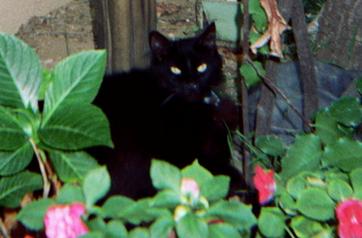
Main remedy Plumbum 34C was tapered off. He had a 1 drop dose on 8 Sep and another (last) drop on 13 Sepia His muscle has all returned, his granulomas are gone, fluid effusion is gone, and he is well. Here’s a photo of Newton back to health:
New rubrics:
This article presents only a few examples of how I approach remedy selection in FIP. I presented cases which required the most frequently used remedies – China for wet FIP and Plumbum for dry FIP. However this is not a suggestion to use these two remedies for all cases. Just the contrary. FIP cases are extremely varied and individual and need very well matched remedies. The existing granuloma rubric/s (eg in Reference Works or Radar) have remedies which have not been useful. For example even though Silica looks good on paper, it has not done anything for any FIP cat yet.
I have been doing this – working with FIP – for 7 years with some 50% success over 500 cases, and as a result of these I’d like to suggest some new rubrics that may be useful in FIP.
SUGGESTED FIP RUBRICS:
GENERALS, FIP:
Agar, Aur, Bar-c, Beryl, Bry, Chin, Cic, Con, Gels, Kali-bi, Kali-c, Lyc, Plb, Sel, Stram, Sulph
….* Effusive FIP: Bar-c, Chin, Lyc, Sel, Sulph
….* Dry FP (including neutrophilic granuloma):
Aur, Beryl, Bry, Con, Gels, Kali-bi, Kali-c, Plb
* Lung granuloma – Beryl
* Intestinal granuloma – Plb
* Nasal granuloma -Plb
* Uveitis in FIP – Aur, Bry, Gels, Kali-bi
* Non-regenerative anemia in FIP – Plb
*Neurological FP – Agar, Cic, Con, Stram
* Terminal stage FIP – Ars, Lachesis – (1M or 10M potency) to ease suffering.
Important: These rubrics should not be considered to contain the only remedies to use for FIP. There may be many more added over time. This is a starter set based on remedies known to have helped cases of FIP to recover full health. It is intended as a guide towards finding a matched remedy that meets all the classical signs and symptoms of an individual case.
Ferrum phosphoricum protocol:
This is invaluable in FIP when the virus fever is perhaps 105F degrees, to make more virus. It is also very helpful in breathing emergencies in FIP. In either case it helps the body get oxygen.
Ferrum Phos 200C is made aqueous and dosed 0.5 ml every 5 minutes for up to ten doses, stopping the dosing as soon as the cat begins to respond (fever starting to abate or breathing starting to ease).
Phosphorus vomiting protocol
This and other useful information and protocols in connection with FIP can be found at the FIP support group site called FIP-to-HEALTH (Membership is free). It is the name of the FIP support group I started to help spread correct information about this illness, and to directly support people whose cats have FIP:
http://groups.yahoo.com/group/FIP-to-HEALTH/
I would like to invite other homeopaths to join the group and help some of the cats so desperately in need of homeopathic help (by email). I hope they will also be able to help some cats locally using this article as a guide.
Summary
Feline Infectious Peritonitis (FIP) is a little understood immune compromise disease in cats, generally diagnosed late and considered universally fatal. Presented summarized here is a way to manage FIP cases. It is based on my work with 500 cases to date. Pitfalls for homeopaths are presented and overcome, showing detailed case examples using appropriate homeopathy practice and supporting nursing care. Three successful cases are presented, illustrating the difficulties faced by homeopaths working with this variable and fast moving illness. Methods are offered to overcome those difficulties, including the suggestions for early diagnostics, new techniques, new protocols and new rubrics.
Conclusion
Feline Infectious Peritonitis (FIP) need not be a universally fatal disease for a million cats per year. Progress is possible in helping cases back to health, using new techniques and rubrics. More homeopaths are invited to use the FIP case management system presented.