
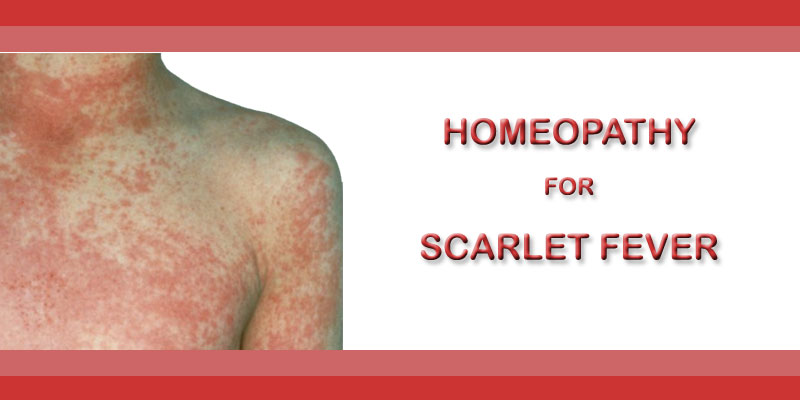

Are you looking for a homeopathic cure for scarlet fever? This article discusses the homeopathy treatment of scarlet fever along with the best homeopathic medicine for scarlet fever treatment.
Once one of the most dreaded diseases of childhood, scarlet fever is now far less prevalent and its symptoms are less severe.
Scarlet fever is a rash accompanied by a sore throat caused by the streptococcus bacteria. The disease most 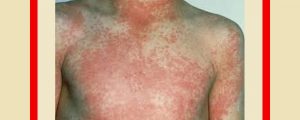 commonly affects children, but can occur in any age group. The characteristic symptoms are a rash and a ‘strawberry tongue’.
It is characterized by a sore throat and a red, if not actually scarlet, rash. Scarlet fever, also known as scarlatina, is a disease caused by a toxin (erythrogenic exotoxin) released by Streptococcus pyogenes or group A beta-hemolytic streptococcus bacteria – the disease occurs in a small percentage of patients with strep infections, such as strep throat or impetigo.
The rash of scarlet fever usually begins like bad sunburn with tiny bumps (papules), and it may itch. The rash usually appears first on the neck and face, often leaving a clear unaffected area around the mouth. It spreads to the chest and back, then to the rest of the body. In body creases, especially around the underarms and elbows, the rash forms classic red streaks called Pastia’s lines. Areas of rash usually blanch (turn white) when you press on them. By the sixth day of a strep infection the rash usually fades, but the affected skin may begin to peel.
Homeopathic Remedies & Homeopathy Treatment for Scarlet Fever

Homeopathy is one of the most popular holistic systems of medicine. The selection of homeopathic medicine for scarlet fever is based upon the theory of individualization and symptoms similarity by using holistic approach. This is the only way through which a state of complete health can be regained by removing all the sign and symptoms from which the patient is suffering. The aim of homeopathic medicine for scarlet fever is not only to treat scarlet fever but to address its underlying cause and individual susceptibility. As far as therapeutic medication is concerned, several remedies are available for scarlet fever which can be selected on the basis of cause, location, sensation, modalities and extension of the complaints. For individualized homeopathic medicine for scarlet fever and treatment, the patient should consult a qualified homeopathic doctor in person. Some important gout remedies are given below which are much helpful in treatment of scarlet fever symptoms:
- Aconite
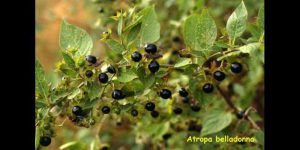
- Belladonna
- Ailanthus
- Arnica montana
- Gelsemium
- Apis mel
- Bryonia
- Ammonium carb
- Rhus tox
- Arsenic album
- Lachesis
- Zincum met
- Pulsatilla
- Sulphur
- Scarlatinum
Aconite
- Scarlet rash with high fever.
- Full, quick pulse.
- Dry, hot, burning skin.
- Over sensitiveness to external impressions.
- Scarlet fever, throat dark-red, with burning and sticking pain when swallowing, which may extend to ears.
- Ear pinna red, sensitive, hot to touch and swollen.
Belladonna
- Excellent remedy for scarlet fever.

- It has a marked action on the vascular system, skin and glands. Belladonna always is associated with hot, red skin, flushed face, glaring eyes, throbbing carotids.
- Belladonna stands for violence of attack and suddenness of onset
- Bright red rosy hue to the skin, smooth, red and shiny eruptions
- Throat dry, as if glazed; angry-looking congestion,red, worse on right side. Tonsils enlarged; throat feels constricted; difficult deglutition; worse by taking liquids.
- Strawberry tongue. Tongue swollen and painful.
- Acts also as a preventive.
Gelsemium
- Here the patients are quiet and listless;
- They are prostrated and dull.
- The pulse is throbbing. Patient is thirstless.
- At the onset of the disease it suits cases where neither Aconite nor Belladonna are indicated.
- Great prostration during fever in poorly nourished children.
Ailanthus
- This is the most potent antidote to malignant scarlet fever and suits especially severe cases.
- The patient lies in a stupor; the rashes are dark and purplish.
- Swollen throat and infiltration of the cellular tissue about the neck.
- Excoriating nasal discharge.
- Drowsiness and prostration.
- Violent vomiting.
- Severe headache and dizziness.
- Small quick pulse.
- Stools thin, bloody and offensives and there is much offensive to all the discharges.
- It will save life oftentimes in the most desperate cases.
Lachesis:
- The blood affection first and the mucus membrane second are prominent.
- Sloughing ulceration of the throat, Pain in tonsils.
- Child is drowsy and the rash comes out imperfectly and slowly, is dark, interspersed with a military rash; inflammation of throat, of cervical glands, tongue is dirty yellow.
Scarlatinum: Should be used as an intercurrent remedy and as preventive for scarlet fever.
Arsenic album –
- Rash does not come out properly
- Child is thrown into convulsions and lies pale and in a sort of stupor with restlessness and moaning
- Suddenly it seems to arouse, goes into convulsions, and then relapses again into stupor.
Rhus toxicodendron
- Child is restless, drowsy, has a red and smooth tongue
- Parotids are especially apt to swell or suppurate.
- Skin red, swollen; itching intense.
- Vesicles, herpes; urticaria; pemphigus; erysipelas; vesicular suppurative forms.
- Glands swollen.
- Cellulitis.
- Burning eczematous eruptions with tendency to scale formation.
- The eruption does not come out well, and when it does come out is miliary.
- The great depression, weakness and bodily restlessness and the supervening of rheumatic symptoms late in the disease will serve to indicate rhus.
Lachesis
- Purpura, septic states, diphtheria, and other low forms of disease, when the system is thoroughly poisoned and the prostration is profound.
- Violent throat pain especially on left side. Dry, intensely swollen, externally and internally.
- Purplish hue of tonsils.
- Tonsils purplish. Purple, livid color of throat. Feeling as if something was swollen which must be swallowed; worse, swallowing saliva or liquids. Pain into ear. Collar and neck-band must be very loose.
- Sleep unrefreshing, all complaints worse after sleep.
- Skin has hot perspiration.Blue-black swellings.
- Skin eruption dark red and bluish and purplish color.
- Patient is thirstless.
Ammonium carbonicum
- Malignant scarlatina, with somnolence, swollen glands, dark red sore throat, faintly developed eruption. This is also a useful remedy in scarlet fever.
- The throat is swollen internally and externally, the glands are enlarged.
- Enlarged tonsils and glands of neck. Burning pain all down throat. Tendency to gangrenous ulceration of tonsils.
- Tonsils are swollen and bluish
- Pulsating forehead; better, pressure and in warm room
- Child is drowsy.
Zincum met
- Zincum will be needed in certain enervated children who become restless and delirious, or quit, unconscious and very weak.
- Too weak in fat to develop an eruption, and as a result of this non-development of the eruption brain symptoms, such as meningitis with sharp pains through the head, supervene.
- In these cases it will often bring out the eruption and safe the child.
Causes of Scarlet fever
Infection of the throat with toxin-producing group A streptococcus (strep) precedes scarlet fever. In some cases, streptococcal infection of the skin leads to scarlet fever.
However, not everyone who becomes infected with group A streptococcus develops Scarlet fever. The disease is transmitted through contact with the secretions of someone infected, including respiratory droplets produced by coughing or sneezing.
Touching something that has been contaminated with such infectious secretions, followed by touching one’s mouth, eyes, or nose, can also cause this illness
Pathophysiology of Scarlet fever
Infection with group A-hemolytic streptococcus (GABHS) usually occurs via direct contact or transmission of large nasal droplets. This if followed by an incubation period of 1 to 7 days, during which time the index case often manifests signs of infection.
The GABHS organism typically causes direct infection of the affected site- pharynx, skin, or wound. Infecting strains then elicit streptococcal pyrogenic exotoxins A and C, which circulate systemically and produce the characteristic rash and strawberry tongue of scarlet fever.
Symptoms of Scarlet fever
Scarlet fever usually starts within two to four days of incubation, although the incubation period can last between one and seven days.
One of the most characteristic aspects of the disease is that it starts in dramatic manner, with a sudden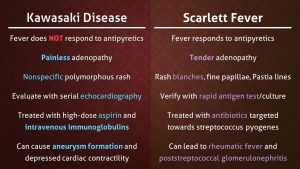 temperature accompanied by vomiting and a sore throat.
At this stage, the tonsils are infected and have a whitish crust, or exudates, on them. Less serious infections do not cause vomiting, and nowadays the disease can be so mild that children do not even have a sore throat.
The day after the disease starts, the rash that gives it its name breaks out. This is a diffuse reddening of the skin caused by all the little blood vessels opening up. If someone presses down over an area of affected skin, the skin will whiten with the pressure.
The rash starts on the face and then spreads down to affect the rest of the body. The farther away from the face it gets, the likelier it is to form actual spots rather than a uniform redness: these spots tend to be found on the legs and to a lesser extent on the hands. The rash usually lasts for about two or three days.
While the rash is appearing and then fading away, there are a series of changes that affect the tongue. First, there is creamy white exudate all over it, with the tongue’s little papillae pointing up through it. This is known as white strawberry tongue. As the exudate peels off, the tongue is left rather red and raw, with its papillae still showing prominently to make it look like a strawberry. This is called red strawberry tongue.
One of the most typical and striking effects of the disease then occurs as the rash begins to fade. The skin starts to peel off and, in more serious cases; it may peel off in great sheets (desquamation). In the past it was not uncommon to see an entire cast of a hand in the form of dead skin; now a days such occurrences are extremely rare.
Although the disease in nearly always caught from a sore throat, there are other ways it can be communicated. It may enter the skin through a wound of some sort, and in the past it was not uncommon for infection to enter through the womb or the va-gina during childbirth.
Risk Factors in case of scarlet fever
Children 5 to 15 years of age are more likely than are other people to get scarlet fever. Scarlet fever germs spread more easily among people in close contact, such as family members or classmates.
Diagnosis of Scarlet fever
Clinical diagnosis of scarlet fever is based on findings of classic GABHS pharyngitis, accompanied by signs associated with toxin-producing strains, such as “strawberry tongue” and the characteristic exanthema.
Throat culture is the gold standard of diagnosis. The oropharynx revels diffuse erythema with palatal petechiae, significant tonsillar enlargement, and purulent exudates of the tonsils or posterior pharynx or both.
The rash usually is accentuated in the flexural creases of the neck, elbows, and groin. This is best demonstrated in the antecubital areas, where lines of papules, known as pastia’s lines, may be seen. The rest of the skin becomes diffusely erythematous; however, the perioral area may be spared, and patients are frequently described as having “circumoral pallor.
- Physical examination
- Throat swab
If we suspect strep as the cause of child’s illness, we’ll swab the tonsils and back of child’s throat to collect material that may harbor the strep bacteria. Tests for the strep bacterium are important because a number of conditions can cause the signs and symptoms of scarlet fever, and these illnesses may require different treatments. If there are no strep bacteria, then some other factor is causing the illness.- A rapid antigen detection test
- Conditionof child’s throat, tonsils and tongue.
- Child’s neck to determine if lymph nodes are enlarged.
- Assess the appearance and texture of the rash
Sometimes referred to as a rapid strep test, may provide results within several minutes, while a throat culture (which is more sensitive) may require 24-48 hours before the results are available.
- A complete blood count
May demonstrate evidence of infection, and streptococcal antibody testing (for example, the antistreptolysin O test) can provide evidence of a previous streptococcal infection, though this test is not useful in the acute phase of the illness.
Clinical Complications of Scarlet fever
Complications include Otitis media, sinusitis, retropharyngeal or Para-pharyngeal abscess, cervical adenitis, and sepsis. Post-streptococcal glomerulonephritis may develop despite treatment. A unique complication of scarlet fever is progression to the life threatening toxic shock syndrome.
Management of scarlet fever
Children with scarlet fever require supportive therapy, including hydration, pain control, and anti-pyresis.
Antibiotic therapy may shorten the duration of illness and reduce symptoms; more importantly, it prevents supportive complications and rheumatic fever. GABHS is susceptible to standard penicillin which remains the first-line therapy, although studies have documented similar efficacy of easier dosed penicillin’s and cephalosporins. For penicillin allergic patients, a course of clinda-mycin or a macrolide antibiotic is efficacious.
The above information about homeopathy treatment of scarlet fever is only for information purpose. Please consult a professional homeopath before taking any homeopathic medicine for scarlet fever.
Scarlet Fever Cases Cured with Homeopathic Medicine
Two Cases of Inflammations in the Head – by Stephen Simpson
A Case of Migraine – by Dagmar Scholz




Thank you for this important and informative article — it is very much appreciated. (Allopathic) doctors are beginning to recognize a disease called “Pediatric Autoimmune Neuro-Psychiatric Disorder Associated with Strep” (PANDAS). So, doctor, could you please tell me, if strep has gotten into the brain and has caused an encephalitis-like condition, including psychosis, could this still be scarlatina? If so, what would the remedy be?