
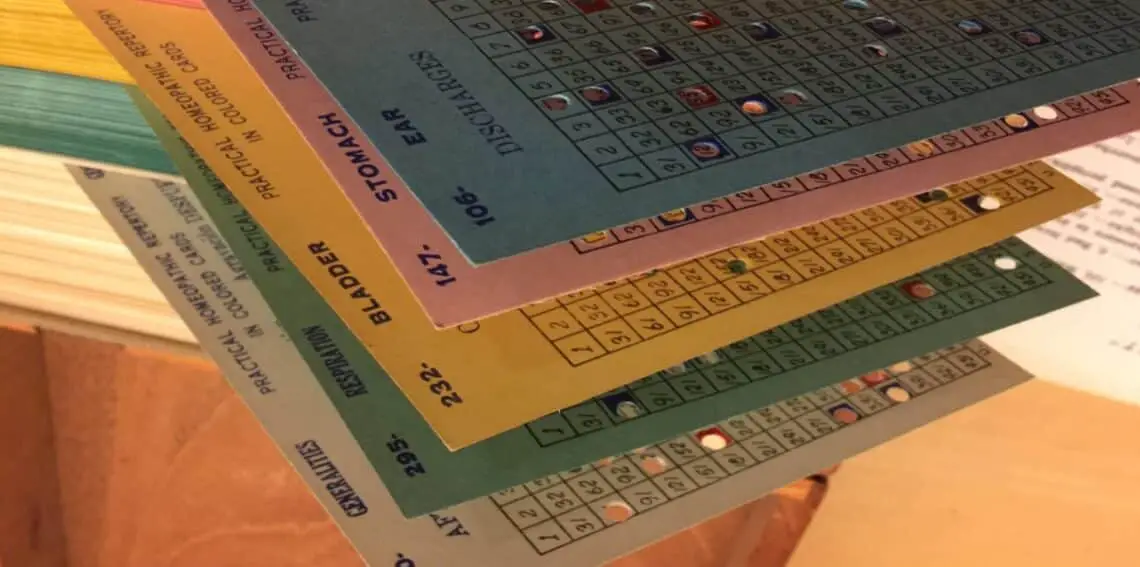

Repertories became voluminous and more complex with the introduction of new philosophies and different types of constructions. The practitioners found it difficult to put them into day-to-day practice. Few of them found that if the rubrics in the books were written on separate pieces of paper, one could quickly glance through them and find simillimum. They started to prepare their own chits, diaries and different paper cuttings. These efforts finally gave birth to Card Repertories.
· Rubrics were written on separate pieces of paper – to quickly glance through them – to save time and energy.
· People prepared their own chits, diaries and paper cuttings – birth of card repertories.
· Card repertories have several cards with rubrics written on top with a group of medicines below.
Card repertory is a system of visual sorting which helps the physician by eliminating the necessity of writing out the rubrics and remedies against them.
MERITS
· One has to select the cards according to rubrics arranged in repertorial totality and look for common remedies.
· It saves time as compared to manual writing down. It cuts down time needed in calculation of marks and analysis.
· It does not require paper work.
· Purpose – elimination of remedies in reportorial analysis.
DEMERITS
· It is difficult to list all remedies and all medicines.
· Most of the card repertories do not represent the rubrics well, especially sub-rubrics. It is difficult to use finer expressions at general and particular levels in repertorisation.
· Computers have made it obsolete.
METHOD OF WORKING OUT A CASE
In this, symptoms are converted into rubrics. The rubrics are seen in the index book, to look for the particular card number. The rubric were chosen from the index and the indicated slips were taken out and made to lie side by side so that name of each remedy ran in a straight line from left to right, on adding up the exponent of several remedies, one with the highest number is the possible remedy for the case.
PRINCIPLES OF CONSTRUCTION
· Important generals are used as rubrics.
· Numerical evaluation plays a little role in this method.
· Cards are employed to determine the likely group of remedies that closely correspond to the general picture of the case.
· It usually suits to a chronic case, which presents with a changed but vivid symptoms.
SELECTION OF RUBRICS
· Conversion of the symptoms in to rubrics should be accurate.
· Characteristic concomitant must be always included.
· Top priority should be given to the cause.
· Generalization of a particular symptom on inadequate grounds should be avoided.
REQUISITES OF A GOOD CARD REPERTORY
· Most card reps were limited in scope due to improper construction.
· Too small and give only a broad general selection limited to few polychrests.
· Most important use is ELIMINATIVE FUNCTION.
1. Results should be as close as possible to factual texts on repertory.
2. Cards should be of standard texture and thinness.
3. Should be strong as well as thin enough and should not shut off light completely
4. Punching should follow standard methods
5. Card system should be elastic, so that new rubrics can be introduced or new remedies added
6. Punching should indicate degree of drugs.
EVOLUTION
| 1888
1892 |
W J Guernsey Improved by H C Allen | Guernsey’s Boenninghausen’s Slips | 2500 cards
1.25 inch X 12.5 inch |
| 1912 | Margaret Tyler | Punched Card Repertory
Based on Kent |
1000 cards |
| 1913 | Welch & Houston | Loose Punched Card Repertory
Based on Kent’s Generals |
134 cards |
| 1922 | Field | Field’s Card Repertory
Based on Kent and Boger |
6800 cards
360 drugs |
| 1928 | Boger | Boger’s Card Index Repertory
Foreword by L D Dhawale |
|
| 1948
1910 |
Marcos Jaminez
Enrique Jaminez |
Based on Boenninghausen | 600 large cards
Introduced evaluation of drugs |
| Braussalian | Card Repertory
Based on Kent |
1861 cards
640 drugs |
|
| 1950 | J G Weiss | Card Repertory | |
| Farley | Spindle Card Repertory | ||
| Young & Pulford | Not published | ||
| L D Dhawale | Modified Boger’s cards
Not published |
||
| 1950 | P Sankaran | Card Repertory
Based on Boger’s Card Repertory |
420 cards
292 drugs |
| 1959 | Jugal Kishore | Kishore Card Repertory | 10000 cards |
| 1984 | Shashi Mohan Sharma | Based on Kent’s Final Repertorium Generale | 3000 cards |
GUERNSEY’S BOENNINGHAUSEN’S SLIPS
· Prepared by William Jefferson Guernsey, nephew of H. N. Guernsey
· Prepared in 1888, released in 1892.
· Chapman called it “Perfection of method for managing MM.”
· Long cards or slips – 1.25 inch X 12.5 inch
· 2500 cards; 126 remedies
· On each card was printed in alphabetical order, names of remedies used in Boenninghausen’s work
· On top was code number of rubric
· A separate index with coded rubrics
· On each card, remedies had number 1 to 4 printed against them, depending upon degree of evaluation of that drug according to TPB.
· Rubrics were chosen from index and the slips made to lie side by side, so that name of each remedy ran in a straight line from left to right.
H C Allen improved the original slips by adding more remedies and were known as Allen’s Boenninghausen’s Slips.
MARGARET TYLER’S PUNCHED CARD REPERTORY
· Made in 1912, but discouraged by Kent.
· Used large cards and hand punched them.
· Based on Kent
· Incomplete work
· 1000 cards
FIELD’S CARDS
· Made in 1922
· Included Kent’s rubrics as well few from others.
· Included Boger’s and Skinner’s corrections and annotations
· 6800 cards + 360 remedies with a provision for 40 more
· Only first and second grade remedies were punched
· Was the first to code names of remedies into numbers
· Cards were thick and blocked the remedy easily
BOGER’S CARD INDEX REPERTORY
· Published in 1928
· Consists of 339 cards + 224 drugs?
· One rubric per card – CIRCULAR PUNCHES
· Fewer rubrics are used; more stress on pathological generals than disease diagnosis – bluish, convulsive, cough, albuminous discharges, dryness, rawness
· Rubrics for prominent mental conditions are also included – anger, fearsome, excitement
· Clinical symptoms are first divided into ‘General’ or constitutional characteristics. The perforated cards covering these rubrics placed in apposition and held up to light.
· Hayes suggested a method of working with the Card Index.
ADVANTAGES
· When closely competing remedies have missing symptoms, this helps to decide easily.
· It is of special value in working out cases having a paucity of symptoms.
· Boger united in one rubric various influences or conditions and this has made it quick and safe.
P SANKARAN’S POCKET CARD REPERTORY
· 420 cards – last card is numbered 392, as there are a number of cards marked ‘A’ in between, eg 45A, 89A
· Each card carries abbreviated names of 292 remedies
· In each card, punches are made below those drugs that cover the symptom – RECTANGULAR PUNCHES.
· Characteristics selected – Index to Card Rep referred – cards are picked and put together in apposition – group of remedies selected – reference to MM and bigger reps.
· Has more remedies and more comprehensive rubrics; remedies are better presented and provides numerous cross references.
Card size-7.4by 2.2inches 27 verticle by 12 horizontal columns ,420 cards.punchin in small, rectangular holes, booklet-name of rubrics acc to numberz n name of medicines, used in acute n chronic, kent’s plus boenninghausen’s concept.
Shashi Mohan’s cards
Forwarded by Diwan Harishchandra, published in -1984, drugs-400, cards-3000
columns3.5 by 7.5 inches 40 vertical by 10 horizontal columns, rectangular holes punched, based on Kent’s repertory rubrics at the top of card with a booklet.
The Kishore Cards – A Homoeopathic Card Repertory
By Dr. Jugal Kishore and Dr. Arvind Kishore
First Edition: 1959
Second Revised and Enlarged Edition: 1967
Third and Enlarged Edition: 1985
Contents
Part I
Introduction
Part II
Rubrics and their code numbers
It took about seven years to complete the first edition of the Card Repertory. About 579 medicines and 3497 rubrics were included in the repertory. The rubrics are arranged in the alphabetical order and they are numbered from 50.
There are certain remedies, which do not appear under any of the rubrics; are included and assigned code number, so as to enable practitioner to add such remedies in suitable rubrics; when his experience and study dictate their inclusion.
Most of the rubrics from Kent’s and Boenninghausen’s Repertories were included in this repertory. The repertory is so constructed that a Practitioner can use it either according to the Boenninghausen method or Kent method. Information from about 91 books was included in this card repertory.
These cards are primarily meant for quick elimination of remedies without the risk of excluding simillimum. The elimination is a mechanical process. The rubric number is stamped on the top of each card. For quick reference a table of contents of some important rubrics are given at the beginning of index. Cross-references are also given. Meanings of some rubrics are also given. For example; code number 1570 – Fever: Zymotic. The meaning of Zymotic has been given within brackets – Fever due to specific virus.
For evaluating remedies he has used two types of holes; round/ square holes and oval/ figure of eight holes. The latter indicate the high grade and the former indicate the lower grade remedies.
Working method:
After case taking, the rubrics are arranged in the descending order of their importance. “Red line” rubrics are considered at the upper most. The respective code numbers are written against each other rubrics. Then pick out the cards for the corresponding numbers, put them in the order of the list; one behind the other, leaving aside (for the time being) the cards of less importance or those rubrics with very few remedies. After arrangement; look for the synchronizing of the holes. Not more than three holes could be seen through the upper most (first) card. He notes down the holes of the cards. Decode those remedy numbers; by using the code numbers and list of remedies. We can also note down the second group of remedies which are not all through but are most tarns -illuminant. In certain cases, there may not be any hole going through all the cards. In such cases, the most illuminant holes should be noted down and decoded. There is an isolated punched hole at the top of left corner of the card. It is only meant for checking and does not have any significance.
In the second edition, the number of rubrics increased to 9063 and the number of medicine increased to 590.
In the third edition, 129 new rubrics and 102 new remedies were added. So that the total number of rubrics in the third edition is 9192 and the total number of remedies is 692. Jugal Kishore’s son Arvind Kishore has given his contributions in this edition.
Description of the ‘Rubric card’ (Kishore Cards)
A card has 80 vertical columns; numbering from 1 to 80 from left to right. They are numbered at the bottom and top in small type. Each vertical column from above downwards contains number from 0 to 9. The first four vertical columns are kept apart (without being divided by vertical lines). They are meant for punching the number of rubric. The rest of the vertical columns are meant for the coded remedies, which have these particular symptoms. The remedies are indicated by the punched holes.
The punched number (any number from 0 to 9) is placed against the small digit number placed at the bottom or top of the column; containing that particular hole and that gives us the number of the remedy. The remedy can be made out from the list of ‘ Remedies and their code numbers’. The code number of remedies starts from 50. The total number of remedies that can be punched on this card is 800; but since we are utilizing first four columns for the number of rubric, the available space on the card is only for 750 remedies.
On the top of the card is printed the name of the rubric along with its code number.
Merits
1. Third edition contains 692 medicines and 9192 rubrics
2. Almost all rubrics in the Kent’s repertory are incorporated in the Card repertory
3. This repertory can be used in two methods, Kent’s and Boenninghausen.
4. Many of the rubrics in the Boenninghausen’s repertory are made available, up to date and complete.
5. Elimination is a mechanical process. We can save the time taken for writing down all the rubrics, medicines and adding their marks. Hence useful for very busy Practitioners
6. The rubrics and the cards are arranged in alphabetical order; so easy to find the required rubric. Table of contents of rubrics with their code numbers is given in the index.
7. Contents of the medicines with their code numbers are given in the index
8. Cross-references are helpful in finding the related and similar rubrics
9. Evaluation of medicines can be done with changing the shape of the holes
10. New remedies are added from the reliable source like British Homoeopathic Journal
11. It requires no paper work
12. It is useful in rural areas were Electricity and computers are not available.
Demerits
1. Quite voluminous ( Repertory include three boxes of cards)
2. Not all rubrics needed in day to day practice will not be available in the card repertory
3. A thorough knowledge of rubrics are necessary before starting the process of repertorisation
4. Evaluation of remedies require an additional amount
5. There are certain medicines in the list , which are not found under any of the rubrics
6. With the invention of computer software repertories, card repertories become out dated.